Question
Differentiate between streamline flow and turbulent flow.

Answer

Stream line flowTurbulent flow
(1) It is the systematic and regular flow of liquidThis is a disorganized and irregular flow of liquid
(2) In streamline flow the velocity of liquid is less than the critical velocityIn this flow the velocity of liquid is more than the critical velocity
(3) The direction of velocity of particles passing through a point remains constantIn this flow, the direction of velocity of particles passing through a point keeps changing.
(4) In this flow, eddy currents do not produce inside the liquidIn this flow, eddy currents produce inside the liquid

Need a full question paper?

Generate a complete, print-ready paper with questions like this in minutes — across 16+ boards, with answer keys.
Start Generating Free

Similar questions

Given the moment of inertia of a disc of mass M and radius R about any of its diameters to be $\frac{\text{MR}^2}{4},$ find its moment of inertia about an axis normal to the disc and passing through a point on its edge.
The principle of ‘parallax’ in section $2.3.1$ is used in the determination of distances of very distant stars. The baseline AB is the line joining the Earth’s two locations six months apart in its orbit around the Sun. That is, the baseline is about the diameter of the Earth’s orbit $\approx 3 \times 10^{11}m$. However, even the nearest stars are so distant that with such a long baseline, they show parallax only of the order of $1”$ (second) of arc or so. A parsec is a convenient unit of length on the astronomical scale. It is the distance of an object that will show a parallax of $1”$ (second of arc) from opposite ends of a baseline equal to the distance from the Earth to the Sun. How much is a parsec in terms of metres?
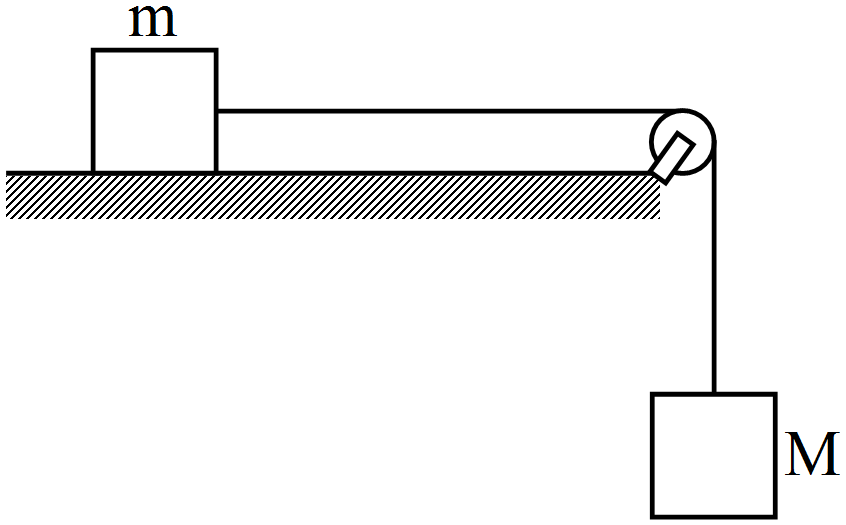
Figure shows two blocks of masses m and M connected by a string passing over a pulley. The horizontal table over which the mass m slides is smooth. The pulley has a radius r and moment of inertia I about its axis and it can freely rotate about this axis. Find the acceleration of the mass M assuming that the string does not slip on the pulley.
Explain the conservation of mechanical energy in the oscillation of a body suspended from a spring.
A steel rod is rigidly clamped at its two ends. The rod is under zero tension at $20^{\circ} \mathrm{C}$. If the temperature rises to $100^{\circ} \mathrm{C}$, what force will the rod exert on one of the clampa? Area of Cross section of the rod $=2.00 \mathrm{~mm}^2$. Coefficient of linear expansion of steel $12.0 \times 10^{-6}{ }^{\circ} \mathrm{C}^{-1}$ and Young's modulus of steel $=2.00 \times 10^{11} \mathrm{~N} \mathrm{~m}^{-2}$.
Considering the pressure p to be proportional to the density, find the pressure p at a height h if the pressure on the surface of the earth is $p_0$.
A man of mass $70kg$ stands on a weighing scale in a lift which is moving. Upwards with a uniform speed of $10 ms^{-1}$.
Two small bodies of masses $10kg$ and $20kg$ are kept a distance $1.0m$ apart and released, Assuming that only mutual gravitational forces are acting, find the speeds of the particles when the separation decreases to $0.5m$.
Should the energy of a photon be called its kinetic energy or its internal energy?
A refrigerator is to maintain eatables kept inside at $9°C$. If room temperature is $36°C$, calculate the coefficient of performance.