Question
Find the general expansion of $(a-b)^2$ using geometry, as we did for $55^2$.

Answer

self

Need a full question paper?

Generate a complete, print-ready paper with questions like this in minutes — across 16+ boards, with answer keys.

Start Generating Free

Similar questions

The diagonals of a rhombus are 8 cm and 15 cm . Find its side.
A mixture of paint is prepared by mixing 1 part of red pigment with 8 parts of base. In the following table, find the parts of base that need to be added.
Parts of red pigment1471220
Parts of base8
Principal $=₹  1000$, Rate $=8 \%$ per annum. Fill in the following table and find which type of interest (simple or compound) changes in direct proportion with time period.
Time period1 yr2 yr3 yr
Simple interest (in ₹)
Compound interest (in ₹)
A suitcase with measures $80 cm \times 48 cm \times 24 cm$ is to be covered with a tarpaulin cloth. How many metres of tarpaulin of width 96 cm is required to cover 100 such suitcases?
TIPS Firstly, find the total surface area of 1 suitcase. Here, the area of cloth used to cover 1 suitcase will be equal to surface area of 1 suitcase. Use this result to find the length of cloth required for 1 suitcase and then multiply it by 100 to get required length of cloth to cover 100 suitcases.
Expand $(3 j+2 k)^2$ using both the identity and by applying the distributive property.
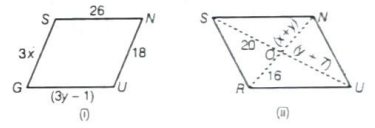
The following figures GUNS and RUNS are parallelograms. Find $x$ and $y$. (lengths are in cm)
Image
Suppose you are using the number system that uses sticks to represent numbers, as in Method 1. Without using either the number names or the numerals of the Hindu number system, give a method for adding, subtracting, multiplying and dividing two numbers or two collections of sticks.
ABCDE is a regular pentagon. The bisector of angle A meets the side CD at M. Find $\angle \text{AMC}.$
A dairy plans to produce 8.5 billion packets of milk in a year. They want a unique ID (identifier) code for each packet. If they choose to use the digits 0–9, how many digits should the code consist of?
When is the sum of two multiples of 3 , a multiple of 6 and when is it not? Explain the different possible cases, and generalise the pattern.