Question
Find the largest number which divides 615 and 963 leaving remainder 6 in each case.

Answer

We need to find the largest number which divides 615 and 963 leaving remainder 6 in each case.
The required number when divides 615 and 963, leaves remainder 6, this means 615 - 6 = 609 and 963 - 6 = 957 are completely divisible by the number.
Therefore,
The required number = H.C.F. of 609 and 957.
By applying Euclid’s division lemma
957 = 609 × 1 + 348
609 = 348 × 1 + 261
348 = 216 × 1 + 87
261 = 87 × 3 + 0.
Therefore, H.C.F. = 87.
Hence, the required number is 87.
Need a full question paper?

Generate a complete, print-ready paper with questions like this in minutes — across 16+ boards, with answer keys.

Start Generating Free

Similar questions

An iron pillar consists of a cylindrical portion 2.8m high and 20cm in diameter and a cone 42cm high is surmounting it. Find the weight of the pillar, given that 1 cubic cm of iron weighs 7.5gm.
Find the LCM and HCF of the following integer by applying the prime factorisation method.
$84, 90$ and $120$
Solve the following quadratic equation: $2x^2 + ax - a^2 = 0$
Draw a circle with centre 'P' and radius 2.6 cm. Draw a chord AB of length 3.8 cm. Draw tangent to the circle through points A and B.
Mukund possesses ₹50 more than what Sagar possesses. The product of the amount they have is 15,000. Find the amount each one has.
Determine the nature of the root of following quadratic equation:
$9a^2b^2x^2 - 24abcdx + 16c^2d^2 = 0$, $\text{a}\neq0,\text{b}\neq0$
If $a - b$, $a$ and $b$ are zeros of the polynomial $f(x) = 2x^3- 6x^2 + 5x - 7$, write the value of a.
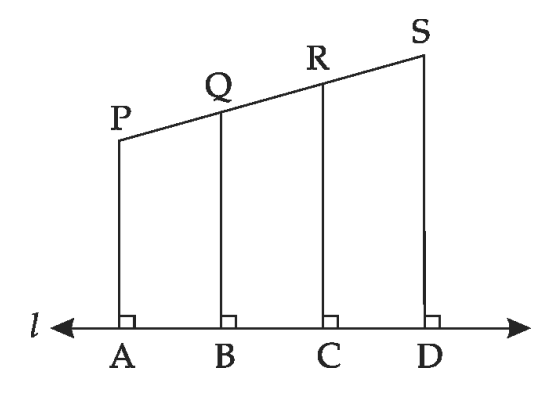
In the adjoining figure, seg PA, seg QB, seg RC and seg SD are $\perp$ to line $l$ AB = 6, BC = 9, CD = 12 and PS = 36, then find PQ, QR and RS.
Image
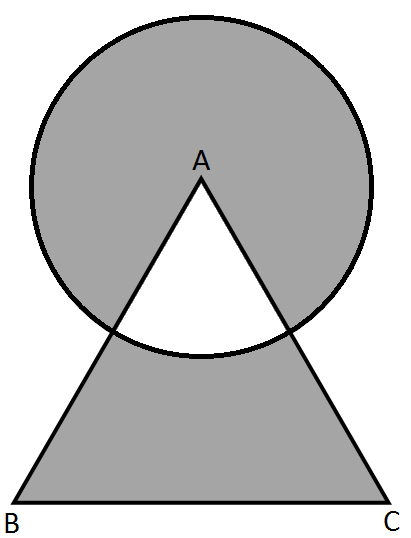
Find the area of a shaded region in the the following figure,where a circular arc of radius $7\ cm$ has been drawn with vertex A of an equilateral triangle ABC of side $14\ cm$ as centre. $\big(\text{Use }\pi=\frac{22}{7}$ and $\sqrt{3}=1.73\big)$
Evaluate the following:
If A and B are acute angle such that $\tan\text{A}=\frac13,\tan\text{B}=\frac12$ and $\tan(\text{A}+\text{B})=\frac{\tan\text{A}+\tan\text{B}}{1-\tan\text{A}\tan\text{B}},$ show that $\text{A}+\text{B}=45^\circ.$