Question
Find the LCM and HCF of the following integer by applying the prime factorisation method.
$84, 90$ and $120$

Answer

$84, 90$ and $120$
Prime factor of $84, 90$ and $120$ are,
$84 = 2 \times 2 \times 3 \times 7 = 2^2 \times 3 \times 7$
$90 = 2 \times 3 \times 3 \times 5 = 2 \times 3^2 \times 5$
$120 = 2 \times 2 \times 2 \times 3 \times 5 = 2^3 \times 3 \times 5$
For H.C.F:
Common prime factor
Least component
$2$
$1$
$3$
$1$
H.C.F $(84, 90, 120) = 2 \times 3 = 6$
For L.C.M:
Prime factor of $84, 90, 120$
Greatest component
$2$
$3$
$3$
$2$
$5$
$1$
$7$
$1$
L.C.M $(84, 90, 120) = 2^3 \times 3^2 \times 5 \times 7$
$= 72 \times 35$
$= 2520$
Thus, H.C.F = 6 and L.C.M $= 2520$

Need a full question paper?

Generate a complete, print-ready paper with questions like this in minutes — across 16+ boards, with answer keys.
Start Generating Free

Similar questions

If $\alpha$ and $\beta$ are the zeroes of the quadratic polynomial $p(y) = 5y^2 - 7y + 1$, find the value of $\frac{1}{\alpha}+\frac{1}{\beta}$
From a rectangular sheet of paper ABCD with $AB = 40\ cm$ and $AD = 28\ cm$, a semicircular portion with BC as diameter is cut off. Find the area of the remaining paper.
Points P, Q and R in that order are dividing a line segment joining A(1, 6) and B(5, -2) in four equal parts. Find the coordinates of P, Q and R.
A card is picked up randomly from well shuffled pack of cards. Write the $n(S), n(A), n(B)$ and $n( C )$
Event A: A red face card.
Event B: An ace of spade
Event C: Not a black king
Find the values of k for which the system will have (i) a unique solution, and (ii) no solution.
Is there a value of k for which the system has infinitely many solutions?
$2x + ky = 1$
$3x - 5y = 7$
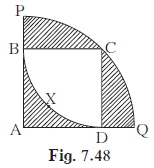
In the figure 7.48, square ABCD is inscribed in the sector A- PCQ. The radius of sector C - BXD is 20 cm. Complete the following activity to find the area of shaded region.
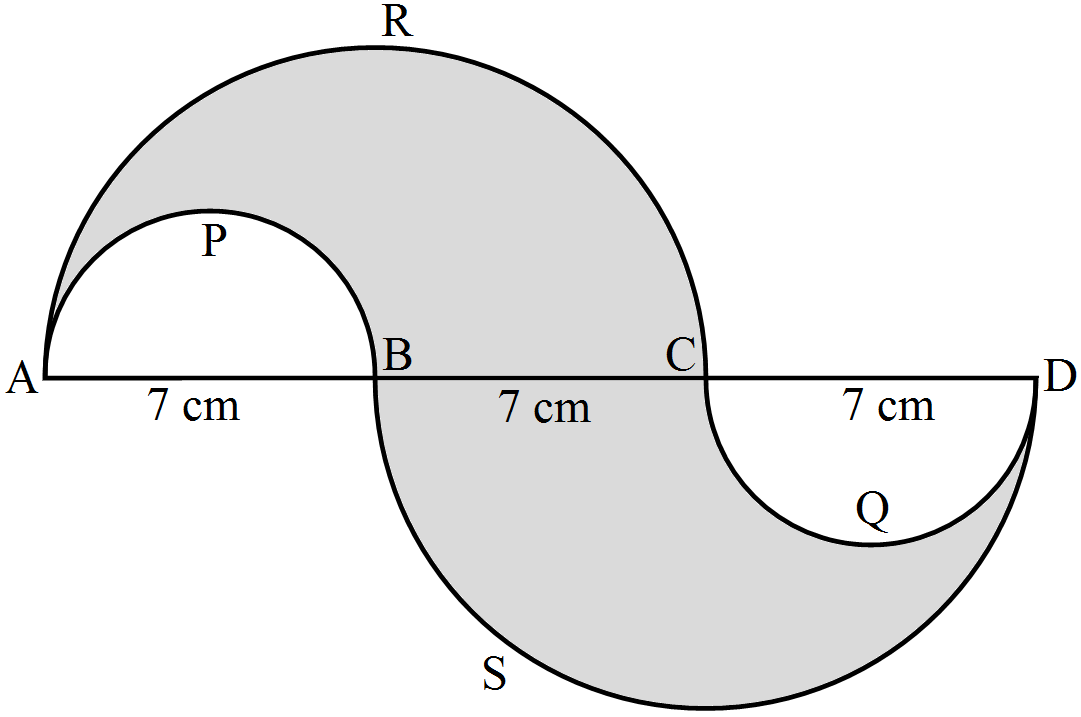
In the given figure, APB and CQD are semicircles of diameter 7cm each, while ARC an BSD are semicircles of diameter 14cm each. Find the,
  1. Perimeter,
  2. Area of the shad d region.
Prove that $\sqrt{\frac{1+\cos A}{1}}=\operatorname{cosec} A+\cot A$
Some plastic balls of radius 1 cm were melted and cast into a tube. The thickness, length and outer radius of the tube were 2 cm, 90 cm and 30 cm respectively. How many balls were melted to make the tube?
The length of three concesutive sides of a quadilateral circumscribing a circle are 4cm, 5cm, 7cm respectively. Determine the length of thefourth side.