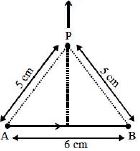
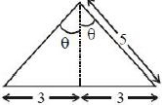
Find the magnetic field at point $P$ due to a straight line segment $AB$ of length $6\, cm$ carrying a current of $5\, A$. (See figure) $(\mu _0 = 4p\times10^{-7}\, N-A^{-2})$
JEE MAIN 2019, Diffcult


Download our appand get started for free
Experience the future of education. Simply download our apps or reach out to us for more information. Let's shape the future of learning together!No signup needed.*
Similar Questions
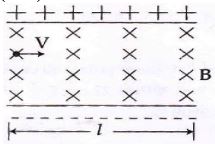
- 1An electron moves straight inside a charged parallel plate capacitor of uniform charge density. The space between the plates is filled with uniform magnetic field of intensity $B ,$ as shown in the figure, Neglecting effect of gravity, the time of straight line motion of the electron in the capacitor isView Solution
- 2In a mass spectrometer used for measuring the masses of ions, the ions are initially accelerated by an electric potential $V$ and then made to describe semicircular paths of radius $R$ using a magnetic field $B$. If $V$ and $B$ are kept constant, the ratio $\left( {\frac{{{\text{charge on the ion}}}}{{{\text{mass of the ion}}}}} \right)$ will be proportional toView Solution
- 3A proton with a kinetic energy of $2.0\,eV$ moves into a region of uniform magnetic field of magnitude $\frac{\pi}{2} \times 10^{-3}\,T$. The angle between the direction of magnetic field and velocity of proton is $60^{\circ}$. The pitch of the helical path taken by the proton is $..........cm$ (Take, mass of proton $=1.6 \times 10^{-27}\,kg$ and Charge on proton $=1.6 \times 10^{-19}\,kg)$View Solution
- 4An electron is moving along positive $x$-axis.Auniform electric field exists towards negative $y$-axis. What should be the direction of magnetic field of suitable magnitude so that net force of electron is zeroView Solution
- 5View SolutionA beam of electrons and protons move parallel to each other in the same direction, then they
- 6Two toroids $1$ and $2$ have total number of tums $200$ and $100 $ respectively with average radii $40\; \mathrm{cm}$ and $20 \;\mathrm{cm}$ respectively. If they carry same current $i,$ the ratio of the magnetic flelds along the two loops isView Solution
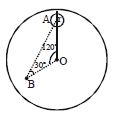
- 7The figure shows the cross section of a long cylindrical conductor through which an axial hole of radius $r$ is drilled with its centre at point $A$ . $O$ is the centre of the conductor. If an identical hole were to be drilled centred at point $B$ while maintaining the same current density the magnitude of magnetic field at $O$View Solution
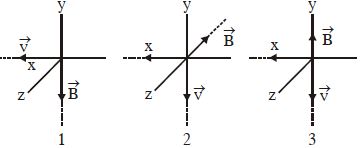
- 8The figure shows three situations when an electron moves with velocity $\vec v$ travels through a uniform magnetic field $\vec B$. In each case, what is the direction of magnetic force on the electronView Solution
- 9A charge particle is moving in a uniform magnetic field $(2 \hat{i}+3 \hat{j}) T$. If it has an acceleration of $(\alpha \hat{i}-4 \hat{j}) m / s ^{2}$, then the value of $\alpha$ will be.View Solution
- 10A uniform beam of positively charged particles is moving with a constant velocity parallel to another beam of negatively charged particles moving with the same velocity in opposite direction separated by a distance $d.$ The variation of magnetic field $B$ along a perpendicular line draw between the two beams is best represented byView Solution