Question
Find the maximum potential difference which may be applied across an X-ray tube with tungsten target without emitting any characteristic K or L X-ray. The energy levels of the tungsten atom with an electron knocked out are as follows.
Cell containing vacancy
K
L
M
Energy in keV
69.5
11.3
2.3

Answer

Let for, k series emission the potential required = v
$\therefore$ Energy of electrons = ev
This amount of energy ev = energy of L shell
The maximum potential difference that can be applied without emitting any electron is 11.3ev.

Need a full question paper?

Generate a complete, print-ready paper with questions like this in minutes — across 16+ boards, with answer keys.

Start Generating Free

Similar questions

Derive/obtain the equation of current in case of $AC$ voltage applied to a resistor and also draw the graph showing the phase difference between voltage and current.
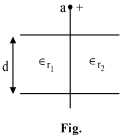
The capacitance of a parallel plate air capacitor is $10 \mu F$. This capacitor is divided into two equal parts as shown in the figure and filled with a medium having dielectric constant $\epsilon_{r_1}=2$ and $\epsilon_{r_2}=4$. Find the value of capacitance of this system.
Image
If we put a cardboard (say 20cm × 20cm) between a light source and our eyes, we can't see the light. But when we put the same cardboard between a sound source and our ear, we hear the sound almost clearly. Explain.
An electron accelerated by 1 kV travels 5 km towards conducting plate of infinite extension is moving in the direction perpendicular to the plate. Calculate the minimum surface charge density on the conducting plate so that the electron cannot collide with the plate.
Can a process on an ideal gas be both adiabatic and isothermal?
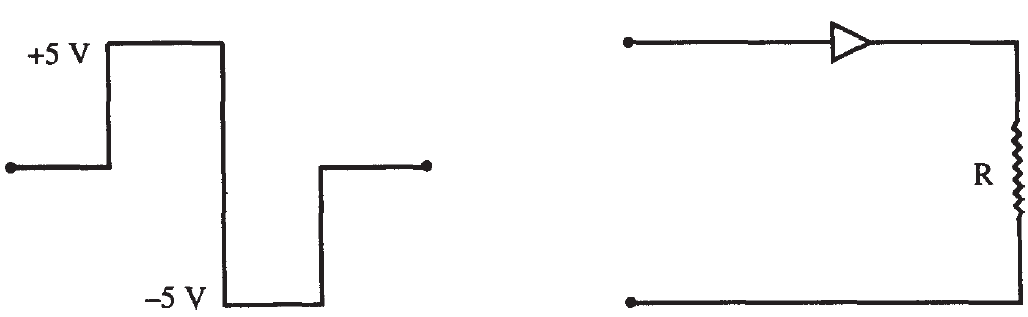
Draw and explain the output waveform across the load resistor R, if the input waveform is as shown in the given figure.
Why is exposure to X-rays injurious to health but not exposure to visible light, when both are electromagnetic waves?
A steel rod is clamped at its two ends and rests on a fixed horizontal base. The rod is unstrained at $20^\circ C.$ Find the longitudinal strain developed in the rod if the temperature rises to $50^\circ C.$ Coefficient of linear expansion of steel $=1.2 \times 10^{-5}{ }^{\circ} \mathrm{C}^{-1}.$
The charge on a parallel plate capacitor varies as $\text{q}=\text{q}_0\cos2\pi\text{vt}$. The plates are very large and close together (area = A, separation = d). Neglecting the edge effects, find the displacement current through the capacitor?
Can we measure the potential difference across an unbiased p–n junction by connecting a sensitive voltmeter across it?