Question types

X-rays question types

58 questions across 6 question groups — pick any mix to generate a Physics paper with step-by-step answer keys.

58
Questions
6
Question groups
5
Question types
Sample Questions

X-rays questions

One sample from each question group in this chapter. Select any group above to see the full set with answer keys.

Frequencies of $\text{K}_\alpha \ X-$rays of different materials are measured. Which one of the graphs in the figure may represent the relation between the frequency $v$ and the atomic number $Z$?
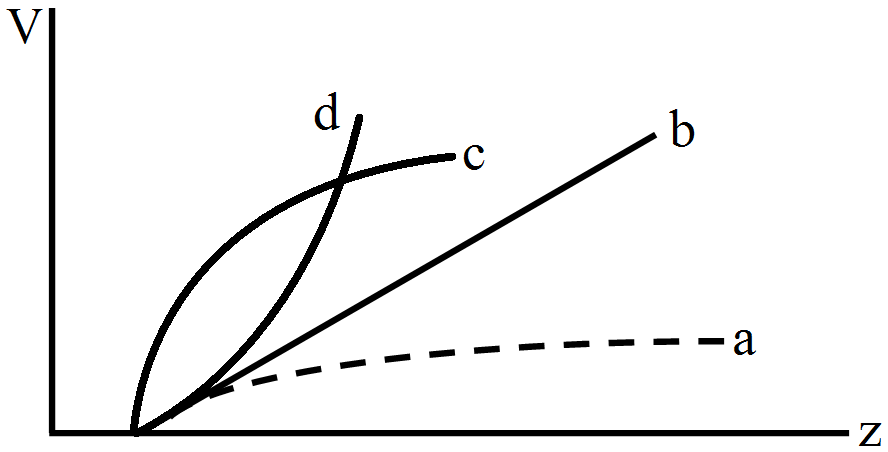
View full solution
The X-ray beam emerging from an X-ray tube:
  1. Is monochromatic.
  2. Has all wavelengths smaller than a certain maximum wavelength.
  3. Has all wavelengths greater than a certain minimum wavelength.
  4. Has all wavelengths lying between a minimum and a maximum wavelength.
View full solution
50% of the X-ray coming from a Coolidge tube is able to pass through a 0.1mm thick aluminium foil. The potential difference between the target and the filament is increased. The thickness of the aluminium foil that will allow 50% of the X-ray to pass through will be:
  1. zero
  2. < 0.1mm
  3. 0.1mm
  4. > 0.1mm
View full solution
Visible light passing through a circular hole forms a diffraction disc of radius 0.1mm on a screen. If an X-ray is passed through the same setup, the radius of the diffraction disc will be:
  1. zero
  2. < 0.1mm
  3. 0.1mm
  4. > 0.1m
View full solution
One of the following wavelengths is absent and the rest are present in the X-rays coming from a Coolidge tube. Which one is the absent wavelength?
  1. 25pm
  2. 50pm
  3. 75pm
  4. 100pm
View full solution
When $40\ kV$ is applied across an $X-$ray tube, $X-$ray is obtained with a maximum frequency of $9.7 \times 10^{18}Hz.$ Calculate the value of Planck constant from these data.
View full solution
Find the maximum potential difference which may be applied across an X-ray tube with tungsten target without emitting any characteristic K or L X-ray. The energy levels of the tungsten atom with an electron knocked out are as follows.
Cell containing vacancy
K
L
M
Energy in keV
69.5
11.3
2.3
View full solution
The wavelength of $\text{K}_\alpha$ X-ray of tungsten is 21.3pm. It takes 11.3keV to knock out an electron from the L shell of a tungsten atom. What should be the minimum accelerating voltage across an X-ray tube having tungsten target which allows production of $\text{K}_\alpha$ X-ray?
View full solution
The distance between the cathode (filament) and the target in an X-ray tube is 1.5m. If the cutoff wavelength is 30pm, find the electric field between the cathode and the target.
View full solution
Q 143 Marks Question3 Marks
The electric current in an $X-$ray tube $($from the target to the filament$)$ operating at $40kV$ is $10mA.$ Assume that on an average, $1\%$ of the total kinetic energy of the electron hitting hte target are converted into $X-$rays.
  1. What is the total power emitted as $X-$rays
  2. How much heat is produced in the target every second?
View full solution
Q 163 Marks Question3 Marks
A free atom of iron emits $\text{K}_\alpha\ X-$rays of energy $6.4keV.$ Calculate the recoil kinetic energy of the atom. Mass of an iron atom $= 9.3 \times 10^{-26}kg.$
View full solution
The electron beam in a colour $TV$ is accelerated through $32kV$ and then strikes the screen. What is the wavelength of the most energetic $X-$ray photon$?$
View full solution
The energy of a silver atom with a vacancy in $K$ shell is $25.31\ keV,$ in $L$ shell is $3.56\ keV$ and in $M$ shell is $0.530\ keV$ higher than the energy of the atom with no vacancy. Find the frequency of $\text{K}_\alpha\text{K}_\beta$ and $\text{L}_\alpha\ X-$rays of silver.
View full solution
An $X-$ray tube operates at $40kV.$ Suppose the electron converts $70\%$ of its energy into a photon at each collision. Find the lowest there wavelengths emitted from the tube. Neglect the energy imparted to the atom with which the electron collides.
View full solution
The $\text{K}_\alpha$ X-rays of aluminium (Z = 13) and zinc (Z = 30) have wavelengths 887pm and 146pm respectively. Use Moseley's law $\sqrt{\text{v}}=\text{a}(\text{z-b})$ to find the wavelengths of the $\text{K}_\alpha$ X-ray of iron (Z = 26).
View full solution

Generate a X-rays paper free

Pick question groups from the list above, set marks and difficulty, and export a branded PDF with step-by-step answer keys. First 3 chapters free — no signup.

Download App