Question
Find the maximum potential difference which may be applied across an X-ray tube with tungsten target without emitting any characteristic K or L X-ray. The energy levels of the tungsten atom with an electron knocked out are as follows.
Cell containing vacancy
K
L
M
Energy in keV
69.5
11.3
2.3

Answer

Let for, k series emission the potential required = v

$\therefore$ Energy of electrons = ev

This amount of energy ev = energy of L shell

The maximum potential difference that can be applied without emitting any electron is 11.3ev.

Need a full question paper?

Generate a complete, print-ready paper with questions like this in minutes — across 16+ boards, with answer keys.

Start Generating Free

Similar questions

A block of mass 5.0kg slides down an incline of inclination 30° and length 10m. Find the work done by the force of gravity.
In Exercise, let us take the position of mass when the spring is unstreched as x = 0, and the direction from left to right as the positive direction of x-axis. Give x as a function of time t for the oscillating mass if at the moment we start the stopwatch (t = 0), the mass is:
At the mean position.
In what way do these functions for SHM differ from each other, in frequency, in amplitude or the initial phase?
What is the length of a simple pendulum, which ticks seconds ?
Find the maximum angular speed of the electron of a hydrogen atom in a stationary orbit.
Find the value of $x$ in the following relation.
$(\text { Velocity })^x=\binom{\text { Pressure }}{\text { difference }}^{3 / 2} \times(\text { Density })^{-3 / 2}$
The luminous flux of a monochromatic source of 1W is 450 lumen/ watt. Find the relative luminosity at the wavelength emitted.
Points P, Q and R are in a vertical line such that PQ = QR. A ball at P is allowed to fall freely. What is the ratio of the times of descent through PQ and QR?
50m3 of saturated vapour is cooled down from 30°C to 20°C. Find the mass of the water condensed. The absolute humidity of saturated water vapour is 30gm-3 at 30°C and 16gm-3 at 20°C.
The mean speed of the molecules of a hydrogen sample equals the mean speed of the molecules of a helium sample. Calculate the ratio of the temperature of the hydrogen sample to the temperature of the helium sample.
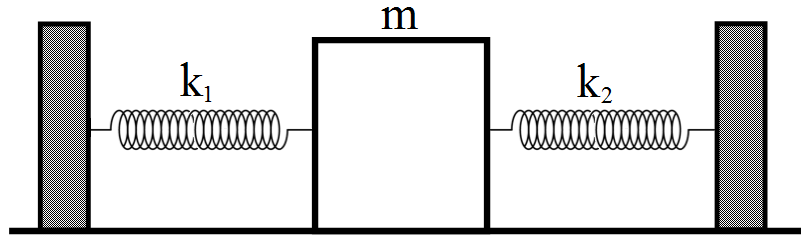
Both the springs shown in figure are unstretched. If the block is displaced by a distance x and released, what will be the initial acceleration?