MCQ
Find the middle term in the expansion of $\Big(\frac{2\text{x}}{3}+\frac{3}{2\text{x}}\Big)^{10}.$
  • A
    210
  • B
    630
  • 252
  • D
    756

Answer

Correct option: C.
252
  1. 252
Solution
The middle term will be the 6th term.
It will also be the only term independent of x.
Hence the coefficient will be
$T_{5+1}​ = ^{10}C_{5​}$
$=\frac{10!}{5!(5!)}$
= 252

Need a full question paper?

Generate a complete, print-ready paper with questions like this in minutes — across 16+ boards, with answer keys.

Start Generating Free

Similar questions

Chord of contact of the point $(3, 2)$ w.r.t. the circle ${x^2} + {y^2} = 25$ meets the coordinate axes in $A$ and $B$. The circumcentre of triangle $OAB$ is
If $x = {\log _3}5,\,\,\,y = {\log _{17}}25,$ which one of the following is correct
The number of five digit numbers, greater than $40000$ and divisible by $5$, which can be formed using the digits $0,1,3,5,7$ and $9$ without repetition, is equal to
Number of natural solutions of the equation $x_1 + x_2 = 100$ , such that $x_1$ and $x_2$ are not multiple of $5$
For the four circles $M , N , O$ and $P ,$ following four equations are given

Circle $M : x ^{2}+ y ^{2}=1$ ; Circle $N : x ^{2}+ y ^{2}-2 x =0$ ; Circle $O : x ^{2}+ y ^{2}-2 x -2 y +1=0$ ;Circle $P: x^{2}+y^{2}-2 y=0$

If the centre of circle $M$ is joined with centre of the circle $N$, further centre of circle $N$ is joined with centre of the circle $O ,$ centre of circle $O$ is joined with the centre of circle $P$ and lastly, centre of circle $P$ is joined with centre of circle $M ,$ then these lines form the sides of a
If a normal chord of the parabola $y^2 = 4ax$ subtend a right angle at the vertex, its slope is-
The locus of the point of intersection of the lines, $\sqrt 2 x - y + 4\sqrt 2 k = 0$ and $\sqrt 2 kx + ky - 4\sqrt 2  = 0$ ( $k$ is any non-zero real parameter) is
Choose the correct answer. If $\alpha+\beta=\frac{\pi}{4},$ then the value of $(1+\tan\alpha)(1+\tan\beta)$ is:
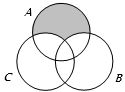
The shaded region in the given figure is
if $x = \,\frac{4}{3}\, - \,\frac{{4x}}{9}\, + \,\,\frac{{4{x^2}}}{{27}}\, - \,\,.....\,\infty $ , then $x$ is equal to