Question
Find the missing frequencies in the following frequency distribution whose mean is $50.$
$x$ $10$ $30$ $50$ $70$ $90$ Total
$f$ $17$ $f_1$ $32$ $f_2$ $19$ $120$

Answer

Let $f_1$ and $f_{2 }$ be the missing frequencies.
We prepare the following frequency distribution table.
$(x_i)$ $(f_i)$ $f_ix_i$
$10$ $17$ $170$
$30$ $f_1$ $30f_1$
$50$ $32$ $1600$
$70$ $f_2$ $70f_2$
$90 $ $19$ $1710$
Total
120
$3480+30f_1+70f_2$
Here,
$\sum\text{f}_\text{i}=68+\text{f}_1+\text{f}_2$
But
$68+\text{f}_1+\text{f}_2=120 ($Given$)$
Therefore,
$68+\text{f}_1+\text{f}_2=120$
$\Rightarrow\text{f}_1+\text{f}_2=120-68=52$
$\text{f}_2=52-\text{f}_1\ \dots(1)$
Mean $=\frac{\sum\text{f}_\text{i}\text{x}_\text{i}}{\sum\text{f}_\text{i}}=\frac{3480+30\text{f}_1+70\text{f}_2}{120}$
$\Rightarrow\frac{3480+30\text{f}_1+70(52-\text{f}_1)}{120}$ Using equation $1$
$\Rightarrow\frac{3480+30\text{f}_1+3640+70\text{f}_1}{120}$
$=\frac{7120-40\text{f}_1}{120}$
But mean $= 50 ($given$)$
Therefore,
We have,
$50=\frac{7120-40\text{f}_1}{120}$
$6000=7120-40\text{f}_1$
$40\text{f}_1=1120$
$\text{f}_1=\frac{1120}{40}=28$
Substituting the value of $f_1$ in equation $1,$
We have,
$f_2 = 52 - 28 = 24$
Thus, the missing frequencies are $f_1 = 28$ and $f_2 = 24$ respectively.

Need a full question paper?

Generate a complete, print-ready paper with questions like this in minutes — across 16+ boards, with answer keys.

Start Generating Free

Similar questions

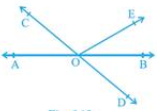
In Figure lines AB and CD intersect at O. If $\angle AOC + \angle BOE = {70^ \circ }$  and $\angle BOD = {40^ \circ }$,find $\angle BOE$ and reflex $\angle COE$
Fig.6.1.png
The difference between the semiperimeter and the sides of a $\triangle\text{ABC}$ are 8cm, 7cm and 5cm respectively. Find the area of the triangle.
The expression $(a - b)^3 + (b - c)^3 + (c - a)^3$ can be factorized as:
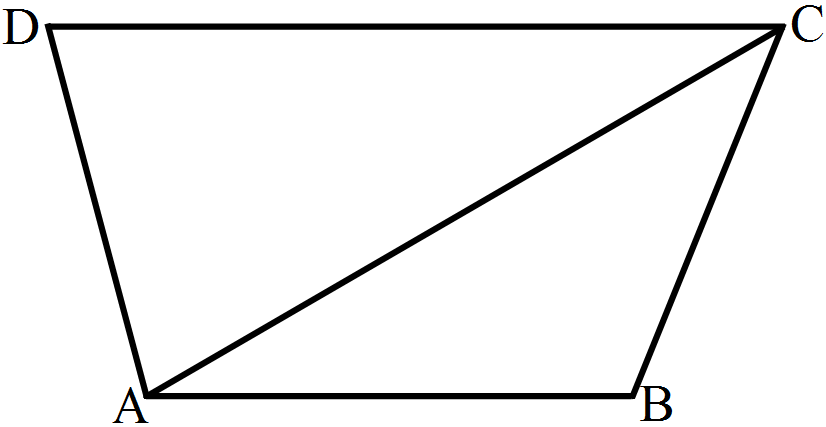
In the adjoining figure, ABCD is a quadrilateral and AC is one of its diagonals. Prove that:
(i) AB + BC + CD + DA > 2AC
(ii) AB + BC + CD > DA
(iii) AB + BC + CD + DA > AC + BD
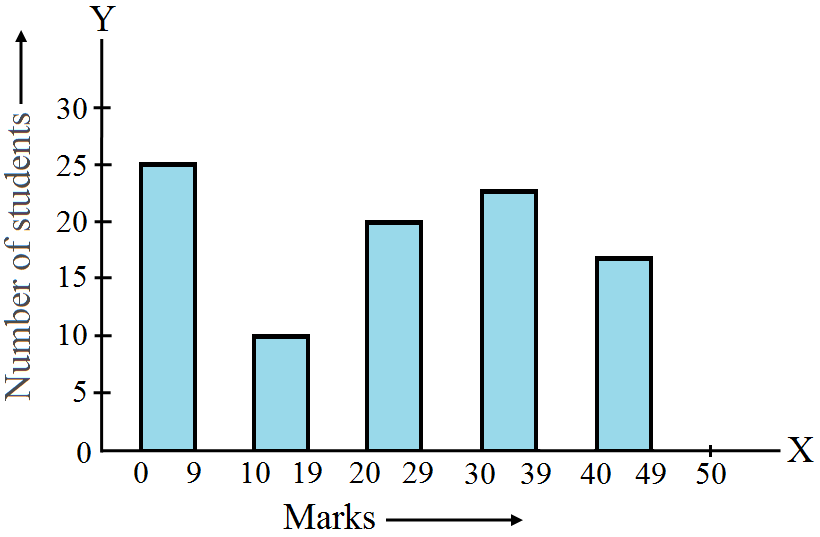
Given below is the bar graph indicating the marks obtained out of 50 in mathematics paper by 100 students. Read the bar graph and answer the following questions:
  1. It is decided to distribute workbooks on mathematics to the students obtaining less than 20 marks, giving one workbook to each of such students. If a workbook costs Rs. 5, what sum is required to buy the workbooks?
  2. Every student belonging to the highest mark group is entitled to get a prize of Rs. 10. How much amount of money is required for distributing the prize money?
  3. Every student belonging to the lowest mark-group has to solve 5 problems per day. How many problems, in all, will be solved by the students of this group per day?
  4. State whether true or false:
  1. 17% students have obtained marks ranging from 40 to 49.
  2. 59 students have obtained marks ranging from 10 to 29.
  1. What is the number of students getting less than 20 marks?
  2. What is the number of students getting more than 29 marks?
  3. What is the number of students getting marks between 9 and 40?
  4. What is the number of students belonging to the highest mark group?
  5. What is the number of students obtaining more than 19 marks?
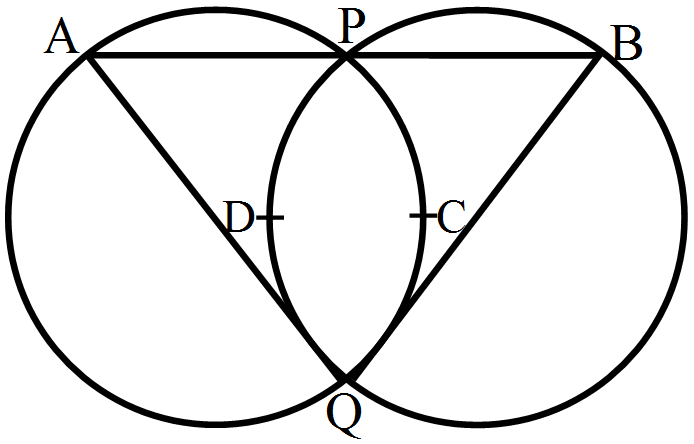
Two equal circles intersect in P and Q. A straight line through P meets the circles in A and B. Prove that QA = QB.
The factors of $x^3 - x^2y - xy^2{ }+ y^3$ are:
Draw the graph of the equation, 3x + 2y = 6.
Find the coordinates of the point where the graph cuts the y-axis.
In a $\triangle\text{ABC},$ the internal bisectors of $\angle\text{B}$ and $\angle\text{E}$ meet at P and the external bisectors of $\angle\text{B}$ and $\angle\text{C}$ meet at Q. Prove that $\angle\text{BPC}+\angle\text{BQC}=180^\circ.$
Show that the quadrilateral formed by joining the midpoints of the pairs of adjacent sides of a rhombus is a rectangle.