Question
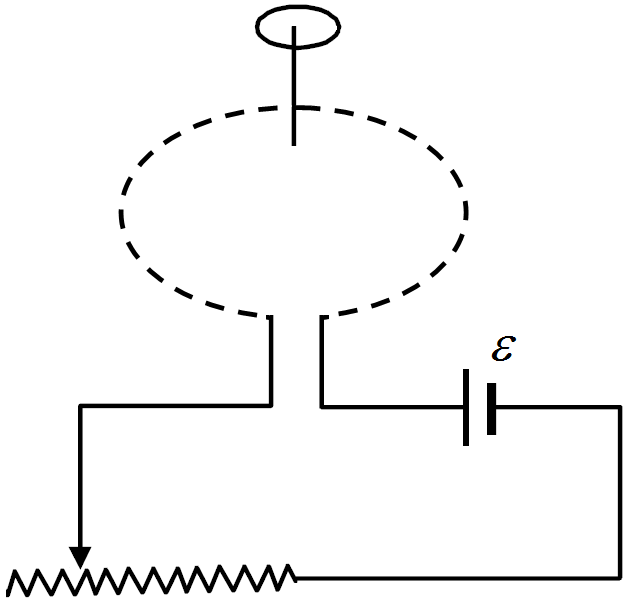
Find the mutual inductance between the circular coil and the loop shown in figure.

Answer

emf induced $=\frac{\pi\mu_0\text{Na}^2\text{a}'^2\text{ERV}}{2\text{L}(\text{a}^2+\text{x}^2)^{\frac{3}{2}}\Big(\frac{\text{R}}{\text{L}\text{x}}+\text{r}\Big)^2}$
$\frac{\text{dl}}{\text{dt}}=\frac{\text{ERV}}{\text{L}\Big(\frac{\text{Rx}}{\text{L}}+\text{r}\Big)^2}$
$\mu=\frac{\text{E}}{\frac{\text{di}}{\text{dt}}}=\frac{\text{N}\mu_0\pi\text{a}^2\text{a}'^2}{2(\text{a}^2+\text{x}^2)^{\frac{3}{2}}}$

Need a full question paper?

Generate a complete, print-ready paper with questions like this in minutes — across 16+ boards, with answer keys.
Start Generating Free

Similar questions

If we put a cardboard (say 20cm × 20cm) between a light source and our eyes, we can't see the light. But when we put the same cardboard between a sound source and our ear, we hear the sound almost clearly. Explain.
A light bulb and a solenoid are connected in series across an ac source of voltage. Explain, how the glow of the light bulb will be affected when an iron rod is inserted in the solenoid.
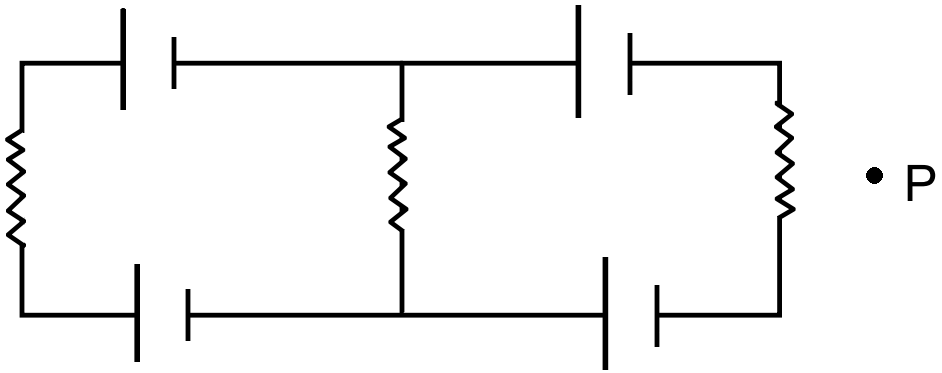
Each of the batteries shown in figure has an emf equal to 5V. Show that the magnetic field B at the point P is zero for any set of values of the resistances.
If the nucleons of a nucleus are separated far apart from each other, the sum of masses of all these nucleons is larger than the mass of the nucleus. Where does this mass difference come from?
Draw the graphs showing variation of inductive reactance and capacitive reactance with frequency of applied a.c. source.
A parallel-plate capacitor is filled with a dielectric material of resistivity ρ and dielectric constant K. The capacitor is charged and disconnected from the charging source. The capacitor is slowly discharged through the dielectric. Show that the time constant of the discharge is independent of all geometrical parameters like the plate area or separation between the plates. Find this time constant.
Explain the phenomena of the total internal reflection in right angle prism and the image formed by it.
Answer the following: A man fixes outside his house one evening a two metre high insulating slab carrying on its top a large aluminium sheet of area $1m^2$. Will he get an electric shock if he touches the metal sheet next morning?
Does a body at $0^\circ C$ radiate in a room, where the room temperature is $30^\circ C?$ If yes, why does its temperature not fall further?
What is electrostatic shielding? How is this property used in actual practice? Is the potential in the cavity of a charged conductor zero?