Question
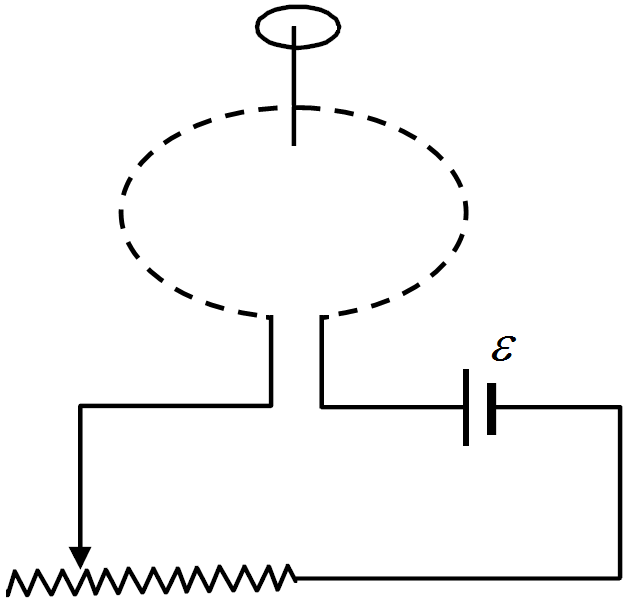
Find the mutual inductance between the circular coil and the loop shown in figure.

Answer

emf induced $=\frac{\pi\mu_0\text{Na}^2\text{a}'^2\text{ERV}}{2\text{L}(\text{a}^2+\text{x}^2)^{\frac{3}{2}}\Big(\frac{\text{R}}{\text{L}\text{x}}+\text{r}\Big)^2}$
$\frac{\text{dl}}{\text{dt}}=\frac{\text{ERV}}{\text{L}\Big(\frac{\text{Rx}}{\text{L}}+\text{r}\Big)^2}$
$\mu=\frac{\text{E}}{\frac{\text{di}}{\text{dt}}}=\frac{\text{N}\mu_0\pi\text{a}^2\text{a}'^2}{2(\text{a}^2+\text{x}^2)^{\frac{3}{2}}}$

Need a full question paper?

Generate a complete, print-ready paper with questions like this in minutes — across 16+ boards, with answer keys.
Start Generating Free

Similar questions

A wire-loop confined in a plane is rotated in its own plane with some angular velocity. A uniform magnetic field exists in the region. Find the emf induced in the loop.
Obtain the binding energy (in MeV) of a nitrogen nucleus $\left({ }_7^{14} N\right)$, given $m\left({ }_7^{14} N\right)=14.00307 u$.
Give the sign convection for electric or magnetic field leaving and entering the plane of the paper.
Explain ferromagnetism and ferromagnetic substances.
Area of cross-section of a wire is $1.0 \times 10^{-7} m^2$ and the number of free electrons per cubic metre in the wire is $2 \times 10^{28}$ per $m ^3$. A current of 3.2 A is flowing in the wire. Find (i) current density in the wire (ii) drift velocity of free electrons.
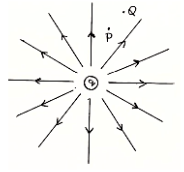
The field lines of a positive point charge are shown in below figure.
Image
(a) Give the sign of the potential difference $V_P-V_Q$
(b) Give the sign of the work done by the field in moving a small positive charge from Q to P.
(c) Give the sign of the potential energy difference of a small negative charge between the points Q to P.
The image of a small electric bulb fixed on the wall of a room is to be obtained on the opposite wall 3 m away by means of a large convex lens. What is the maximum possible focal length of the lens required for the purpose?
The internal resistance of an accumulator battery of emf 6V is $10\Omega$ when it is fully discharged. As the battery gets charged up, its internal resistance decreases to $1\Omega.$
The battery in its completely discharged state is connected to a charger that maintains a constant potential difference of 9V. Find the current through the battery (a) just after the connections are made and (b) after a long time when it is completely charged.
It is found experimentally that $13.6 eV$ energy is required to separate a hydrogen atom into a proton and an electron. Compute the orbital radius and the velocity of the electron in a hydrogen atom.
A man of mass 50kg starts moving on the earth and acquires a speed of 1.8m/s. With what speed does the earth recoil? Mass of earth = 6 × 1024kg.