Question
Find the point on X-axis which is equidistant from P(2,-5) and Q(-2,9).

Answer

According to the distance formula, the distance 'd' between two points $(a, b)$ and $(c, d)$ is given by
$d=\sqrt[2]{(a-c)^2+(b-d)^2}$
As the point is on the $x=$ axis it is of the form $(x, 0)$
Distance from point $P=\sqrt{(2-x)^2+(-5-0)^2}=\sqrt{(2-x)^2+25}$
Distance from point $Q =\sqrt{(-2- x )^2+(9-0)^2}=\sqrt{(2+ x )^2+81}$
As the two points are equidistant from ( $x , 0$ )
$\sqrt{(2-x)^2+25}=\sqrt{(2+x)^2+81}$
Squaring both sides
$(2-x)^2+25=(2+x)^2+81$
Expanding and simplifying
$-4 x+25=4 x+81$
$8 x=-56$
$x=-7$
Hence the point is $(-7,0)$

Need a full question paper?

Generate a complete, print-ready paper with questions like this in minutes — across 16+ boards, with answer keys.
Start Generating Free

Similar questions

Find the length of the arc of the circle of diametr $8.4 \ cm$ with area of the sector $18.48 \ cm^2$​​​​​​​. Also find measure of the arc.
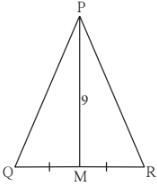
In the figure 2.26, seg PM is a median of ∆PQR. PM = 9 and PQ² + PR² = 290, then find QR.

Image

The corresponding sides of two similar triangles are in the ratio $2 : 3$. If the area of the smaller triangle is $48\ cm^2$​​​​​​​, find the area of the larger triangle.
Ramkali would need Rs. 1800 for admission fee and books etc., for her daughter to start going to school from next year. She saved Rs. 50 in the first month of this year and increased her monthly saving by Rs. 20. After a year, how much money will she save? Will she be able to fulfil her dream of sending her daughter to school?
Find the sum of the following APs:
0.6, 1.7, 2.8, ..... to 100 terms.
If a $\triangle\text{ABC},$ AD is the bisector of $\angle\text{A},$ Meeting side BC at D.
If AB = 5.6cm, AC = 6cm and DC = 3cm, find BC.
Prove : $\left(\frac{1}{\cos \theta}+\frac{1}{\cot \theta}\right)=(\sec \theta-\tan \theta)=1$
Find the distance of the point (1, 2) from the mid-point of the line segment joining the points (6, 8) and (2, 4).
$\triangle\text{ABC}\sim\triangle\text{DEF}$ such that $\text{ar}(\triangle\text{ABC})=64\text{cm}^2$ and $\text{ar}(\triangle\text{DEF})=169\text{cm}^2.$ If BC = 4cm, find EF.
In the following, determine whether the given quadratic equation have real root and if so, find the root:
$2\text{x}^2+5\sqrt{3}\text{x}+6=0$