Question 13 Marks
Find the distances between the following points.
(i) A(a, 0), B(0, a)
(ii) P(-6, -3), Q(-1, 9)
(iii) R(-3a, a), S(a, -2a)
AnswerAccording to the distance formula, the distance ' d ' between two points $( a , b )$ and $( c , d )$ is given by
$d=\sqrt[2]{(a-c)^2+(b-d)^2}$
$\text { (i) } A(a, 0), B(0, a) $
$\text { i. } d=\sqrt{(a-0)^2+(0-a)^2} $
$=\sqrt{2 a^2}$
$=a \sqrt{2}$
$\text { (ii) } P(-6,-3), Q(-1,9) $
$d=\sqrt{(-6-(-1))^2+(-3-9)^2}$
$=\sqrt{(-5)^2+(-12)^2} $
$=\sqrt{25+144} $
$=\sqrt{169 }$
$=13$
$\text { (iii) } R(-3 a, a), S(a,-2 a) $
$d=\sqrt{(-3 a-a)^2+(a-(-2 a))^2} $
$=\sqrt{(-4 a)^2+(3 a)^2} $
$=\sqrt{16 a^2+9 a^2}$
$= \sqrt{{25}^2}$
$= 5a$
View full question & answer→Question 23 Marks
Find the point on X-axis which is equidistant from P(2,-5) and Q(-2,9).
AnswerAccording to the distance formula, the distance 'd' between two points $(a, b)$ and $(c, d)$ is given by
$d=\sqrt[2]{(a-c)^2+(b-d)^2}$
As the point is on the $x=$ axis it is of the form $(x, 0)$
Distance from point $P=\sqrt{(2-x)^2+(-5-0)^2}=\sqrt{(2-x)^2+25}$
Distance from point $Q =\sqrt{(-2- x )^2+(9-0)^2}=\sqrt{(2+ x )^2+81}$
As the two points are equidistant from ( $x , 0$ )
$\sqrt{(2-x)^2+25}=\sqrt{(2+x)^2+81}$
Squaring both sides
$(2-x)^2+25=(2+x)^2+81$
Expanding and simplifying
$-4 x+25=4 x+81$
$8 x=-56$
$x=-7$
Hence the point is $(-7,0)$
View full question & answer→Question 33 Marks
Find the coordinates of the midpoint of the line segment joining P(0,6)and Q(12,20).
AnswerAccording to the mid point theorem the coordinates of the point P(x,y) dividing the line formed by A(a,b) and B(c,d) is given by:
$x =\frac{ a + c }{2} $
$y =\frac{ b + d }{2}$
In question $x =\frac{0+12}{2}=6$
$y=\frac{6+20}{2}=13$
Hence mid point is $(6,13)$
View full question & answer→Question 43 Marks
Determine whether the given points are collinear.
(1) A(0,2) , B(1,-0.5), C(2,-3)
(2) P(1, 2) , Q(2, 8/5) , R(3, 6/5)
(3) L(1,2) , M(5,3) , N(8,6)
AnswerIf Three points $(a, b),(c, d),(e, f)$ are collinear then the area formed by the triangle by the three points is zero.
Area of a triangle $=\frac{1}{2}| a ( d - f )+ c ( f - b )+ e ( b - d )|$
1. area $=\frac{1}{2}(0(-0.5-(-3))+1(-3-2)+2(2-(-0.5)))=0$
Hence the points are collinear.
2. area $=\frac{1}{2}\left(1\left(\frac{8}{5}-\frac{6}{5}\right)+2\left(\frac{6}{5}-2\right)+3\left(2-\frac{8}{5}\right)\right)=0$
Hence the points are collinear
3. area $=\frac{1}{2}(1(3-6)+5(6-2)+8(2-3))=\frac{9}{2}$
Hence the points are not collinear
View full question & answer→Question 53 Marks
If A (1, -1),B (0, 4),C (-5, 3) are vertices of a triangle then find the slope of each side
AnswerSlope $m$ of a line passing through two points $A(a, b)$ and $B(c, d)$ is given by
$m =\frac{ d - b }{ c - a }$
Slope of $A B=$
$=\frac{4-(-1)}{0-1}=-5$
Slope of BC =
$\frac{3-4}{-5-0}=\frac{1}{5}$
Slope of $A C=$
$\frac{3-(-1)}{-5-1}=-\frac{2}{3}$
View full question & answer→Question 63 Marks
Determine whether the following points are collinear.
(1) A(-1, -1), B(0, 1), C(1, 3)
(2) D(-2, -3), E(1, 0), F(2, 1)
(3) L(2, 5), M(3, 3), N(5, 1)
(4) P(2, -5), Q(1, -3), R(-2, 3)
(5) R(1, -4), S(-2, 2), T(-3, 4)
(6) A(-4, 4), K(-2, 5/ 2 ), N(4, -2)
AnswerThree points are said to be collinear if they all lie in a straight line.
If Three points $\left( x _1, y _1\right),\left( x _2, y _2\right),\left( x _3, y _3\right)$ are collinear then no triangle can be formed using three points and so the area formed by the triangle by the three points is zero.
Area of Triangle $=1 / 2\left[x_1\left(y_2-y_3\right)+x_2\left(y_3-y_1\right)+x_3\left(y_1-y_2\right)\right]$.
1. For triangle, $A(-1,-1), B(0,1), C(1,3)$
$\text { Area }=\frac{1}{2}(-1(1-3)+0(3-(-1))+1(-1-1))$
= 1/2 [ -1(-2) + 0(3+1) + 1(-1-1)]
= 1/2 [2 + 0 - 2]
= 1/2 [2-2]
= 0
Hence the points are collinear
2. For triangle, D(-2, -3), E(1, 0), F(2, 1)
Using 1,
Area = 1/2 [-2(0-1) + 1(1-(-3)) + 2(-3-0)]
= 1/2 [-2(-1) + 1(1+3) + 2(-3)]
= 1/2 [ 2 + 4 -6 ]
= 1/2 [ 6 - 6 ]
= 1/2 (0)
= 0
Hence the points are collinear.
3. For triangle, L(2, 5), M(3, 3), N(5, 1)
Using 1,
Area = 1/2 [2(3-1) + 3(1-5) + 5(5-3)]
= 1/2 [ 2(2) + 3(-4) + 5(2)]
= 1/2 [ 4 - 12 + 10 ]
= 1/2 [ 14 - 12 ]
= 1/2 (2)
= 1
Hence the points are not collinear.
4. For triangle, P(2, -5), Q(1, -3), R(-2, 3)
Using 1,
Area $=\frac{1}{2}(2(-3-3)+1(3-(-5))+(-2)(-5-(-3))=0$
Area = 1/2 [ 2(-3-3) + 1(3-(-5)) + (-2)(-5-(-3))]
= 1/2 [ 2(-6) + 1(3+5) - 2 (-5+3)]
= 1/2 [ -12 + 8 -2(-2)]
= 1/2 [-12 + 8 +4]
= 1/2 [ -12 + 12]
= 1/2 (0)
= 0
Hence the points are collinear.
5. For triangle, R(1, -4), S(-2, 2), T(-3, 4)
Area $=\frac{1}{2}(1(2-4)+(-2)(4-(-4))+(-3)(-4-2))=0$
Hence the points are collinear.
6. For triangle, A(-4, 4), K(-2, 5/ 2 ), N(4, -2)
Area $=\frac{1}{2}\left((-4)\left(\frac{5}{2}-(-2)+(-2)(-2-4)+4\left(4-\frac{5}{2}\right)\right)=0\right.$
Hence the points are collinear.
View full question & answer→Question 73 Marks
Find the centroids of the triangles whose vertices are given below.
(1) (-7, 6), (2, -2), (8, 5)
(2) (3, -5), (4, 3), (11, -4)
(3) (4, 7), (8, 4), (7, 11)
AnswerThe coordinates of the centroid (x,y) od a triangle formed by points (a,b), (c,d), (e,f) is given by
$x=\frac{a+c+e}{3} $
$ y=\frac{b+d+f}{3} $
$ \text { 1. } x=\frac{-7+2+8}{3}=1 $
$ y=\frac{6-2+5}{3}=3$
$ \text { 2. } x=\frac{3+4+11}{3}=6 $
$y=\frac{-5+3-4}{3}=-2 \\ \text { 3. } x=\frac{4+8+7}{3}=\frac{19}{3} $
$ y=\frac{7+4+11}{3}=\frac{22}{3}$
View full question & answer→Question 83 Marks
Find the ratio in which point T(-1, 6)divides the line segment joining the pointsP(-3, 10) and Q(6, -8).
AnswerA point $P(x, y)$ divides the line formed by points $(a, b)$ and $(c, d)$ in the ratio of $m: n$, then the coordinates of the point $P$ is given by
$x =\frac{ an + cm }{ m + n } \text { and } y =\frac{ bn + dm }{ m + n }$
In the given question,
Let the point T divide the line $PQ$ in the ratio m:n
Here $x=-1$ and $y=6$
$1=\frac{-3 n+6 m}{m+n}$
$6=\frac{10 n -8 m}{ m + n }$
Simplifying (1) we get,
$-m-n=-3 n+6 m$
$2 n=7 m$
Simplifying (2) we get,
$6 m+6 n=10 n-8 m$
$14 m=4 n$
From both we get $\frac{ m }{ n }=\frac{2}{7}$
Hence the point $T$ divides $P Q$ in the ratio $2: 7$
View full question & answer→Question 93 Marks
Find the coordinates of the centre of the circle passing through the points P(6,-6), Q(3,-7)and R(3,3).
AnswerAccording to the distance formula, the distance 'd' between two points (a,b) and (c,d) is given by
$d=\sqrt[2]{(a-c)^2+(b-d)^2}............(1)$
Let the centre be A(x,y)
As it passes through the given points, distance between centre and the points is the radius.
$A P=\sqrt{(x-6)^2+(y+6)^2}$
$A Q=\sqrt{(x-3)^2+(y+7)^2}$
$A R=\sqrt{(x-3)^2+(y-3)^2}$
As AP = AQ
Squaring both sides
$(x-6)^2+(y+6)^2=(x-3)^2+(y+7)^2$
Simplifying
$12 y-12 x+72=14 y-6 x+58$
$2 y+6 x-14=0 \ldots \text { (a) }$
$A P=A R$
Squaring both sides and simplifying
$6 y-6 x+54=0$
Solving for $x$ and $y$ using (a) and (b)
We get $x=3 ; y=-2$
Hence centre is $(3,-2)$
View full question & answer→Question 103 Marks
In each of the following examples find the co-ordinates of point A which divides segment PQ in the ratio a:b.
(1) P(-3, 7), Q(1, -4), a:b = 2:1
(2) P(-2, -5), Q(4, 3), a:b = 3:4
(3) P(2, 6), Q(-4, 1), a:b = 1:2
AnswerA point P(x,y) divides the line formed by points (a,b) and (c,d) in the ratio of m:n, then the coordinates of the point P is given by
$x =\frac{ an + cm }{ m + n } \text { and } y =\frac{ bn + dm }{ m + n }$
Where m and n is defined as the ratio in which the line segments are divided
$\text { 1. } x=\frac{(-3)(1)+7(2)}{2+1}$
$x=\frac{11}{3}$
$y=\frac{(1) 7+(-4) 2}{2+1}$
$y=\frac{-1}{3}$
2. $x=\frac{(-2) 4+(4) 3}{4+3}$
$x=\frac{4}{7}$
$y=\frac{(-5) 4+(3) 3}{4+3}$
$y=\frac{-11}{7}$
$\text { 3. } x=\frac{2(2)+(-4) 1}{2+1}=0$
$y=\frac{(6) 2+1(1)}{2+1}$
$y=\frac{13}{3}$
View full question & answer→Question 113 Marks
The line segment AB is divided into five congruent parts at P, Q, R and S suchthat A-P-Q-R-S-B. If point Q(12, 14) and
S(4, 18) are given find thecoordinates of A, P, R,B.
Answer$x=\frac{ an + cm }{ m + n } \text { and } y=\frac{ bn + dm }{ m + n }$
Coordinates of $R$ as $Q R: R S:: 1: 1$
$X=\frac{12+4}{2}=8$
$Y=\frac{14+18}{2}=16$
As RS:SB: :1:1
Coordinates of $B$
$4=\frac{8+x}{2}$
$x=0$
And
$18=\frac{16+y}{2}$
$Y=20$
As $PQ:QR::1:1$
Coordinates of $P$
$12=\frac{x+8}{2}$
$x=16$
and
$14=\frac{y+16}{2}$
$y=12$
$As AP:PQ::1:1$
Coodinates of $A$
$16=\frac{x+12}{2}$
$x=20$
and
$12=\frac{y+14}{2}$
$y=10$
View full question & answer→Question 123 Marks
If A (-14, -10), B(6, -2) is given, find the coordinates of the points whichdivide segment AB into four equal parts.
Answerlet the points dividing AB be C,D,E.
AC:CD:DE:EB∷1:1:1:1
A point P(x,y) divides the line formed by points (a,b) and (c,d) in the ratio of m:n, then the coordinates of the point P is given by
$x =\frac{ an + cm }{ m + n } \text { and } y =\frac{ bn + dm }{ m + n }$
$\text { For } C m:n :: 1: 3$
$x =\frac{(-14) 3+(6) 1}{1+3}=-9$
$y =\frac{(-10) 3+(-2) 1}{1+3}=-8$
For D m:n ::2:2
$x=\frac{(-14) 2+(6) 2}{2+2}=-4$
$y=\frac{(-10) 2+(-2) 2}{2+2}=-6$
For E m:n :: 3:1
$x=\frac{(-14) 1+(6) 3}{3+1}=1$
$y=\frac{(-10) 1+(-2) 3}{1+3}=-4$
Hence coordinates of $C=(-9,-8)$
$D=(-4,-6)$
$E=(1,-4)$
View full question & answer→Question 133 Marks
Find the co-ordinates of the points of trisection of the line segment AB with A(2, 7) and B(-4, -8).
Answerlet The points of trisection of a given line AB be P and Q
Then the ratio AP:PQ:QB = 1:1:1
Hence we get AP:PB = 1:2
And AQ:QB = 2:1
A point P(x,y) divides the line formed by points (a,b) and (c,d) in the ratio of m:n, then the coordinates of the point P is given by
$x=\frac{a n+c m}{m+n} \text { and } y=\frac{b n+d m}{m+n}$
To find point $P(x, y)$
$x=\frac{2(2)+(-4) 1}{2+1}$
$x=0$
$y=\frac{(7) 2+(-8) 1}{2+1}$
$y=2$
To find the point $Q\left(x^{\prime}, y^{\prime}\right)$
$x ^{\prime}=\frac{((2) 1+(-4) 2)}{2+1}$
$x ^{\prime}=-2$
$y ^{\prime}=\frac{(1) 7+(-8) 2}{2+1}$
$y ^{\prime}=-3$
Hence point $P=(0,2)$ and $Q=(-2,-3)$
View full question & answer→Question 143 Marks
Find the coordinates of point P if P divides the line segment joining the points A(-1,7) and B(4,-3) in the ratio 2:3.
AnswerA point $P(x, y)$ divides the line formed by points $(a, b)$ and $(c, d)$ in the ratio of $m: n$, then the coordinates of the point $P$ is given by
$x=\frac{a n+c m}{m+n} \text { and } y=\frac{b n+d m}{m+n}$
In the given question $x =\frac{(-1) 3+4(2)}{2+3}$
$x=\frac{8}{8}=1$
$y=\frac{7(3)+(-3)(2)}{2+3}$
$y=3$
Hence the coordinates of the point are $(1,3)$.
View full question & answer→Question 153 Marks
Find the type of the quadrilateral if points A(-4, -2), B(-3, -7) C(3, -2) andD(2, 3) are joined serially.
AnswerAccording to the distance formula, the distance ' $d$ ' between two points $(a, b)$ and $(c, d)$ is given by
$d=\sqrt[2]{(a-c)^2+(b-d)^2}$
Slope of a line between two points $(a, b)$ and $(c, d)$ is
$m =\frac{d-b}{ c - a }$
$AB =\sqrt{(-4+3)^2+(-2+7)^2}=\sqrt{(26)}$
$BC =\sqrt{(-3-3)^2+(-7+2)^2}=\sqrt{(61)}$
$CD =\sqrt{(2-3)^2+(-2-3)^2}=\sqrt{(26)}$
$A D=\sqrt{(-4-2)^2+(-2-3)^2}=\sqrt{61}$
Slope $A B=\frac{-7+2}{-3+4}=-5$
Slope $B C=\frac{-2+7}{3+3}=\frac{5}{6}$
Slope $C D=\frac{3+2}{2-3}=-5$
Slope $A D=\frac{3+2}{2+4}=\frac{5}{6}$
As opposite sides are equal and parallel, it forms a parallelogram.
View full question & answer→Question 163 Marks
Find the coordinates of circumcentre and radius of circumcircle of triangle ABC ifA(7, 1), B(3, 5) and C(2, 0) are given.
AnswerLet the circumcentre be $(x, y)$
As the circumcentre is equidistant from all the 3 points, we get
$\sqrt{(3-x)^2+(5-y)^2}=\sqrt{(2-x)^2+y^2} \ldots \ldots i$
And
$\sqrt{(2-x)^2+y^2}=\sqrt{(7-x)^2+(y-1)^2}$
Squaring both sides of i and simplifying, we get
$-2 x-10 y=-30$
Squaring both sides of ii and simplifying, we get
$10 x+2 y=46$
Solving the above equations, we get
$x=\frac{25}{6}$
$y=\frac{13}{6}$
Radius of circumcircle is the distance between any point on the triangle and the circumcentre.
$\text { Radius }=\sqrt{\left(2-\frac{25}{6}\right)^2+\left(0-\frac{13}{6}\right)^2}=\frac{13}{6} \sqrt{2}$
View full question & answer→Question 173 Marks
Show that A(4, -1), B(6, 0), C(7, -2) and D(5, -3)are vertices of a square.
AnswerAccording to the distance formula, the distance 'd' between two points $(a, b)$ and $(c, d)$ is given by
$d=\sqrt[2]{(a-c)^2+(b-d)^2}$
Slope of a line between two points $(a, b)$ and $(c, d)$ is
$m =\frac{ d - b }{ c - a }$
Note: If the Product of slopes of two lines $=-1$ then they are perpendicular to each other.
$A B=\sqrt{(6-4)^2+(-1+2)^2}=\sqrt{5}$
$B C=\sqrt{(6-7)^2+(-2-0)^{\wedge} 2}=\sqrt{5}$
$C D=\sqrt{(7-5)^2+(-2+3)^2}=\sqrt{(5)}$
$A D=\sqrt{(5-4)^2+(-1+3)^2}=\sqrt{5}$
Slope $A B=\frac{0-(-1)}{6-4}=\frac{1}{2}$
Slope $B C=\frac{-2-0}{7-6}=-2$
Slope $C D=\frac{-3+2}{5-7}=\frac{1}{2}$
Slope $A D=\frac{-3+1}{5-4}==2$
As all sides are equal and ajdacent sides are perndicular. Given points form a square.
View full question & answer→Question 183 Marks
Show that points A(-4, -7), B(-1, 2), C(8, 5) and D(5, -4) are vertices of a rhombus ABCD.
AnswerIn a parallelogram, opposite sides are equal and parallel.
According to the distance formula, the distance 'd' between two points $(a, b)$ and $(c, d)$ is given by
$d=\sqrt[2]{(a-c)^2+(b-d)^2}$
For the given points, length $P Q=\sqrt{(2-7)^2+(-2-3)^2}$
$P Q=\sqrt{50}$
Length $Q R=\sqrt{(11-7)^2+(3-(-1))^2}$
$Q R=\sqrt{16+16}=32$
Length $R S=\sqrt{(11-6)^2+(-1-(-6))^2}$
$R S=\sqrt{25+25}=\sqrt{50}$
Length $S P=\sqrt{(6-2)^2+(-6-(-2))^2}$
$S P=\sqrt{16+16}=\sqrt{32}$
As $P Q=R S$ and $Q R=S P$
Checking for slopes
Slope of a line between two points $(a, b)$ and $(c, d)$ is
$m =\frac{ d - b }{ c - a }$
Slope $P Q=\frac{7-2}{3-(-2)}=1$
Slope $QR =\frac{11-7}{-1-3}=-1$
Slope RS $=\frac{6-11}{-6-(-1)}=1$
Slope SP $=\frac{6-2}{-6-(-2)}=-1$
As $P Q=R S$ and their slope $=1$
And
$Q R=S P$ and their slope $=-1$
Hence the given points form a parallelogram.
View full question & answer→Question 193 Marks
Show that points P(2, -2), Q(7, 3), R(11, -1) and S (6, -6) are vertices of a parallelogram.
AnswerIn a parallelogram, opposite sides are equal and parallel.
According to the distance formula, the distance 'd' between two points $(a, b)$ and $(c, d)$ is given by
$d=\sqrt[2]{(a-c)^2+(b-d)^2}$
For the given points, length $P Q=\sqrt{(2-7)^2+(-2-3)^2}$
$P Q=\sqrt{50}$
Length $Q R=\sqrt{(11-7)^2+(3-(-1))^2}$
$Q R=\sqrt{16+16}=32$
Length $R S=\sqrt{(11-6)^2+(-1-(-6))^2}$
$R S=\sqrt{25+25}=\sqrt{50}$
Length $S P=\sqrt{(6-2)^2+(-6-(-2))^2}$
$S P=\sqrt{16+16}=\sqrt{32}$
As $P Q=R S$ and $Q R=S P$
Checking for slopes
Slope of a line between two points $(a, b)$ and $(c, d)$ is
$m =\frac{ d - b }{ c - a }$
Slope $P Q=\frac{7-2}{3-(-2)}=1$
Slope $QR =\frac{11-7}{-1-3}=-1$
Slope RS $=\frac{6-11}{-6-(-1)}=1$
Slope SP $=\frac{6-2}{-6-(-2)}=-1$
As $P Q=R S$ and their slope $=1$
And
$Q R=S P$ and their slope $=-1$
Hence the given points form a parallelogram.
View full question & answer→Question 203 Marks
Verify that points P(-2, 2), Q(2, 2) and R(2, 7) are vertices of a right angled triangle.
AnswerIn a right angles triangle ABC, right angled at B, according to the pythagoras theorem
$\mathrm{AB}^2+\mathrm{BC}^2=\mathrm{AC}^2$
According to the distance formula, the distance 'd' between two points (a,b) and (c,d) is given by
$d=\sqrt[2]{(a-c)^2+(b-d)^2}\dots(1)$
For the given points Distance between P and Q is
$P Q=\sqrt{(-2-2)^2+(2-2)^2}=\sqrt{16} $
$Q R=\sqrt{(2-2)^2+(7-2)^2}=\sqrt{25} $
$P R=\sqrt{(-2-2)^2+(2-7)^2}=\sqrt{16+25}=\sqrt{41}$
$\mathrm{PQ}^2=16$
$\mathrm{QR}^2=25$
$\mathrm{PR}^2=41$
As $P Q^2+Q^2=P R^2$
Hence the given points form a right angled triangle.
View full question & answer→Question 213 Marks
Find the point on the X-axis which is equidistant from A(-3, 4) and B(1, -4).
AnswerA point in the x = axis is of the form (a,0)
Distance d between two points(a,b) and (c,d)is given by
$d=\sqrt[2]{(a-c)^2+(b-d)^2}$
Distance between $(-3,4)$ and $(a, 0)=$
$D=\sqrt{(-3-a)^2+(0-4)^2} $
$D \sqrt{(3+a)^2+16}$
Distance between $(1,-4)$ and $(a, 0)$
$D=\sqrt{(1-a)^2+(0-(-4))^2} $
$D=\sqrt{(1-a)^2+16}$
As the two points are equidistant from the point (a.0)
$\sqrt{(1-a)^2+16}=\sqrt{(3+a)^2+16}$
Squaring both sides, we get
$(1-a)^2+16=(3+a)^2+16$
$1+a^2-2 a=9+a^2+6 a$
$8 a=-8$
$a=-1$
Hence the point is $(-1,0)$
View full question & answer→Question 223 Marks
Find the coordinates of the circumcentre of a triangle whose vertices are (-3,1),(0,-2) and (1,3)
AnswerThe circumcentre is equidistant from all the points of the triangle. Let the coordinates of circumcentre be $(x, y)$
$\sqrt{(-3-x)^2+(1-y)^2}=\sqrt{x^2+(y+2)^2} \ldots i$
And
$\sqrt{x^2+(y+2)^2}=\sqrt{(1-x)^2+(3-y)^2} \ldots \text { ii }$
Squaring and simplifying $i$, we get
$2 x-2 y=-6$
Squaring and simplifying ii, we get
$2 x+10 y=6$
Solving the above equations, we get
$x=-\frac{1}{3}$
$y=\frac{2}{3}$
hence the coordinates of circumcircle is $\left(-\frac{1}{3}, \frac{2}{3}\right)$
View full question & answer→Question 233 Marks
If point $\mathrm{P}(-4,6)$ divides the line segment $\mathrm{AB}$ with $\mathrm{A}(-6,10)$ and $\mathrm{B}(\mathrm{r}, \mathrm{s})$ in the ratio $2: 1$, find the co-ordinates of $B$.
AnswerBy section formula
$-4=\frac{2 \times r+1 \times(-6)}{2+1}$
$6=\frac{2 \times s+1 \times 10}{2+1}$
$\therefore-4=\frac{2 r-6}{3}$
$\therefore 6=\frac{2 s+10}{3}$
$\therefore-12=2 r-6$
$\therefore 18=2 \mathrm{~s}+10$
$\therefore 2 \mathrm{r}=-6$
$\therefore 2 \mathrm{~s}=8$
$\therefore \quad r=-3$
$\therefore \mathrm{s}=4$
$\therefore$ co-ordinates of point $\mathrm{B}$ are $(-3,4)$.
View full question & answer→Question 243 Marks
If point $T$ divides the segment $A B$ with $A(-7,4)$ and $B(-6,-5)$ in the ratio $7: 2$, find the co-ordinates of $T$.
AnswerLet the co-ordinates of $\mathrm{T}$ be $(x, y)$.
$\therefore$ by the section formula,
$
\begin{aligned}
x=\frac{m x_2+n x_1}{m+n} & =\frac{7 \times(-6)+2 \times(-7)}{7+2} \\
& =\frac{-42-14}{9}=\frac{-56}{9}
\end{aligned}
$
$
y=\frac{m y_2+n y_1}{m+n}=\frac{7 \times(-5)+2 \times(4)}{7+2}
$
$
=\frac{-35+8}{9}=\frac{-27}{9}=-3
$
$\therefore$ co-ordinates of point $\mathrm{T}$ are $\left(\frac{-56}{9},-3\right)$.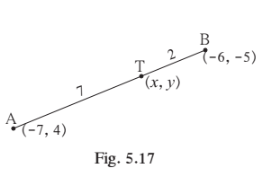
View full question & answer→Question 253 Marks
$\mathrm{A}(-3,-4), \mathrm{B}(-5,0), \mathrm{C}(3,0)$ are the vertices of $\triangle \mathrm{ABC}$. Find the co-ordinates of the circumcentre of $\triangle \mathrm{ABC}$.
AnswerLet, $\mathrm{P}(a, b)$ be the circumcentre of $\triangle \mathrm{ABC}$.
$\therefore$ point $\mathrm{P}$ is equidistant from $\mathrm{A}, \mathrm{B}$ and $\mathrm{C}$.
$
\begin{aligned}
\therefore \mathrm{PA}^2=\mathrm{PB}^2=\mathrm{PC}^2 \ldots \ldots \ldots & \text { (I) } \quad \therefore \mathrm{PA}^2=\mathrm{PB}^2 \\
(a+3)^2+(\mathrm{b}+4)^2 & =(a+5)^2+(\mathrm{b}-0)^2 \\
\therefore a^2+6 a+9+\mathrm{b}^2+8 \mathrm{~b}+16 & =a^2+10 a+25+\mathrm{b}^2 \\
\therefore-4 a+8 \mathrm{~b} & =0 \\
\therefore a-2 \mathrm{~b} & =0 \ldots \ldots \ldots \text { (II) } \\
\text { Similarly } \mathrm{PA}^2 & =\mathrm{PC}^2 \ldots \ldots \ldots \text { (I) From } \\
\therefore(a+3)^2+(\mathrm{b}+4)^2 & =(a-3)^2+(\mathrm{b}-0)^2 \\
\therefore a^2+6 a+9+\mathrm{b}^2+8 \mathrm{~b}+16 & =a^2-6 a+9+\mathrm{b}^2 \\
\therefore 12 a+8 \mathrm{~b} & =-16 \\
\therefore 3 a+2 \mathrm{~b} & =-4 \ldots \ldots \ldots \text { (III) }
\end{aligned}
$
Solving (II) and (III) we get $a=-1, \mathrm{~b}=-\frac{1}{2}$
$\therefore$ co-ordinates of circumcentre are $\left(-1,-\frac{1}{2}\right)$.
View full question & answer→Question 263 Marks
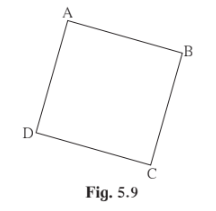
Show that points $(1,7),(4,2),(-1,-1)$ and $(-4,4)$ are vertices of a square.
AnswerIn a quadrilateral, if all sides are of equal length and both diagonals are of equal length, then it is a square.
$\therefore$ we will find lengths of sides and diagonals by using the distance formula.
Suppose, $A(1,7), B(4,2), C(-1,-1)$ and $D(-4,4)$ are the given points.
$ \mathrm{AB}=\sqrt{(1-4)^2+(7-2)^2}=\sqrt{9+25}=\sqrt{34}$
$\mathrm{BC}=\sqrt{(4+1)^2+(2+1)^2}=\sqrt{25+9}=\sqrt{34}$
$\mathrm{CD}=\sqrt{(-1+4)^2+(-1-4)^2}=\sqrt{9+25}=\sqrt{34}$
$\mathrm{DA}=\sqrt{(1+4)^2+(7-4)^2}=\sqrt{25+9}=\sqrt{34}$
$\mathrm{AC}=\sqrt{(1+1)^2+(7+1)^2}=\sqrt{4+64}=\sqrt{68}$
$\mathrm{BD}=\sqrt{(4+4)^2+(2-4)^2} \quad=\sqrt{64+4}=\sqrt{68}$
$\therefore \mathrm{AB}=\mathrm{BC}=\mathrm{CD}=\mathrm{DA} \text { and } \mathrm{AC}=\mathrm{BD}$
$\therefore A B=B C=C D=D A \text { and } A C=B D$
So, the lengths of four sides are equal and two diagonals are equal.
$\therefore (1,7), (4,2), (-1,-1)$ and $(-4,4)$ are the vertices of a square.
View full question & answer→Question 273 Marks
Verify, whether points $P(6,-6), Q(3,-7)$ and $R(3,3)$ are collinear.
Answer$\mathrm{PQ}=\sqrt{(6-3)^2+(-6+7)^2}$ by distance formula
$
\begin{aligned}
& =\sqrt{(3)^2+(1)^2}=\sqrt{10} \\
\mathrm{QR} & =\sqrt{(3-3)^2+(-7-3)^2} \\
& =\sqrt{(0)^2+(-10)^2}=\sqrt{100} \\
\mathrm{PR} & =\sqrt{(3-6)^2+(3+6)^2} \\
& =\sqrt{(-3)^2+(9)^2}=\sqrt{90} .
\end{aligned}
$
From I, II and III out of $\sqrt{10}, \sqrt{100}$ and $\sqrt{90}, \sqrt{100}$ is the largest number.
Now we will verify whether $(\sqrt{100})$ and $(\sqrt{10}+\sqrt{90})$ are equal.
For this compare $(\sqrt{100})^2$ and $(\sqrt{10}+\sqrt{90})^2$.
You will see that $(\sqrt{10}+\sqrt{90})>(\sqrt{100}) \therefore \mathrm{PQ}+\mathrm{PR} \neq \mathrm{QR}$
$\therefore$ points $\mathrm{P}(6,-6), \mathrm{Q}(3,-7)$ and $\mathrm{R}(3,3)$ are not collinear.
View full question & answer→Question 283 Marks
Find the value of $k$, if $(2,1)(4,3)$ and $(0, k)$ are collinear 1.
View full question & answer→Question 293 Marks
Find the value of $k$, if $(5, k),(-3,1)$ and $(-7,-2)$ are collinear.
View full question & answer→Question 303 Marks
Find the coordinates of centroid $G$ of $A B C$, if
(i) $A (8,9), B (4,5), C (6,2)$
(ii) $A (11,8), B (-6,5), C (1,-28)$
Answer(i) $(6,5.33)$ (ii) $(2,-5)$
View full question & answer→Question 313 Marks
Find the coordinates of the points which divide the line segment joining the points $(-2,2)$ and $(6,-6)$ in four equal parts.
Answer$(0,0)(2,-2)(4,-4)$
View full question & answer→Question 323 Marks
Find the ratio in which the line segment joining the points $(6,4)$ and $(1,-7)$ is divided by X -axis.
View full question & answer→Question 333 Marks
In what ratio does the point $(1,3)$ divide line segment joining the points $(3,6)$ and $(-5,-6)$ ?
View full question & answer→Question 343 Marks
Find the coordinates of the circumcentre of ABC, if A(2, 3), B(4, $-1$) and C(5, 2). Also, find circumradius.
Answer$(3,1)$ circumradius $=\sqrt{5}$ units
View full question & answer→Question 353 Marks
Show that the points (2, 4), (2, 6) and $(2+\sqrt{3}, 5)$ are the vertices of an equilateral triangle.
View full question & answer→Question 363 Marks
Find the coordinates of the circumcentre of PQR if P(2, 7), $Q(-5,8)$ and $R(-6,1)$.
View full question & answer→Question 373 Marks
Show that the points A(4, 7) B(8, 4) and C(7, 11) are the vertices of a right angled triangle.
Question 383 Marks
Find the coordinates of the point on Y-axis which is equidistant from the points M(6, 5) and point N(-4, 3).
Question 393 Marks
Find the relation between x and y, where point (x, y) is equidistant from (2, -4) and (-2, 6).
Question 403 Marks
Find the distances between the following points.
(i) A(a, 0), B(0, a)
(ii) P(-6, -3), Q(-1, 9)
(iii) R(-3a, a), S(a, -2a)
Question 413 Marks
Find the point on X-axis which is equidistant from P(2,-5) and Q(-2,9).
Question 423 Marks
Find the coordinates of the midpoint of the line segment joining P(0,6)and Q(12,20).
Question 433 Marks
Determine whether the given points are collinear.
(1) A(0,2) , B(1,-0.5), C(2,-3)
(2) P(1, 2) , Q(2, 8/5) , R(3, 6/5)
(3) L(1,2) , M(5,3) , N(8,6)
Question 443 Marks
If A (1, -1),B (0, 4),C (-5, 3) are vertices of a triangle then find the slope of each side
Question 453 Marks
Determine whether the following points are collinear.
(1) A(-1, -1), B(0, 1), C(1, 3)
(2) D(-2, -3), E(1, 0), F(2, 1)
(3) L(2, 5), M(3, 3), N(5, 1)
(4) P(2, -5), Q(1, -3), R(-2, 3)
(5) R(1, -4), S(-2, 2), T(-3, 4)
(6) A(-4, 4), K(-2, 5/ 2 ), N(4, -2)
Question 463 Marks
Find the centroids of the triangles whose vertices are given below.
(1) (-7, 6), (2, -2), (8, 5)
(2) (3, -5), (4, 3), (11, -4)
(3) (4, 7), (8, 4), (7, 11)
Question 473 Marks
Find the ratio in which point T(-1, 6)divides the line segment joining the pointsP(-3, 10) and Q(6, -8).
Question 483 Marks
Find the coordinates of the centre of the circle passing through the points P(6,-6), Q(3,-7)and R(3,3).
Question 493 Marks
In each of the following examples find the co-ordinates of point A which divides segment PQ in the ratio a:b.
(1) P(-3, 7), Q(1, -4), a:b = 2:1
(2) P(-2, -5), Q(4, 3), a:b = 3:4
(3) P(2, 6), Q(-4, 1), a:b = 1:2
Question 503 Marks
The line segment AB is divided into five congruent parts at P, Q, R and S suchthat A-P-Q-R-S-B. If point Q(12, 14) and
S(4, 18) are given find thecoordinates of A, P, R,B.
Question 513 Marks
If A (-14, -10), B(6, -2) is given, find the coordinates of the points whichdivide segment AB into four equal parts.
Question 523 Marks
Find the co-ordinates of the points of trisection of the line segment AB with A(2, 7) and B(-4, -8).
Question 533 Marks
Find the coordinates of point P if P divides the line segment joining the points A(-1,7) and B(4,-3) in the ratio 2:3.
Question 543 Marks
Find the type of the quadrilateral if points A(-4, -2), B(-3, -7) C(3, -2) andD(2, 3) are joined serially.
Question 553 Marks
Find the coordinates of circumcentre and radius of circumcircle of triangle ABC ifA(7, 1), B(3, 5) and C(2, 0) are given.
Question 563 Marks
Show that A(4, -1), B(6, 0), C(7, -2) and D(5, -3)are vertices of a square.
Question 573 Marks
Show that points A(-4, -7), B(-1, 2), C(8, 5) and D(5, -4) are vertices of a rhombus ABCD.
Question 583 Marks
Show that points P(2, -2), Q(7, 3), R(11, -1) and S (6, -6) are vertices of a parallelogram.
Question 593 Marks
Verify that points P(-2, 2), Q(2, 2) and R(2, 7) are vertices of a right angled triangle.
Question 603 Marks
Find the point on the X-axis which is equidistant from A(-3, 4) and B(1, -4).
Question 613 Marks
Find the coordinates of the circumcentre of a triangle whose vertices are (-3,1),(0,-2) and (1,3)
Question 623 Marks
If point $T$ divides the segment $A B$ with $A(-7,4)$ and $B(-6,-5)$ in the ratio $7: 2$, find the co-ordinates of $T$.
View full question & answer→Question 633 Marks
If point $\mathrm{P}(-4,6)$ divides the line segment $\mathrm{AB}$ with $\mathrm{A}(-6,10)$ and $\mathrm{B}(\mathrm{r}, \mathrm{s})$ in the ratio $2: 1$, find the co-ordinates of $B$.
View full question & answer→Question 643 Marks
$\mathrm{A}(-3,-4), \mathrm{B}(-5,0), \mathrm{C}(3,0)$ are the vertices of $\triangle \mathrm{ABC}$. Find the co-ordinates of the circumcentre of $\triangle \mathrm{ABC}$.
View full question & answer→Question 653 Marks
Verify, whether points $P(6,-6), Q(3,-7)$ and $R(3,3)$ are collinear.
View full question & answer→Question 663 Marks
Show that points $(1,7),(4,2),(-1,-1)$ and $(-4,4)$ are vertices of a square.
View full question & answer→Question 673 Marks
Show that the points A(4, 7) B(8, 4) and C(7, 11) are the vertices of a right angled triangle.
Question 683 Marks
Show that the points (2, 4), (2, 6) and $(2+\sqrt{3}, 5)$ are the vertices of an equilateral triangle.
View full question & answer→Question 693 Marks
In what ratio does the point $(1,3)$ divide line segment joining the points $(3,6)$ and $(-5,-6)$ ?
View full question & answer→Question 703 Marks
Find the value of $k$, if $(5, k),(-3,1)$ and $(-7,-2)$ are collinear.
View full question & answer→Question 713 Marks
Find the value of $k$, if $(2,1)(4,3)$ and $(0, k)$ are collinear 1.
View full question & answer→Question 723 Marks
Find the relation between x and y, where point (x, y) is equidistant from (2, -4) and (-2, 6).
Question 733 Marks
Find the ratio in which the line segment joining the points $(6,4)$ and $(1,-7)$ is divided by X -axis.
View full question & answer→Question 743 Marks
Find the coordinates of the points which divide the line segment joining the points $(-2,2)$ and $(6,-6)$ in four equal parts.
View full question & answer→Question 753 Marks
Find the coordinates of the point on Y-axis which is equidistant from the points M(6, 5) and point N(-4, 3).
Question 763 Marks
Find the coordinates of the circumcentre of PQR if P(2, 7), $Q(-5,8)$ and $R(-6,1)$.
View full question & answer→Question 773 Marks
Find the coordinates of the circumcentre of ABC, if A(2, 3), B(4, $-1$) and C(5, 2). Also, find circumradius.
View full question & answer→Question 783 Marks
Find the coordinates of centroid $G$ of $A B C$, if
(i) $A (8,9), B (4,5), C (6,2)$
(ii) $A (11,8), B (-6,5), C (1,-28)$
View full question & answer→