Question
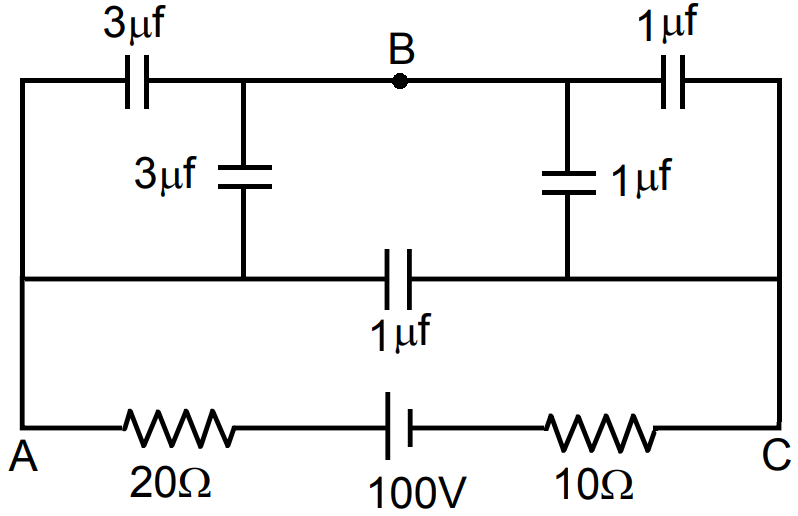
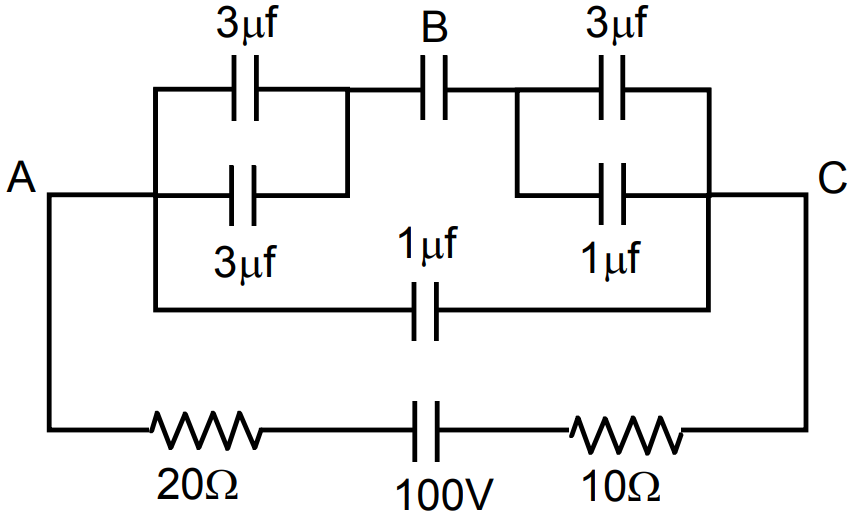
Find the potential difference between the points $A$ and $B$ and between the points $B$ and $C$ of the figure. in steady state.
Answer


$\text{C}_\text{eq}=\big[(3\mu\text{fp}\ 3\mu\text{f})\text{s}(1\mu\text{f p}1\mu\text{f})\big]\text{p}(1\mu\text{f})$
$=\big[(3+3)\mu\text{f s}(2\mu\text{f})\big]\text{p}1\mu\text{f}$
$=\frac{3}{2}+1=\frac{5}{2}\mu\text{f}$
$\text{V}=100\text{V}$
$\text{Q}=\text{CV}=\frac{5}{2}\times100=250\mu\text{c}$
Charge stored across $1\mu\text{f}$ capacitor $=100\mu\text{C}$
$C_{eq}$ between $A$ and $B$ is $=6\mu\text{f}=\text{C}$
Potential drop across $\text{AB}=\text{V}=\frac{\text{Q}}{\text{C}}=25\text{V}$
Potential drop across $BC = 75V$.

Need a full question paper?

Generate a complete, print-ready paper with questions like this in minutes — across 16+ boards, with answer keys.
Start Generating Free

Similar questions

In an experiment with a potentiometer $, VB = 10V. R$ is adjusted to be $50\Omega ($Fig.$)$. A student wanting to measure voltage $E_1$ of a battery $($approx. $8V)$ finds no null point possible. He then diminishes $R$ to $10\Omega$ and is able to locate the null point on the last $(4^{th})$ segment of the potentiometer. Find the resistance of the potentiometer wire and potential drop per unit length across the wire in the second case.
The count rate of nuclear radiation coming from a radiation coming from a radioactive sample containing $^{128}I$ varies with time as follows.
Time $t($minute$):$ $0$ $25$ $50$ $75$ $100$
Ctount rate $R(10^9s^{-1}):$ $30$ $16$ $8.0$ $3.8$ $2.0$
  1. Plot In $\Big(\frac{\text{R}_0}{\text{R}}\Big)$ against $t.$
  2. From the slope of the best straight line through the points, find the decay constant $\lambda.$
  3. Calculate the half-life $\text{t}_{\frac{1}{2}}.$
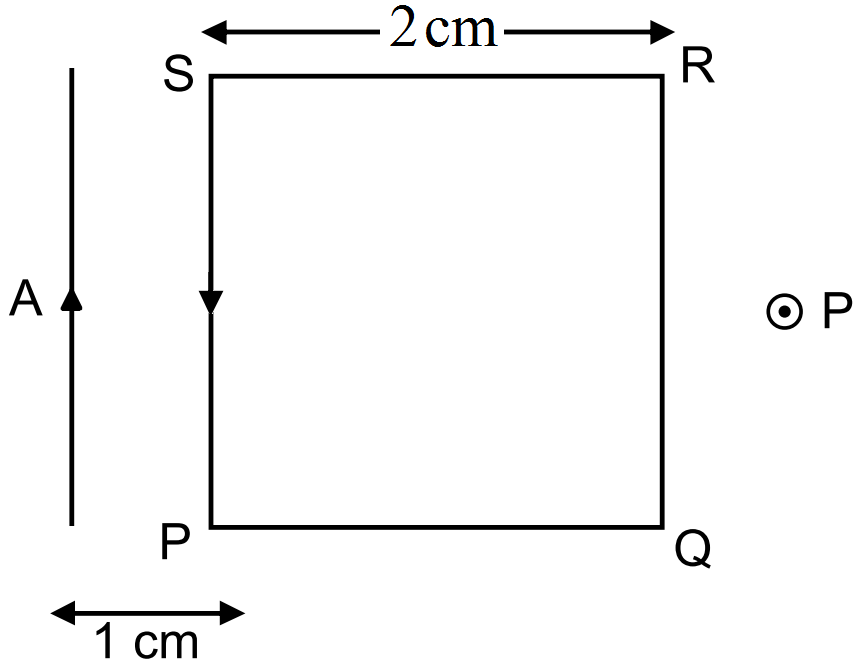
A square loop PQRS carrying a current of 6.0A is placed near a long wire carrying 10A as shown in figure.
  1. Show that the magnetic force acting on the part PQ is equal and opposite to that on the part RS. 
  2. Find the magnetic force on the square loop.
Two heaters are marked 200V, 300W and 200V, 600W. If the heaters are connected in series and the combination connected to a 200V dc supply, which heater will produce more heat?
Calculate the smallest wavelength of radiation that may be emitted by $(a)$ hydrogen$, (b) He^+$ and $(c) Li^{++}$​​​​​​​
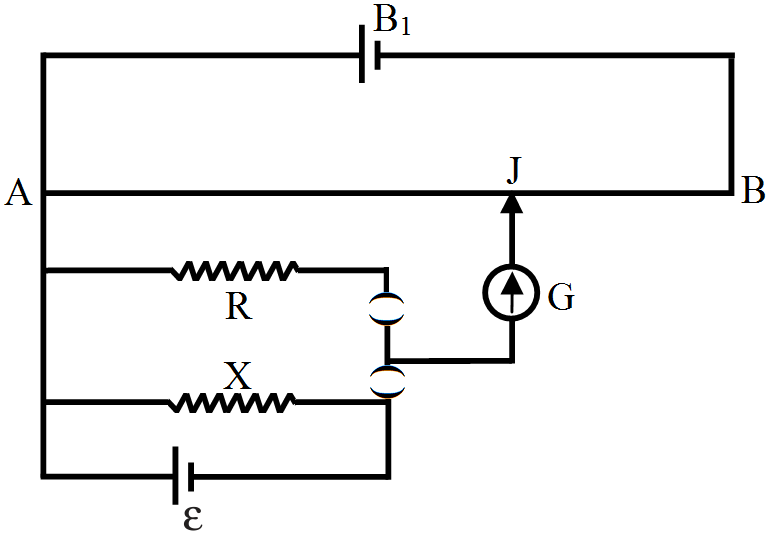
Figure shows a potentiometer circuit for comparison of two resistances. The balance point with a standard resistance $\text{R}=10.0\Omega$ is found to be $58.3\ cm,$ while that with the unknown resistance $X$ is $68.5\ cm$. Determine the value of $X$. What might you do if you failed to find a balance point with the given cell $\varepsilon.$
The activity R of an unknown radioactive nuclide is measured at hourly intervals. The results found are tabulated as follows:
t(h) 0 1 2 3 4
R(MBq) 100 35.36 12.51 4.42 1.56
  1. Plot the graph of R versus t and calculate half-life from the graph.
  2. Plot the graph of 0 ln $\Big(\frac{\text{R}}{\text{R}_0}\Big)$ versus t and obtain the value of half-life from the graph.
When a p-n junction is reverse-biased, the current becomes almost constant at $25\mu\text{A}.$ When it is forwardbiased at 200mV, a current of $75\mu\text{A}$ is obtained. Find the magnitude of diffusion current when the diode is,
  1. Unbiased.
  2. Reverse-biased at 200mV.
  3. Forward-biased at 200mV.
Radiation coming from transition $n = 2$ to $n = 1$ of hydrogen atoms falls on helium ions in $n = 1$ and $n = 2$ states. What are the possible transitions of helium ions as they absorbs energy from the radiation?
An $X-$ray tube operates at $40kV.$ Suppose the electron converts $70\%$ of its energy into a photon at each collision. Find the lowest there wavelengths emitted from the tube. Neglect the energy imparted to the atom with which the electron collides.