Question
When a p-n junction is reverse-biased, the current becomes almost constant at $25\mu\text{A}.$ When it is forwardbiased at 200mV, a current of $75\mu\text{A}$ is obtained. Find the magnitude of diffusion current when the diode is,
  1. Unbiased.
  2. Reverse-biased at 200mV.
  3. Forward-biased at 200mV.

Answer

  1. $\text{i}_1=25\mu\text{A},\text{V}=200\text{mV},\text{i}_2=75\mu\text{A}$
When in unbiased condition drift current = diffusion current
$\therefore$ Diffusion current $=25\mu\text{A}.$
  1. On reverse biasing the diffusion current becomes ‘O’.
  2. On forward biasing the actual current be x.
x - Drift current = Forward biasing current
$\Rightarrow\text{x}-25\mu\text{A}=75\mu\text{A}$
$\Rightarrow\text{x}=(75+25)\mu\text{A}=100\mu\text{A}.$

Need a full question paper?

Generate a complete, print-ready paper with questions like this in minutes — across 16+ boards, with answer keys.

Start Generating Free

Similar questions

A parallel-plate capacitor of plate area A and plate separation d is charged to a potential difference V and then the battery is disconnected. A slab of dielectric constant K is then inserted between the plates of the capacitor so as to fill the space between the plates. Find the work done on the system in the process of inserting the slab.
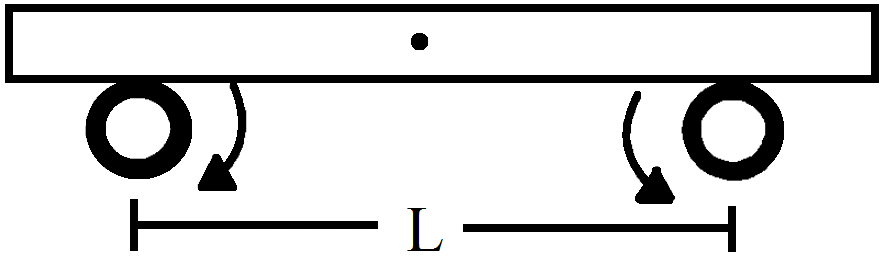
A uniform plate of mass $M$ stays horizontally and symmetrically on two wheels rotating in opposite directions figure The separation between the wheels is $L.$ The friction coefficient between each wheel and the plate is $N.$ Find the time period of oscillation of the plate if it is slightly displayed along its length and released.
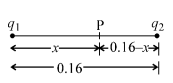
Two charges of$5 \times 10^{-8} C$ and $-3 \times 10^{-8}$ are located at a distance of 16 cm apart. At what point on the line joining the two charges is the electric potential zero? Take the potential at infinity to be zero.
Image
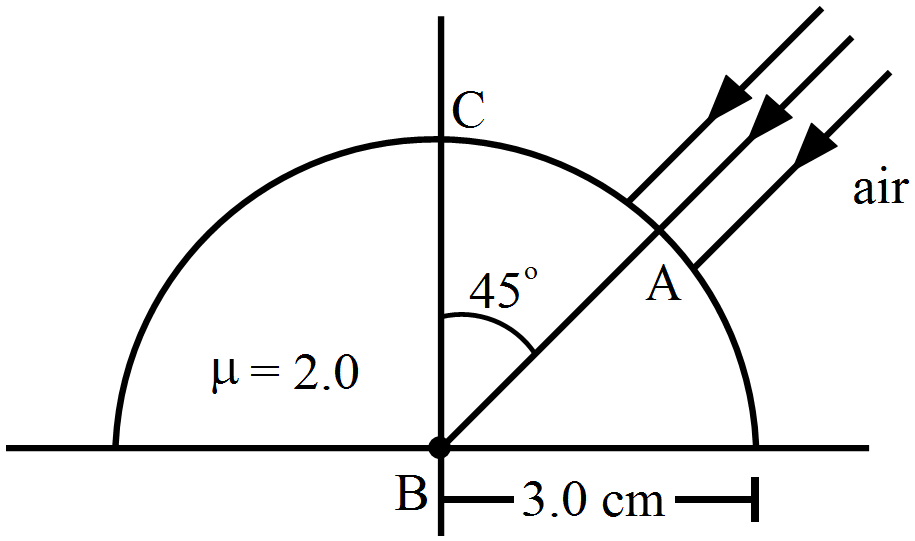
Figure shows a transparent hemisphere of radius 3.0cm made of a material of refractive index 2.0.
  1. A narrow beam of parallel rays is incident on the hemisphere as shown in the figure. Are the rays totally reflected at the plane surface?
  2. Find the image formed by the refraction at the first surface.
  3. Find the image formed by the reflection or by the refraction at the plane surface.
  4. Trace qualitatively the final rays as they come out of the hemisphere.
Explain with the help of a diagram the formation of depletion region and barrier potential in a $p-n$ junction diode.
A gas is initially at a pressure of $100\ kPa$ and its volume is $2.0m^3.$ Its pressure is kept constant and the volume is changed from $2.0m^3$ to $2.5m^3.$ Its volume is now kept constant and the pressure is increased from $100\ kPa$ to $200\ kPa.$ The gas is brought back to its initial state, the pressure varying linearly with its volume.
  1. Whether the heat is supplied to or extracted from the gas in the complete cycle?
  2. How much heat was supplied or extracted?
Sometimes a radioactive nucleus decays into a nucleus which itself is radioactive. An example is:
$^{38}\text{Sulphur}\xrightarrow [=2.48\text{h}]{\text{half-life}}\ \ ^{38}\text{Cl}\ \xrightarrow[=0.62\text{h}]{\text{half-life}}\ ^{38}\text{Ar}(\text{stable})$
Assume that we start with $1000^{38}S$ nuclei at time $t = 0$. The number of ${38}Cl$ is of count zero at $t = 0$ and will again be zero at $t = \infty$ . At what value of $t,$ would the number of counts be a maximum?
A train running at 108km/h towards east whistles at a dominant frequency of 500Hz. Speed of sound in air is 340m/s.
  1. What frequency will a passenger sitting near the open window hear?
  2. What frequency will a person standing near the track hear whom the train has just passed?
  3. A wind starts blowing towards east at a speed f 36km/h. Calculate the frequencies heard by the passenger in the train and by the person standing near the track.
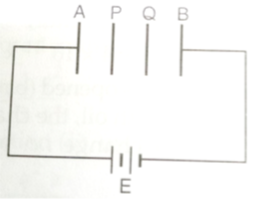
Two parallel metal plates P and Q are inserted at equal distances into a plane capacitor as shown in fig. Plates A and B of the capacitor are connected to a battery of e.m.f. V.
a. What are the potentials of the four plates?
Image
a. What are the potentials of the four plates?
b. How will the potentials of plates P and Q and the intensities of the fields in each of the three spaces change after plates P and Q have been connected by a wire?
c..What will happen to the charges on plates A and B, when plates P and Q are connected with a wire?
d. Will there be charges on the plates P and Q after connecting them with a wire?
Prove that due to a charged layer of infinite expansion, the value of the electric field at any point near it does not depend on the area of the surface and the distance from the layer . i.e., the electric field remains uniform at points near the layer.###Write Gauss'law.By applying this rule,find the value of the electric field due to a uniformly charged infinite plane sheet at any point near the sheet.