Question
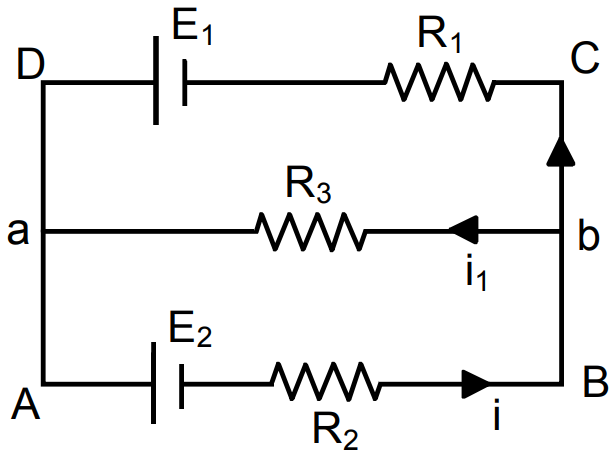
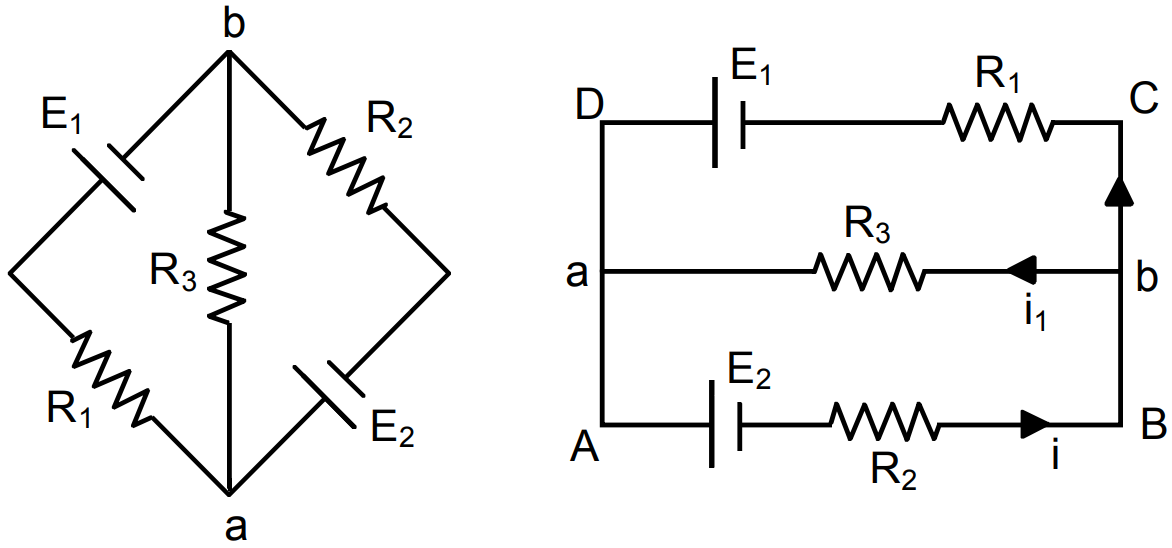
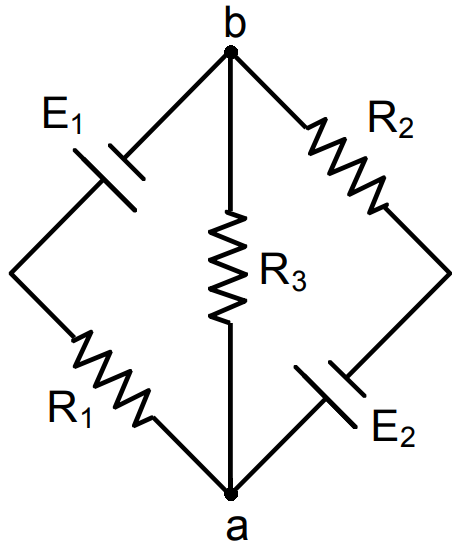
Find the potential difference $V_a - V_b$ in the circuits shown in figure.

Answer

  1. In circuit$, AB$ ba $A$

$\text{E}_2+\text{iR}_2+\text{i}_1\text{R}_3=0$
In circuit, $\text{i}_1\text{R}_3+\text{E}_1-(\text{i}-\text{i}_1)\text{R}_1=0$
$\Rightarrow\text{i}_1\text{R}_3+\text{E}_1-\text{iR}_1+\text{i}_1\text{R}_1=0$
$[\text{iR}_2+\text{i}_1\text{R}_3\ \ \ \ \ \ \ \ \ \ \ \ \ \ \ \ \ \ \ \ \ \ =-\text{E}_2]\text{R}_1$
$[\text{iR}_2-\text{i}_1(\text{R}_1+\text{R}_3)\ \ \ \ \ \ \ \ \ =\text{E}_1]\text{R}_2$
$\underline{\ \ \ \ \ \ \ \ \ \ \ \ \ \ \ \ \ \ \ \ \ \ \ \ \ \ \ \ \ \ \ \ \ \ \ \ \ \ \ \ \ \ \ \ \ \ \ \ \ \ \ \ \ \ \ \ \ }$
$\text{iR}_2\text{R}_1+\text{i}_1\text{R}_3\text{R}_1\ \ \ \ \ \ \ \ \ \ \ \ \ =-\text{E}_2\text{R}_1$
$\text{iR}_2\text{R}_1-\text{i}_1\text{R}_2(\text{R}_1+\text{R}_3)=\ \ \ \text{E}_1\text{R}_2$
$\underline{ \ \ \ \ \ \ \ \ \ \ \ \ \ \ \ \ \ \ \ \ \ \ \ \ \ \ \ \ \ \ \ \ \ \ \ \ \ \ \ \ \ \ \ \ \ \ \ \ \ \ \ \ \ \ \ \ \ }$
$\text{iR}_3\text{R}_1+\text{i}_1\text{R}_2\text{R}_1+\text{i}_1\text{R}_2\text{R}_3=\text{E}_1\text{R}_2-\text{E}_1\text{R}_1$
$\Rightarrow\text{i}_1(\text{R}_3\text{R}_1+\text{R}_2\text{R}_1+\text{R}_2\text{R}_3)=\text{E}_1\text{R}_2-\text{E}_2\text{R}_1$
$\Rightarrow\text{i}_1=\frac{\text{E}_1\text{R}_2-\text{E}_2\text{R}_1}{\text{R}_3\text{R}_1+\text{R}_2\text{R}_1+\text{R}_2\text{R}_3}$
$\Rightarrow\frac{\text{E}_1\text{R}_2\text{R}_3-\text{E}_2\text{R}_1\text{R}_3}{\text{R}_3\text{R}_1+\text{R}_2\text{R}_1+\text{R}_2\text{R}_3}=\Bigg(\frac{\frac{\text{E}_1}{\text{R}_1}-\frac{\text{E}_2}{\text{R}_2}}{\frac{1}{\text{R}_2}+\frac{1}{\text{R}_1}+\frac{1}{\text{R}_3}}\Bigg)$
  1. $\therefore$ Same as a

Need a full question paper?

Generate a complete, print-ready paper with questions like this in minutes — across 16+ boards, with answer keys.
Start Generating Free

Similar questions

Two blocks of masses $10\ kg$ and $30\ kg$ are placed along a vertical line. The first block is raised through a height of $7\ cm.$ By what distance should the second mass be moved to raise the centre of mass by $1\ cm$?
ls it always true that for two sources of equal intensity, the number of photons emitted in a given time are equal?
Show that the ratio of the magnetic dipole moment to the angular momentum (l = mvr) is a universal constant for hydrogen-like atoms and ions. Find its value.
For a given position of an object, an equiconvex lens forms its real image at a distance of 60cm from the lens. A convex mirror is now kept in between this image position and the convex lens. The final image formed by this combination coincides with the object when the distance between the convex lens and the convex mirror equals 25cm. Calculate the radius of curvature of the convex mirror.
$i$. Using Bohr's second postulate of quantisation of orbital angular momentum show that the circumference of the electron in the nth orbital state in hydrogen atom is $n-$ times the de $-$ Broglie wavelength associated with it.
$ii.$ The electron in hydrogen atom is initially in the third excited state. What is the maximum number of spectral lines which can be emitted when it finally moves to the ground state?
  1. Write an expression of magnetic moment associated with a current (I) carrying circular coil of radius r having N turns.
  2. Consider the above mentioned coil placed in YZ plane with its centre at the origin. Derive expression for the value of magnetic field due to it at point (x, 0, 0).
A parallel$-$plate capacitor having plate area $25\ cm^2$ and separation $1.00\ mm$ is connected to a battery of $6.0V.$ Calculate the charge flown through the battery. How much work has been done by the battery during the process?
A uranium reactor develops thermal energy at a rate of $300\ MW$. Calculate the amount of $^{235}U$ being consumed every second. Average released per fission is $200\ MeV$.
A semicircular wire has a length $L$ and mass $M.A$ particle of mass $m$ is placed at the centre of the circle. Find the gravitational attraction on the particle due to the wire.
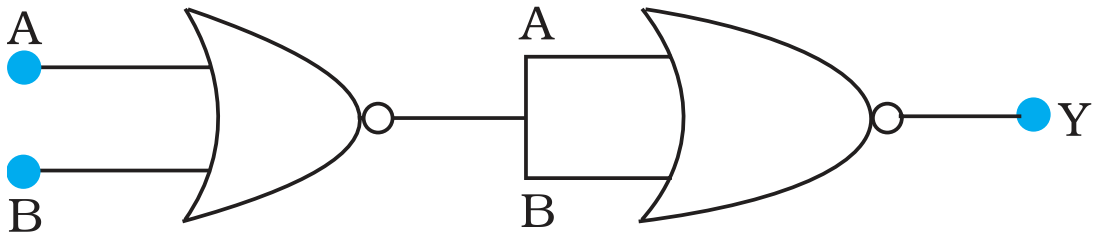
Write the truth table for circuit given in Fig. 14.47 below consisting of NOR gates and identify the logic operation (OR, AND, NOT) which this circuit is performing.
(Hint: A = 0, B = 1 then A and B inputs of second NOR gate will be 0 and hence Y=1. Similarly work out the values of Y for other combinations of A and B. Compare with the truth table of OR, AND, NOT gates and find the correct one.)