Question
$i$. Using Bohr's second postulate of quantisation of orbital angular momentum show that the circumference of the electron in the nth orbital state in hydrogen atom is $n-$ times the de $-$ Broglie wavelength associated with it.
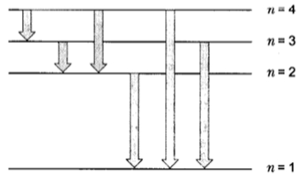
$ii.$ The electron in hydrogen atom is initially in the third excited state. What is the maximum number of spectral lines which can be emitted when it finally moves to the ground state?
Answer

$i$. Only those orbits are stable for which the angular momentum of revolving electron is an integral multiple of $\left(\frac{h}{2 \pi}\right)$ where $h$ is the planck's constant.
According to Bohr's second postulate
$m v r_n=n \frac{h}{2 \pi} $
$\Rightarrow 2 \pi r_n=\frac{n h}{m v}$
$\text { But } \frac{h}{m v}=\frac{h}{p}=\lambda \ ($By de Broglie hypothesis$)$
$\therefore 2 \pi r_n=n \lambda$
$ii$. For third excited state $ ,n = 4$
For ground state $,n = 1$
Hence possible transitions are
$ n _{ i }=4 $ to $ n _{ f }=3,2,1$
$n _{ i }=3 $  to $n _{ f }=2,1$
$n _{ i }=2 $ to $ n _{ f }=1$
Image
Total number of transitions $= 6$
$ E _C- E _{ R }=\frac{h c}{\lambda_1} \ldots( i )$
$E _{ B }- E _{ A }=\frac{h c}{\lambda_2} \ldots \text { (ii) }$
$E _{ C }- E _{ A }=\frac{h c}{\lambda_a} \ldots \text { (iii) }$
Adding $(i)$ and $(ii),$ we have
$E _{ C }- E _{ A }=\frac{h c}{\lambda_1}+\frac{h c}{\lambda_2} \ldots (iv)$
From $(iii)$ and $(iv),$ we have
$\frac{h c}{\lambda_3}=\frac{h c}{\lambda_1}+\frac{h c}{\lambda_2} $
$\Rightarrow \frac{1}{\lambda_3}=\frac{1}{\lambda_1}+\frac{1}{\lambda_2}$
$\lambda_3=\frac{\lambda_1 \lambda_2}{\lambda_1+\lambda_2}$


Need a full question paper?

Generate a complete, print-ready paper with questions like this in minutes — across 16+ boards, with answer keys.

Start Generating Free

Similar questions

Define the terms half$-$life period and decay constant of a radioactive substance. Write their $S.I.$ units. Establish the relationship between the two.
The magnetic field of a beam emerging from a filter facing a floodlight is given by $B_0 = 12 \times 10^{-8}\sin (1.20 \times 10^7z - 3.60 \times 10^{15}t) T.$ What is the average intensity of the beam?
  1. State Ampere's circuital law, expressing it in the integral form.
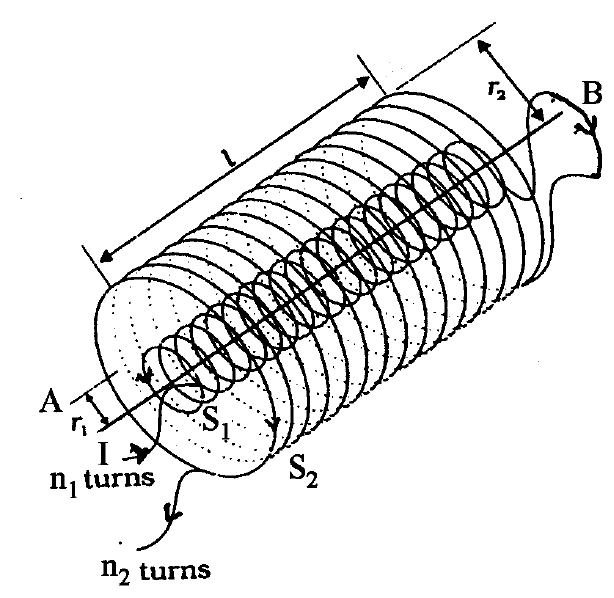
  2. Two long coaxial insulated solenoids$, S_1$ and $S_2$ of equal lengths are wound one over the other as shown in the figure. A steady current $"I"$ flow through the inner solenoid $S_1$ to the other end $B,$ which is connected to the outer solenoid $S_2$ through which the same current $"I"$ flows in the opposite direction so as to come out at end $A$. If $n_1$ and $n_2$ are the number of terms per unit length, find the magnitude and direction of the net magnetic field at a point $(i)$ inside on the axis and $(ii)$ outside the combined system.
  1. Obtain the expression for the cyclotron frequency.
  2. A deuteron and a proton are accelerated by the cyclotron. Can both be accelerated with the same oscillator frequency? Give reason to justify your answer.
What do you mean by resolving limit of a telescope ? What will be the resolving limit of a telescope whose objective has aperture of 5 m if the wavelength of the light is 5000 Å ?
A particle is subjected to two simple harmonic motions of same time period in the same direction. The amplitude of the first motion is 3.0cm and that of the second is 4.0cm. Find the resultant amplitude if the phase difference between the motions is:
  1. 60°
  2. 90°
A proton is projected with a velocity of $3 \times 10^6 ms^{-1}$ perpendicular to a uniform magnetic field of $0.6T$. Find the acceleration of the proton.
$a$. Draw the energy level diagram for the line spectra representing Lyman series and Balmer series in the spectrum of hydrogen atom.
$b$. Using the Rydberg formula for the spectrum of hydrogen atom, calculate the largest and shortest wavelengths of the emission lines of the Balmer series in the spectrum of hydrogen atom. $($Use the value of Rydberg constant $\left.R =1.1 \times 10^7 m^{-1}\right)$
It is sometimes heard that inertial frame of reference is only an ideal concept and no such inertial frame actually exists. Comment.
  1. Draw a schematic diagram of a reflecting telescope.
  2. State the advantages of reflecting telescope over refracting telescope.