Question
Find the remainder obtained on dividing $p(x) = x^3 + 1 by x + 1.$
Answer

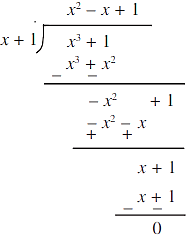
By long division,we have,

Therefore, remainder is $0.$
Here $p(x) = x^3 + 1$, and the root of $x + 1 = 0$ is $x = –1.$ We have,
$p(–1) = (–1)^3 + 1$
$= –1 + 1 = 0,$
which is equal to the remainder obtained by actual division.

Need a full question paper?

Generate a complete, print-ready paper with questions like this in minutes — across 16+ boards, with answer keys.
Start Generating Free

Similar questions

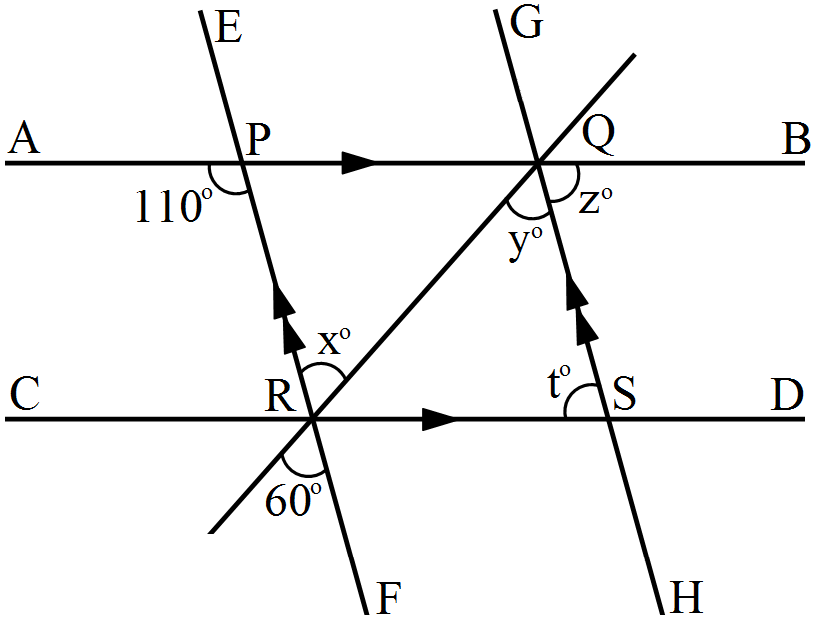
In the given figure, $AB\ ||\ CD$ and $EF\ ||\ GH$. Find the value of $x, y, z$ and $t.$
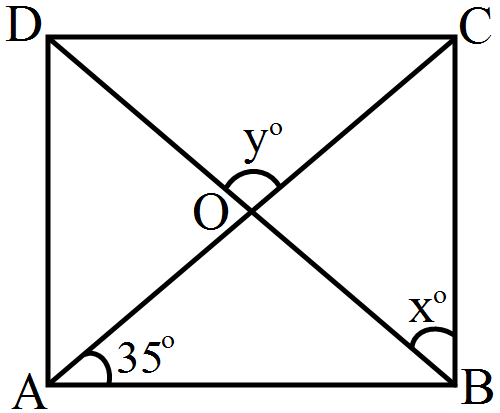
In each of the figures given below, $ABD$ is a rectangle. Find the values of $x$ and $y$ in each case.
The following data gives the value $($in crores of rupees$)$ of the Indian export of cotton textiles for different years:
Years $1982–83$ $1983–84$ $1984–85$ $1985–86$ $1986–87$
Value of exports of cotton textiles $($in crores of rupees$)$ $300$ $325$ $475$ $450$ $550$
Represent the above data with the help of a bar graph. Indicate with the help of a bar graph the year in which the rate of increase in exports is maximum over the preceding year.
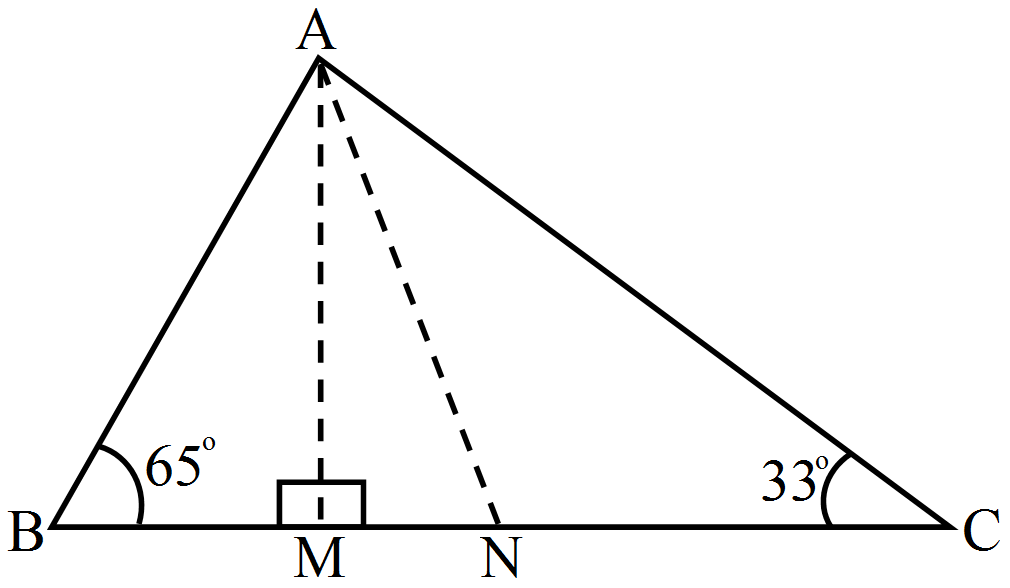
In Fig. $\text{AM}\perp\text{BC}$ and $AN$ is the bisector of $\angle\text{A}.$ If $\angle\text{B}=65^\circ$ and $\angle\text{C}=33^\circ,$ find $\angle\text{MAN}.$
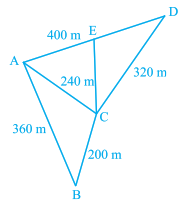
Kamla has a triangular field with sides $240 \ m, 200 \ m, 360 \ m$, where she grew wheat. In another triangular field with sides $240 \ m, 320 \ m, 400 \ m$ adjacent to the previous field, she wanted to grow potatoes and onions.
She divided the field in two parts by joining the mid-point of the longest side to the opposite vertex and grew potatoes in one part and onions in the other part. How much area (in hectares) has been used for wheat, potatoes and onions? [$1$ hectare $= 1000 m^2,$ $\sqrt{2} = 1.41]$
The factors of $x^3 - 1 + y^3 + 3xy$ are :
If both $(x - 2)$ and $\Big(\text{x}-\frac{1}{2}\Big)$ are factors of $px^2 + 5x + r$, prove that $p = r.$
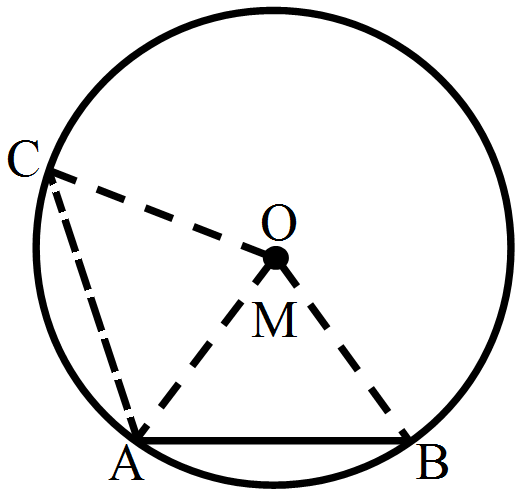
In the adjoining figure, $AB$ and $AC$ are two equal chords of a circle with centre $O$. Show that $O$ lies on the bisector of $\angle\text{BAC}.$
In a parallelogram $PQRS, PQ = 12\ cm$ and $PS = 9\ cm$. The bisector of $\angle\text{P}$ meets $SR$ in $M$. $PM$ and $QR$ both when produced meet at $T$. Find the length of $RT$.
In the given figure, $ABC$ is an equilateral triangle; $PQ\ ||\ AC$ and $AC$ is produced to $R$ such that $CR = BP$. Prove that $QR$ bisects $PC$.