Question
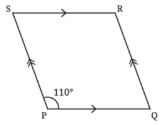
Find the remaining angles in the following quadrilaterals.
Image

Answer

Here $PQ \| SR$, and $PS \| QR$
$\therefore PQRS$ is a parallelogram.
$\angle P =\angle R =110^{\circ}$ $\qquad$ (Opposite angles of a parallelogram are equal)
$\angle P +\angle S =180^{\circ}$ $\qquad$ (The sum of the adjacent angles of a parallelogram is $180^{\circ}$ )
$110^{\circ}+\angle S =180^{\circ}$
$\angle S =180^{\circ}-110^{\circ}$
$\angle S =70^{\circ}$.
$\angle S =\angle Q =70^{\circ}$ $\qquad$ (Opposite angles of a parallelogram are equal)

Need a full question paper?

Generate a complete, print-ready paper with questions like this in minutes — across 16+ boards, with answer keys.

Start Generating Free

Similar questions

Evaluate the following: $\Big\{(5^2+12^2)^{\frac{1}{2}}\Big\}^3$
A boy is cycling such that the wheels of the cycle are making $140$ revolutions per hour. If the diameter of the wheel is $60\ cm$, calculate the speed in km/h with which the boy is cycling.
If a box of sweets is divided among $24$ children, they will get $5$ sweets each. How many would each get, if the number of the children is reduced by $4?$
In which of the following case do the quantities vary directly with each other?
(i)
x0.52832
y2832128
(ii)
p$1^2$$2^2$$3^2$$4^2$
q$1^3$$2^3$$3^3$$4^3$
A square and a rectangle have the same perimeter. Calculate the area of the rectangle is the side of the square is 60 cm and the length of the rectangle is 80 cm .
Factorise: $m^4- 256$
A bag contains $5$ red marbles, $8$ white marbles, $4$ green marbles. What is the probability that if one marble is taken out of the bag at random, it will be
$i.$ red
$ii.$ white
$iii.$ not green
Find the values of the following expressions:
$16 x^2+24 x+9 $, when $ \text{x}=\frac{7}{4}$
Write the quotient and remainder when we divide: $\left(5 x^3-12 x^2+12 x+13\right)$ by $\left(x^2-3 x+4\right)$
The floor of a bullding consists of 3000 tiles, which are rhombus shaped and each of its diagonals are 45 cm and 30 cm In length. Find the total cost of polishing the floor, if the cost per $m ^2$ is ₹ 4 .
TIPS Firstly, find the area of floor by multiplying area of one tile with total number of tiles. Then, multiply area of floor by cost per $m^2$ to get total cost of polishing.