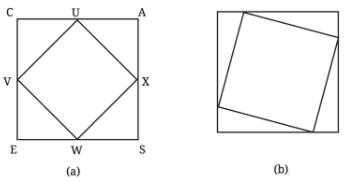
CASE is a square. The points U, V, W and X are the midpoints of the sides of the square. What type of quadrilateral is UVWX? Find this by using geometric reasoning, as well as by construction and measurement. Find other ways of constructing a square within a square such that the vertices of the inner square lie on the sides of the outer square, as shown in Figure (b).
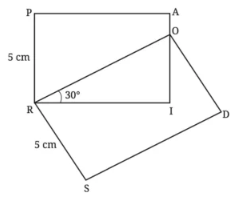
If PAIR and RODS are two rectangles, find $\angle I O D$.
Answer
Since PAIR and RODS are two triangles. $\angle RIO =90^{\circ}$ $\qquad$ (Corner angle of a rectangle) In $\triangle RIO$, $\angle IRO +\angle IOR +\angle RIO =180^{\circ}$ $\qquad$ (Sum of angles of a triangle) $30^{\circ}+\angle IOR +90^{\circ}=180^{\circ}$ $120^{\circ}+\angle IOR =180^{\circ}$ $\angle IOR =180^{\circ}-120^{\circ}=60^{\circ}$. $\therefore \angle IOD =90^{\circ}-\angle IOR =90^{\circ}-60^{\circ}=30^{\circ}$.
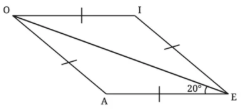
Find the remaining angles in the following quadrilaterals.
Answer
Here, AEIO is a rhombus (all sides equal). In $\triangle E A O, A E=A O$, then the angles opposite them are equal. $\begin{array}{l}\therefore \angle AOE=\angle AEO=20^{\circ} \\\angle AEO=\angle IEO=20^{\circ} \ldots \ldots \ldots \ldots .\end{array}$ (The diagonals of a rhombus bisect its angles) Also, $\angle AOE =\angle IOE =20^{\circ}$ $\qquad$ (The diagonals of a rhombus bisect its angles) $\begin{array}{l}\angle E=2 \times \angle A E O=2 \times 20^{\circ}=40^{\circ} \\\angle E=\angle O=40^{\circ} \ldots \ldots \ldots . . \text { (Opposite angles of a rhombus are equal) } \\\angle E+\angle A=180^{\circ} \ldots \ldots \ldots . . \text { (The sum of adjacent angles of a rhombus is } 180^{\circ} \text { ) } \\40^{\circ}+\angle A=180^{\circ} \\\angle A=180^{\circ}-40^{\circ} \\\angle A=140^{\circ} \\\angle A=\angle I=140^{\circ} \ldots \ldots \ldots . . \text { (Opposite angles of a rhombus are equal) }\end{array}$
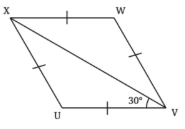
Find the remaining angles in the following quadrilaterals.
Answer
Here, XWUV is a rhombus (all sides equal). In $\triangle VUX , UV = UX$, then the angles opposite them are equal. $\begin{array}{l}\therefore \angle U X V=\angle U V X=30^{\circ} \\\angle U X V=\angle W X V=30^{\circ} \ldots\end{array}$ $\qquad$ (The diagonals of a rhombus bisect its angles) Also, $\angle UVX =\angle WVX =30^{\circ}$ $\qquad$ (The diagonals of a rhombus bisect its angles) $\begin{array}{l}\angle E=2 \times \angle UVX=2 \times 30^{\circ}=60^{\circ} \\\angle V=\angle X=60^{\circ} \ldots \ldots \ldots . . \text { (Opposite angles of a rhombus are equal) } \\\angle V+\angle U=180^{\circ} \ldots \ldots \ldots . . \text { (The sum of adjacent angles of a rhombus is } 180^{\circ} \text { ) } \\ 60^{\circ}+\angle U=180^{\circ} \\\angle U=180^{\circ}-60^{\circ} \\\angle U=120^{\circ} \\\angle U=\angle W=120^{\circ} \ldots \ldots \ldots . . \text { (Opposite angles of a rhombus are equal) }\end{array}$
Find the remaining angles in the following quadrilaterals.
Answer
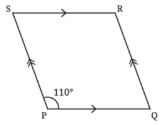
Here $PQ \| SR$, and $PS \| QR$ $\therefore PQRS$ is a parallelogram. $\angle P =\angle R =110^{\circ}$ $\qquad$ (Opposite angles of a parallelogram are equal) $\angle P +\angle S =180^{\circ}$ $\qquad$ (The sum of the adjacent angles of a parallelogram is $180^{\circ}$ ) $110^{\circ}+\angle S =180^{\circ}$ $\angle S =180^{\circ}-110^{\circ}$ $\angle S =70^{\circ}$. $\angle S =\angle Q =70^{\circ}$ $\qquad$ (Opposite angles of a parallelogram are equal)
Find the remaining angles in the following quadrilaterals.
Answer
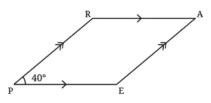
Here $P R \| E A$, and $P E \| R A$ Therefore, PEAR is a parallelogram. $\angle P =\angle A =40^{\circ}$ $\qquad$ (Opposite angles of a parallelogram are equal) $\angle P +\angle R =180^{\circ}$ $\qquad$ (The sum of the adjacent angles of a parallelogram is $180^{\circ}$ ) $\begin{array}{l}40^{\circ}+\angle R=180^{\circ} \\\angle R=180^{\circ}-40^{\circ} \\\angle R=140^{\circ} . \\\angle R=\angle E=140^{\circ} .\end{array}$$\qquad$ (Opposite angles of a parallelogram are equal)