Question
Find the shortest distance between the lines $I_1$ and $l_2$
$\vec{r}=(-\hat{\imath}-\hat{\jmath}-\hat{k})+\lambda(7 \hat{\imath}-6 \hat{\jmath}+\hat{k})$ and $\vec{r}=(3 \hat{\imath}+5 \hat{\jmath}+7 \hat{k})+\mu(\hat{\imath}-2 \hat{\jmath}+\hat{k})$where $\lambda$ and $\mu$ are parameters.
Answer

Image
Given that equation of lines are
$\vec{r} =(-\hat{\imath}-\hat{\jmath}-\hat{k})+\lambda(7 \hat{\imath}-6 \hat{\jmath}+\hat{k})\ldots(i)$
$\vec{r} =(3 \hat{\imath}+5 \hat{\jmath}+7 \hat{k})+\mu(\hat{\imath}-2 \hat{\jmath}+\hat{k})\ldots(ii)$
The given lines are non-parallel lines as vectors $7 \hat{\imath}-6 \hat{\jmath}+\hat{k}$ and $\hat{\imath}-2 \hat{\jmath}+\hat{k}$ are not parallel.
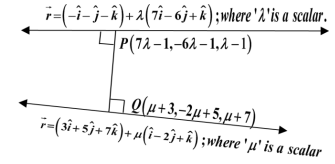
There is a unique line segment $P Q\ ( P$ lying on line $(i)$ and $Q$ on the other line $(i i) ),$ which is at right angles to both the lines $P Q$ is the shortest distance between the lines.
Hence, the shortest possible distance between the lines $=P Q$.
Let the position vector of the point $P$ lying on the line $r=(-\hat{\imath}-\hat{\jmath}-\hat{k})+\lambda(7 \hat{\imath}-6 \hat{\jmath}+\hat{k})$ where ' $\lambda$ ' is a scalar, is $(7 \lambda-1) \hat{\imath}-(6 \lambda+1) \hat{\jmath}+(\lambda-1) \hat{k}$, for some $\lambda$ and the position vector of the point $Q$ lying on the line $r=(3 \hat{\imath}+5 \hat{\jmath}+7 \hat{k})+\mu(\hat{\imath}-2 \hat{\jmath}+\hat{k})$ where $'\mu\ ^{\prime}$ is a scalar, is $(\mu+3) \hat{\imath}+(-2 \mu+5) \hat{\jmath}+(\mu+7) \hat{k}$, for some $\mu$.
Now, the vector
$\overline{P Q}=\overline{O Q}-\overline{O P}=(\mu+3-7 \lambda+1) \hat{\imath}+(-2 \mu+5+6 \lambda+1) \hat{\jmath}+(\mu+7-\lambda+1) \hat{k}$
i.e., $\overline{P Q}=(\mu-7 \lambda+4) \hat{\imath}+(-2 \mu+6 \lambda+6) \hat{\jmath}+(\mu-\lambda+8) \hat{k}; ($where $'O\ '$ is the origin$),$ is perpendicular to both the lines, so the vector $\overline{P Q}$ is perpendicular to both the vectors $7 \hat{\imath}-6 \hat{\jmath}+\hat{k}$ and $\hat{\imath}-2 \hat{\jmath}+\hat{k}$.
$\Rightarrow(\mu-7 \lambda+4) \cdot 7+(-2 \mu+6 \lambda+6) \cdot(-6)+(\mu-\lambda+8) \cdot 1=0$
$\ (\mu-7 \lambda+4) \cdot 1+(-2 \mu+6 \lambda+6) \cdot(-2)+(\mu-\lambda+8) \cdot 1=0$
$\Rightarrow 2 0 \mu- 8 6 \lambda= 0$
$\Rightarrow 1 0 \mu- 4 3 \lambda= 0 \ 6 \mu-20 \lambda=0 $
$\Rightarrow 3 \mu-10 \lambda=0$
On solving the above equations, we get $\mu=\lambda=0$
So, the position vector of the points $P$ and $Q$ are $-\hat{\imath}-\hat{\jmath}-\hat{k}$ and $3 \hat{\imath}+5 \hat{\jmath}+7 \hat{k}$ respectively.
$\overline{P Q}=4 \hat{\imath}+6 \hat{\jmath}+8 \hat{k}$ and $|\overline{P Q}|=\sqrt{4^2+6^2+8^2}=\sqrt{116}=2 \sqrt{29}$ units. 

Need a full question paper?

Generate a complete, print-ready paper with questions like this in minutes — across 16+ boards, with answer keys.

Start Generating Free

Similar questions

If $\text{y}=\frac{\text{e}^\text{x}-\text{e}^{-\text{x}}}{\text{e}^{\text{x}}+\text{e}^{-\text{x}}},$ prove that $\frac{\text{dy}}{\text{dx}}=1-\text{y}^2$
Examine the differentiability of f, where f is defined by:
$\text{f(x)}=\begin{cases}1+\text{x},&\text{if x}\leq2\\5-\text{x},&\text{if x}>2\end{cases}$
at x = 2.
Discuss the continuity of the following functions at the indicated point:
$\text{f(x)}=\begin{cases}\frac{\text{x}^\text{x}-1}{\log(1+2\text{x})}&,\text{ if x}\neq0&\\ \ &&\text{at x}=0\\7&,\text{ if x}=0\end{cases}$
Find the differential equation of all the parabolas with latus rectum '4a' and whose axes are parallel to x-axis.
If $\text{A}=\begin{bmatrix}\cos\theta&\text{i}\sin\theta\\\text{i}\sin\theta&\cos\theta\end{bmatrix},$ then prove by principle of mathematical induction that $\text{A}^\text{n}=\begin{bmatrix}\cos\text{n}\theta&\text{i}\sin\text{n}\theta\\\text{i}\sin\text{n}\theta&\cos\text{n}\theta\end{bmatrix}$ for all $\text{n}\in\text{N}.$
Maximum Z = 3x + 4y Subject to$\text{x}+\text{y}\leq30000$
$\text{y}\leq12000$
$\text{x}\geq6000$
$\text{x}\geq\text{y}$
$\text{x},\text{y}\geq0$
Find:
$\int \frac{\cos \theta}{(4 + \sin^{2} \theta) (5 - 4 \cos^{2} \theta)} \text{d} \theta$
$\int\text{e}^{\tan^{-1}\text{x}}\Big(\frac{1+\text{x}+\text{x}^2}{1+\text{x}^2}\Big)\text{dx}$
Evaluate the following integrals:
$\int\limits^{\frac{\pi}{2}}_0\cos^5\text{x dx}$
Solve the following systems of homogeneous linear equations by matrix method: $x + y - z = 0 , x - 2y + z = 0 , 3x + 6y - 5z = 0$