Questions

5 Marks Questions

🎯

Test yourself on this topic

6 questions · timed · auto-graded

Question 15 Marks
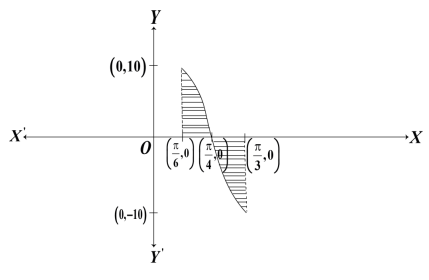
Draw the rough sketch of the curve $y=20 \cos 2 x ;\left(\right.$ where $\left.\frac{\pi}{6} \leq x \leq \frac{\pi}{3}\right)$
Using integration, find the area of the region bounded by the curve $y = 20 \cos2x$ from the ordinates
$x=\frac{\pi}{6}$ to $x=\frac{\pi}{3}$ and the $x-$axis.
Answer
$y=20 \cos 2 x ;\left\{\frac{\pi}{6} \leq x \leq \frac{\pi}{3}\right\}$
Image

$\text { Required area }=20 \int_{\frac{\pi}{6}}^{\frac{\pi}{4}} \cos 2 x d x+\left|20 \int_{\frac{\pi}{4}}^{\frac{\pi}{3}} \cos 2 x d x\right|$
$=20\left[\frac{\sin 2 x}{2}\right]_{\frac{\pi}{6}}^{\frac{\pi}{4}}+\left|20\left[\frac{\sin 2 x}{2}\right]_{\frac{\pi}{4}}^{\frac{\pi}{3}}\right|$
$=10\left(1-\frac{\sqrt{3}}{2}\right)+10\left(1-\frac{\sqrt{3}}{2}\right)=20\left(1-\frac{\sqrt{3}}{2}\right) \text { sq. units. }$
View full question & answer
Question 25 Marks
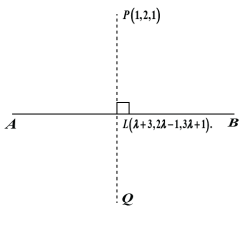
Find the image of the point (1,2,1) with respect to the line$\frac{x-3}{1}=\frac{y+1}{2}=\frac{z-1}{3}$ Also find the equation of the line joining the given point and its image.
View full question & answer
Question 35 Marks
If $(x-a)^2+(y-b)^2=c^2$, for some $c>0$, prove that $\frac{\left[1+\left(\frac{d y}{d x}\right)^2\right]^{\frac{3}{2}}}{\frac{d^2 y}{d x^2}}$ is a constant independent of $a$ and $b$.
Answer
Given relation is $(x-a)^2+(y-b)^2=c^2, c>0$.
Let $x - a = c \cos \theta$ and $y-b=c \sin \theta$.
Therefore, $\frac{d x}{d \theta}=-c \sin \theta$ And $\frac{d y}{d \theta}=c \cos \theta$
$\therefore \frac{d y}{d x}=-\cot \theta$
Differentiate both sides with respect to $\theta$, we get $\frac{d}{d \theta}\left(\frac{d y}{d x}\right)=\frac{d}{d \theta}(-\cot \theta)$$\text { Or, } \frac{d}{d x}\left(\frac{d y}{d x}\right) \frac{d x}{d \theta}=\operatorname{cosec}^2 \theta$
$\text { Or, } \frac{d^2 y}{d x^2}(-c \sin \theta)=\operatorname{cosec}^2 \theta$
$\frac{d^2 y}{d x^2}=-\frac{\operatorname{cosec}^3 \theta}{c}$
$\therefore \frac{\left[1+\left(\frac{d y}{d x}\right)^2\right]^{\frac{3}{2}}}{\frac{d^2 y}{d x^2}}=\frac{c\left[1+\cot ^2 \theta\right]^{\frac{3}{2}}}{-\operatorname{cosec}^2 \theta}=\frac{-c\left(\operatorname{cosec}^2 \theta\right)^{\frac{3}{2}}}{\operatorname{cosec}^3 \theta}=-c,$
which is constant and is independent of $a$ and $b.$
View full question & answer
Question 45 Marks
If $f: R \rightarrow R$ is defined by $f(x)=|x|^3$, show that $f^{\prime \prime}(x)$ exists for all real $x$ and find it.
Answer
We have, $f(x)=|x|^3,\left\{\begin{array}{l}x^3, \text { if } x \geq 0 \\ (-x)^3=-x^3, \text { if } x<0\end{array}\right.$
Now, $( \ce{LHD}$ at $x=0)=\lim _{x \rightarrow 0^{-}} \frac{f(x)-f(0)}{x-0}$
$=\lim _{x \rightarrow 0^{-}}\left(\frac{-x^3-0}{x}\right)$
$= \lim _{x \rightarrow 0^{-}}\left(-x^2\right)=0$
$(\text { RHD}$ at $x =0) \lim _{x \rightarrow 0^{+}} \frac{f(x)-f(0)}{x-0}$
$=\lim _{x \rightarrow 0^{+}}\left(\frac{x^3-0}{x}\right)$
$=\lim _{x \rightarrow 0}\left(-x^2\right)=0$
$\therefore(\operatorname{LHD}$ of $f(x)$ at $x=0)=( \ce{RHD}$ of $f(x)$ at $x=0)$
So, $f(x)$ is differentiable at $x =0$ and the derivative of $f(x)$ is given by
$f^{\prime}(x)=\left\{\begin{array}{l}3 x^2, \text { if } x \geq 0 \\-3 x^2, \text { if } x<0\end{array}\right.$
View full question & answer
Question 55 Marks
Find the shortest distance between the lines $I_1$ and $l_2$
$\vec{r}=(-\hat{\imath}-\hat{\jmath}-\hat{k})+\lambda(7 \hat{\imath}-6 \hat{\jmath}+\hat{k})$ and $\vec{r}=(3 \hat{\imath}+5 \hat{\jmath}+7 \hat{k})+\mu(\hat{\imath}-2 \hat{\jmath}+\hat{k})$where $\lambda$ and $\mu$ are parameters.
Answer
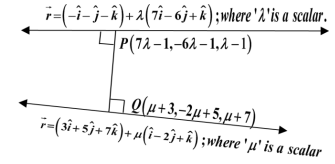
Image
Given that equation of lines are
$\vec{r} =(-\hat{\imath}-\hat{\jmath}-\hat{k})+\lambda(7 \hat{\imath}-6 \hat{\jmath}+\hat{k})\ldots(i)$
$\vec{r} =(3 \hat{\imath}+5 \hat{\jmath}+7 \hat{k})+\mu(\hat{\imath}-2 \hat{\jmath}+\hat{k})\ldots(ii)$
The given lines are non-parallel lines as vectors $7 \hat{\imath}-6 \hat{\jmath}+\hat{k}$ and $\hat{\imath}-2 \hat{\jmath}+\hat{k}$ are not parallel.
There is a unique line segment $P Q\ ( P$ lying on line $(i)$ and $Q$ on the other line $(i i) ),$ which is at right angles to both the lines $P Q$ is the shortest distance between the lines.
Hence, the shortest possible distance between the lines $=P Q$.
Let the position vector of the point $P$ lying on the line $r=(-\hat{\imath}-\hat{\jmath}-\hat{k})+\lambda(7 \hat{\imath}-6 \hat{\jmath}+\hat{k})$ where ' $\lambda$ ' is a scalar, is $(7 \lambda-1) \hat{\imath}-(6 \lambda+1) \hat{\jmath}+(\lambda-1) \hat{k}$, for some $\lambda$ and the position vector of the point $Q$ lying on the line $r=(3 \hat{\imath}+5 \hat{\jmath}+7 \hat{k})+\mu(\hat{\imath}-2 \hat{\jmath}+\hat{k})$ where $'\mu\ ^{\prime}$ is a scalar, is $(\mu+3) \hat{\imath}+(-2 \mu+5) \hat{\jmath}+(\mu+7) \hat{k}$, for some $\mu$.
Now, the vector
$\overline{P Q}=\overline{O Q}-\overline{O P}=(\mu+3-7 \lambda+1) \hat{\imath}+(-2 \mu+5+6 \lambda+1) \hat{\jmath}+(\mu+7-\lambda+1) \hat{k}$
i.e., $\overline{P Q}=(\mu-7 \lambda+4) \hat{\imath}+(-2 \mu+6 \lambda+6) \hat{\jmath}+(\mu-\lambda+8) \hat{k}; ($where $'O\ '$ is the origin$),$ is perpendicular to both the lines, so the vector $\overline{P Q}$ is perpendicular to both the vectors $7 \hat{\imath}-6 \hat{\jmath}+\hat{k}$ and $\hat{\imath}-2 \hat{\jmath}+\hat{k}$.
$\Rightarrow(\mu-7 \lambda+4) \cdot 7+(-2 \mu+6 \lambda+6) \cdot(-6)+(\mu-\lambda+8) \cdot 1=0$
$\ (\mu-7 \lambda+4) \cdot 1+(-2 \mu+6 \lambda+6) \cdot(-2)+(\mu-\lambda+8) \cdot 1=0$
$\Rightarrow 2 0 \mu- 8 6 \lambda= 0$
$\Rightarrow 1 0 \mu- 4 3 \lambda= 0 \ 6 \mu-20 \lambda=0 $
$\Rightarrow 3 \mu-10 \lambda=0$
On solving the above equations, we get $\mu=\lambda=0$
So, the position vector of the points $P$ and $Q$ are $-\hat{\imath}-\hat{\jmath}-\hat{k}$ and $3 \hat{\imath}+5 \hat{\jmath}+7 \hat{k}$ respectively.
$\overline{P Q}=4 \hat{\imath}+6 \hat{\jmath}+8 \hat{k}$ and $|\overline{P Q}|=\sqrt{4^2+6^2+8^2}=\sqrt{116}=2 \sqrt{29}$ units. 
View full question & answer
Question 65 Marks
The equation of the path traversed by the ball headed by the footballer is$y=a x^2+b x+c ;($ where $0 \leq x \leq 14$ and $a, b, c \in R$ and $a \neq 0)$ (2,15), (4,25) and (14,15) Determine the values of a, b and c by solving the system of linear equations in a, b and c, using matrix method. Also find the equation of the path traversed by the ball.
Answer
$\begin{array}{l} y=a x^2+b x+c \\ 15=4 a+2 b+c \\ 25=16 a+4 b+c \\ 15=196 a+14 b+c \end{array}$
The set of equations can be represented in the matrix form as $A X = B$,
where $A=\left[\begin{array}{ccc}4 & 2 & 1 \\ 16 & 4 & 1 \\ 196 & 14 & 1\end{array}\right], X=\left[\begin{array}{l}a \\ b \\ c\end{array}\right]$ and $B=\left[\begin{array}{l}15 \\ 25 \\ 15\end{array}\right] \Rightarrow\left[\begin{array}{ccc}4 & 2 & 1 \\ 16 & 4 & 1 \\ 196 & 14 & 1\end{array}\right]\left[\begin{array}{l}a \\ b \\ c\end{array}\right]=\left[\begin{array}{l}15 \\ 25 \\ 15\end{array}\right]$ $ |A|=4(4-14)-2(16-196)+(224-784)=-40+360-560=-240 \neq 0 \text {. Hence } A ^{-1} $ exists. $ \begin{array}{l} \text { Now, } \operatorname{adj}(A)=\left[\begin{array}{ccc} -10 & 180 & -560 \\ 12 & -192 & 336 \\ -2 & 12 & -16 \end{array}\right]^T=\left[\begin{array}{ccc} -10 & 12 & -2 \\ 180 & -192 & 12 \\ -560 & 336 & -16 \end{array}\right] \\ \qquad\left[\begin{array}{l} a \\ b \\ c \end{array}\right]=-\frac{1}{240}\left[\begin{array}{ccc} -10 & 12 & -2 \\ 180 & -192 & 12 \\ -560 & 336 & -16 \end{array}\right]\left[\begin{array}{c} 15 \\ 25 \\ 15 \end{array}\right]=-\frac{5}{240}\left[\begin{array}{ccc} -10 & 12 & -2 \\ 180 & -192 & 12 \\ -560 & 336 & -16 \end{array}\right]\left[\begin{array}{l} 3 \\ 5 \\ 3 \end{array}\right]=-\frac{5}{240}\left[\begin{array}{c} 24 \\ -384 \\ -48 \end{array}\right] \\ \therefore a =-\frac{1}{ 1 }, b = 8 , c = 1 \end{array} $So, the equation becomes $y=-\frac{1}{2} x^2+8 x+1$
View full question & answer
5 Marks Questions - MATHS STD 12 Science Questions - Vidyadip