Question
Find the shortest distance between the lines

$\vec r = \left( {\hat i + 2\hat j + \hat k} \right) + \lambda \left( {\hat i - \hat j + \hat k} \right)$

$\vec r = \left( {2\hat i - \hat j - \hat k} \right) + \mu \left( {2\hat i + \hat j + 2\hat k} \right)$

Answer

${\vec a_1} = \hat i + 2\hat j + \hat k,{\vec b_1} = \hat i - \hat j + \hat k$

${\vec a_2} = 2\hat i - \hat j - \hat k,{\vec b_2} = 2\hat i + \hat j + 2\hat k$

$d = \left| {\frac{{\left( {{{\vec a}_2} - {{\vec a}_1}} \right).\left( {{{\vec b}_1} \times {{\vec b}_2}} \right)}}{{\left| {{{\vec b}_1} \times {{\vec b}_2}} \right|}}} \right|$

${\vec a_2} - \vec a{_1} = \hat i - 3\hat j - 2\hat k$

${\vec b_1} \times {\vec b_2} = \left| {\begin{array}{*{20}{c}} {\hat i}&{\hat j}&{\hat k} \\ 1&{ - 1}&1 \\ 2&1&2 \end{array}} \right|\\ $

$=\hat i(-2-1)-\hat j(2-2)+\hat k(1+2)$

$ = - 3\hat i + 3\hat k$

$d = \left| {\frac{{\left( {\hat i - 3\hat j - 2\hat k} \right).\left( { - 3\hat i + 3\hat k} \right)}}{{\left| { - 3\hat i + 3\hat k} \right|}}} \right|$

$ = \left| {\frac{{ - 3 - 6}}{{\sqrt {9 + 9} }}} \right| = \left| {\frac{9}{{3\sqrt 2 }}} \right| = \frac{3}{{\sqrt 2 }}$
Need a full question paper?

Generate a complete, print-ready paper with questions like this in minutes — across 16+ boards, with answer keys.

Start Generating Free

Similar questions

Find the intervals in which f(x) is increasing or decreasing:
$\text{f}(\text{x})=\text{x}|\text{x}|,\text{x}\in\text{R}$
Find the mean and standard deviation of the following probability distributions$:$
$x_i$ $-3$ $-1$ $0$ $1$ $3$
$p_i$ $0.05$ $0.45$ $0.20$ $0.25$ $0.05$
Show that the lines $\frac{\text{x}-5}{7}=\frac{\text{y}+2}{-5}=\frac{\text{z}}{1}$ and $\frac{\text{x}}{1}=\frac{\text{y}}{2}=\frac{\text{z}}{3}$ are perpendicular to each other.
If $\vec{\text{a}}=2\hat{\text{i}}-\hat{\text{j}}+\hat{\text{k}},\vec{\text{b}}=\hat{\text{i}}+\hat{\text{j}}-2\hat{\text{k}}$ and $\vec{\text{c}}=\hat{\text{i}}+3\hat{\text{j}}-\hat{\text{k}}.$ find $\lambda$ such that $\vec{\text{a}}$ is perpendicular to $\lambda\vec{\text{b}}+\vec{\text{c}}.$
Evaluate the following integrals:
$\int\limits^\text{b}_{\text{a}}\frac{\text{f(x)}}{\text{f(x)}+\text{f}(\text{a}+\text{b}-\text{x})}\text{ dx}$
For any two vectors $\vec{\text{a}}$ and $\vec{\text{b}},$ prove that $\big|\vec{\text{a}}\times\vec{\text{b}}\big|^2=\begin{vmatrix}\vec{\text{a}}.\vec{\text{a}}&\vec{\text{a}}.\vec{\text{b}}\\\vec{\text{b}}.\vec{\text{a}}&\vec{\text{b}} .\vec{\text{b}}\end{vmatrix}.$
If the direction cosines of any variable line in its two adjacent position are $l , m , n$ and $l +\delta, m +\delta m$, $n +\delta n$ the angle between those position be $\delta \theta$, then prove that
$
(\delta \theta)^2=(\delta l)^2+(\delta m)^2+(\delta n)^2
$
Find the angle between the plane:
2x - y + z = 4 and x + y + 2z = 3
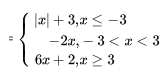
Find all points of discontinuity of $f$ where $f$ is defined as follows$, f(x)$
Image
The cartesian equation of a line AB are $\frac{2\text{x}-1}{\sqrt{3}}=\frac{\text{y}+2}{2}=\frac{\text{z}-3}{3}.$ Find the direction cosines of a line parallel to AB.