The Cartesian equation of the line passing through the point $(1,-3,2)$ and parallel to the line $\vec{r}=(2+\lambda) \hat{i}+\lambda \hat{j}+(2 \lambda-1) \hat{k}$ is
View full solution →Question types
Three Dimensional Geometry question types
310 questions across 9 question groups — pick any mix to generate a MATHS paper with step-by-step answer keys.
310
Questions
9
Question groups
5
Question types
01
M.C.Q (1 Marks)
230 Q→02Assertion (A) & Reason (B) MCQ
10 Q→032 Marks Questions
15 Q→043 Marks Question
19 Q→055 Marks Questions
5 Q→06Case study (4 Marks)
10 Q→07Fill In The Blanks[1 Marks ]
6 Q→08True False[1 Marks ]
8 Q→09Answer the question [ 4 mark question ]
7 Q→Sample Questions
Three Dimensional Geometry questions
One sample from each question group in this chapter. Select any group above to see the full set with answer keys.
The lines $\frac{1-x}{2}=\frac{y-1}{3}=\frac{z}{1}$ and $\frac{2 x-3}{2 p}=\frac{y}{-1}=\frac{z-4}{7}$ are perpendicular to each other for $p$ equal to :
View full solution →The coordinates of the foot of the perpendicular drawn from the point $(0,1,2)$ on the $x$-axis are given by:
View full solution →If a line makes an angle of $30^{\circ}$ with the positive direction of $x$-axis, $120^{\circ}$ with the positive direction of $y-$axis, then the angle which it makes with the positive direction of $z-$axis is :
View full solution →The vector equation of a line passing through the point $(1,-1,0)$ and parallel to $Y$-axis is :
View full solution →Assertion $(A):$ The lines $\vec{r}=\vec{a}_1+\lambda \vec{b}_1$ and $\vec{r}=\vec{a}_2+\mu \vec{b}_2$ are perpendicular, when $\vec{b}_1 \cdot \vec{b}_2=0$.
Reason $(R):$ The angle $\theta$ between the lines $\vec{r}=\vec{a}_1+\lambda \vec{b}_1$ and $\vec{r}=\vec{a}_2+\mu \vec{b}_2$ is given by $\cos \theta=\frac{\vec{b}_1 \cdot \vec{b}_2}{\left|\vec{b}_1\right|\left|\vec{b}_2\right|}$.
View full solution →Reason $(R):$ The angle $\theta$ between the lines $\vec{r}=\vec{a}_1+\lambda \vec{b}_1$ and $\vec{r}=\vec{a}_2+\mu \vec{b}_2$ is given by $\cos \theta=\frac{\vec{b}_1 \cdot \vec{b}_2}{\left|\vec{b}_1\right|\left|\vec{b}_2\right|}$.
Assertion $(A) :$ Quadrilateral formed by vertices $A(0,0,0), B(3,4,5), C(8,8,8)$ and $D(5,4,3)$ is a rhombus. Reason $(R): A B C D$ is a rhombus if $A B=B C=C D=D A$, $A C \neq B D$.
View full solution →Assertion (A): The pair of lines given by $\vec{r}=\hat{i}-\hat{j}+\lambda(2 \hat{i}+\hat{k})$ and $\vec{r}=2 \hat{i}-\hat{k}+\mu(\hat{i}+\hat{j}-\hat{k})$ intersect.
Reason $(R) :$ Two lines intersect each other, if they are not parallel and shortest distance $=0$.
View full solution →Reason $(R) :$ Two lines intersect each other, if they are not parallel and shortest distance $=0$.
Assertion (A) : The points $(1,2,3),(-2,3,4)$ and $(7,0,1)$ are collinear.
Reason (R): If the points $\left(x_1, y_1, z_1\right),\left(x_2, y_2, z_2\right)$ and $\left(x_3, y_3, z_3\right)$ are collinear, then
$\frac{x_2-x_1}{x_3-x_2}=\frac{y_2-y_1}{y_3-y_2}=\frac{z_2-z_1}{z_3-z_2} .$
View full solution →Reason (R): If the points $\left(x_1, y_1, z_1\right),\left(x_2, y_2, z_2\right)$ and $\left(x_3, y_3, z_3\right)$ are collinear, then
$\frac{x_2-x_1}{x_3-x_2}=\frac{y_2-y_1}{y_3-y_2}=\frac{z_2-z_1}{z_3-z_2} .$
Assertion (A) : The lines $\vec{r}=\vec{a}_1+\lambda \vec{b}_1$ and $\vec{r}=\vec{a}_2+\mu \vec{b}_2$ are perpendicular, when $\vec{b}_1 \cdot \vec{b}_2=0$.
Reason (R): The angle $\theta$ between the lines $\vec{r}=\vec{a}_1+\lambda \vec{b}_1$ and $\vec{r}=\vec{a}_2+\mu \vec{b}_2$ is given by $\cos \theta=\frac{\vec{b}_1 \cdot \vec{b}_2}{\left|\vec{b}_1\right|\left|\vec{b}_2\right|}$.
View full solution →Reason (R): The angle $\theta$ between the lines $\vec{r}=\vec{a}_1+\lambda \vec{b}_1$ and $\vec{r}=\vec{a}_2+\mu \vec{b}_2$ is given by $\cos \theta=\frac{\vec{b}_1 \cdot \vec{b}_2}{\left|\vec{b}_1\right|\left|\vec{b}_2\right|}$.
If the lines $\frac{{x - 1}}{{ - 3}} = \frac{{y - 2}}{{2k}} = \frac{{z - 3}}{2}$ and $\frac{{x - 1}}{{3k}} = \frac{{y - 1}}{1} = \frac{{z - 6}}{{ - 5}}$ are perpendicular, find the value of 'k'.
View full solution →Find the equation of a line parallel to x-axis and passing through the origin.
The Cartesian equation of a line is $\frac{{x - 5}}{3} = \frac{{y + 4}}{7} = \frac{{z - 6}}{2}$. Write its vector form.
View full solution →Find the cartesian equation of the line which passes through the point (-2, 4, -5) and parallel to the line given by$\frac{{x + 3}}{3} = \frac{{y - 4}}{5} = \frac{{z + 8}}{6}$.
View full solution →Find the equation of the line in cartesian form that passes through the point with position vector $2\hat i - \hat j + 4\hat k$ and is in the direction $\hat i + 2\hat j - \hat k$.
View full solution →Find the vector equation of the line passing through the point (1, 2, -4) and perpendicular to the two lines:$ \frac { x - 8 } { 3 } = \frac { y + 19 } { - 16 } = \frac { z - 10 } { 7 }$ and $ \frac { x - 15 } { 3 } = \frac { y - 29 } { 8 } = \frac { z - 5 } { - 5 }.$
View full solution →Find the shortest distance between lines $\vec{r}=6 \hat{i}+2 \hat{j}+2 \hat{k}+\lambda(\hat{i}-2 \hat{j}+2 \hat{k})$ and $\vec{r}=-4 \hat{i}-\hat{k}+\mu(3 \hat{i}-2 \hat{j}-2 \hat{k})$
View full solution →Find the angle between the lines whose direction ratios are a, b, c and b - c, c - a, a - b.
Find the angle between the lines $\frac{x}{2} = \frac{y}{2} = \frac{z}{1}$ and $\frac{{x - 5}}{4} = \frac{{y - 2}}{1} = \frac{{z - 3}}{8}$.
View full solution →Find the angle between the lines $\frac{{x - 2}}{2} = \frac{{y - 1}}{5} = \frac{{z + 3}}{{ - 3}}$ and $\frac{{x + 2}}{{ - 1}} = \frac{{y - 4}}{8} = \frac{{z - 5}}{4}$.
View full solution →Find the shortest distance between the lines whose vector equations are $ \vec r = \left( {1 - t} \right)\hat i + (t - 2)\hat j + (3 - 2t)\hat k$ and $\vec r = \left( {s + 1} \right)\hat i + (2s - 1)\hat j - (2s + 1)\hat k$
View full solution →Find the shortest distance between the lines $\frac{{x + 1}}{7} = \frac{{y + 1}}{{ - 6}} = \frac{{z + 1}}{1}$ and $\frac{{x - 3}}{1} = \frac{{y - 5}}{{ - 2}} = \frac{{z - 7}}{1}$
View full solution →Find the direction cosines of the sides of the triangle whose vertices are $(3, 5, -4), (-1, 1, 2)$ and $(-5, -5, -2).$
View full solution →Find the vector and Cartesian equations of the line through the point (5, 2, -4) and which is parallel to the vector $3\hat i + 2\hat j - 8\hat k$.
View full solution →Find the distance between the lines $l_1$ and $l_2$ given by
$\vec r = \hat i + 2\hat j - 4\hat k + \lambda (2\hat i + 3\hat j + 6\hat k)$
and $\vec r = 3\hat i + 3\hat j - 5\hat k + \mu (2\hat i + 3\hat j + 6\hat k)$
View full solution →$\vec r = \hat i + 2\hat j - 4\hat k + \lambda (2\hat i + 3\hat j + 6\hat k)$
and $\vec r = 3\hat i + 3\hat j - 5\hat k + \mu (2\hat i + 3\hat j + 6\hat k)$
A mobile tower stands at the top of a hill. Consider the surface on which tower stand as a plane having points A(0, 1, 2), B(3, 4, -1), and C(2, 4, 2) on it. The mobile tower is tied with 3 cables from the point A, Band C such that it stand vertically on the ground. The peak of the tower is at the point ( 6, 5, 9), as shown in the figure. 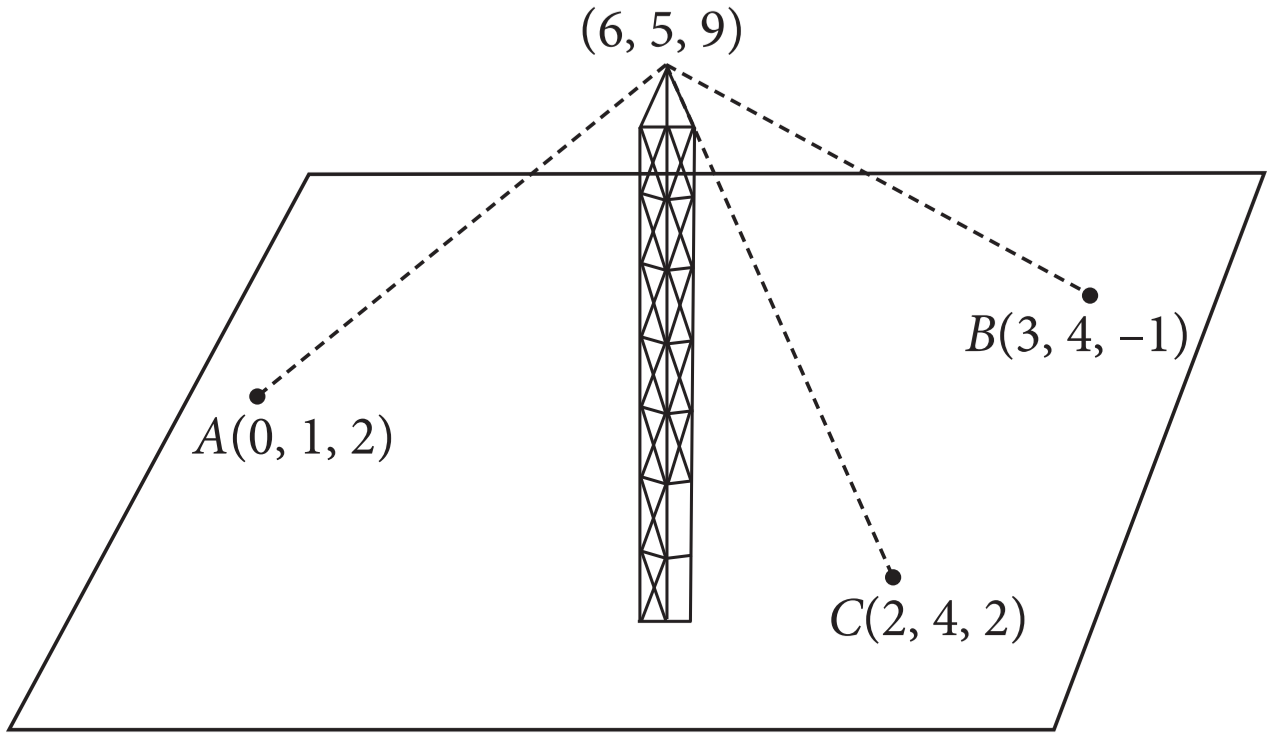 Based on the above information, answer the following questions.
View full solution → Based on the above information, answer the following questions.
- The equation of plane passing through the points A, Band C is:
- 3x - 4y + z = 0
- 3x - 2y + z = 0
- 3x - 2y + z = 0
- 4x - 3y + 3z = 0
- The height of the tower from the ground is:
- 6 units
- 5 units
- $\frac{17}{\sqrt{14}}\text{units}$
- $\frac{5}{\sqrt{14}}\text{units}$
- The equation of line of perpendicular drawn from the peak of tower to the ground is:
- $\frac{\text{x}-6}{3}=\frac{\text{y}-4}{-2}=\frac{\text{z}-9}{1}$
- $\frac{\text{x}-6}{3}=\frac{\text{y}-5}{-2}=\frac{\text{z}-9}{1}$
- $\frac{\text{x}-6}{3}=\frac{\text{y}-4}{2}=\frac{\text{z}-9}{1}$
- $\frac{\text{x}-6}{3}=\frac{\text{y}-5}{2}=\frac{\text{z}-9}{1}$
- The coordinates of foot of perpendicular drawn from the peak of tower to the ground are:
- $\Big(\frac{33}{14},\frac{104}{14},\frac{109}{14}\Big)$
- $\Big(\frac{33}{14},\frac{109}{14},\frac{104}{14}\Big)$
- $\Big(\frac{33}{14},\frac{105}{14},\frac{109}{14}\Big)$
- None of these
- The area of $\triangle\text{ABC}$ is:
- $\frac{1}{2}\sqrt{14}\text{sq}.\text{units}$
- $\frac{3}{2}\sqrt{14}\text{sq}.\text{units}$
- $\sqrt{14}\text{sq}.\text{units}$
- $2\sqrt{14}\text{sq}.\text{units}$
A football match is organised between students of class XII of two schools, say school A and school B. For which a team from each school is chosen. Remaining students of class XII of school A and Bare respectively sitting
on the plane represented by the equation$ \vec{\text{r}}.(\hat{\text{i}}+\hat{\text{j}}+\hat{2\text{k}})=5$ and $ \vec{\text{r}}.(\hat{2\text{i}}-\hat{\text{j}}+\hat{\text{k}})=6$ to cheer up the team of their respective schools.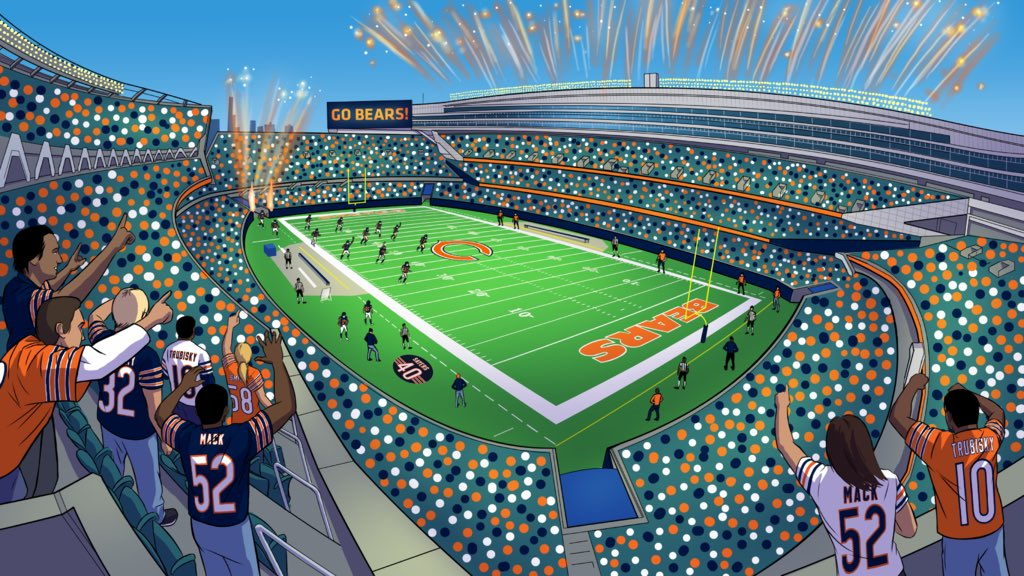
Based on the above information, answer the following questions.
View full solution →on the plane represented by the equation$ \vec{\text{r}}.(\hat{\text{i}}+\hat{\text{j}}+\hat{2\text{k}})=5$ and $ \vec{\text{r}}.(\hat{2\text{i}}-\hat{\text{j}}+\hat{\text{k}})=6$ to cheer up the team of their respective schools.
Based on the above information, answer the following questions.
- The cartesian equation of the plane on which students of school A are seated is:
- 2x - y + z = 8
- 2x + y + z = 8
- x + y + 2z = 5
- x + y + z = 5
- The magnitude of the normal to the plane on which students of school Bare seated, is:
- $\sqrt{5}$
- $\sqrt{6}$
- $\sqrt{3}$
- $\sqrt{2}$
- The intercept form of the equation of the plane on which students of school Bare seated is:
- $\frac{\text{x}}{6}+\frac{\text{y}}{6}+\frac{\text{z}}{6}=1$
- $\frac{\text{x}}{3}+\frac{\text{y}}{(-6)}+\frac{\text{z}}{6}=1$
- $\frac{\text{x}}{3}+\frac{\text{y}}{6}+\frac{\text{z}}{6}=1$
- $\frac{\text{x}}{3}+\frac{\text{y}}{6}+\frac{\text{z}}{3}=1$
- Which of the following is a student of school B?
- Mohit sitting at (1, 2, 1)
- Ravi sitting at (0, 1, 2)
- Khushi sitting at (3, 1, 1)
- Shewta sitting at (2, -1, 2)
- The distance of the plane, on which students of school Bare seated, from the origin is:
- 6 units
- $\frac{1}{\sqrt{6}}\text{ units}$
- $\frac{5}{\sqrt{6}}\text{ units}$
- $\sqrt{6}\text{ units}$
The Indian Coast Guard (ICG) while patrolling, saw a suspicious boat with four men. They were nowhere looking like fishermen. The soldiers were closely observing the movement of the boat for an opportunity to seize the boat. They observe that the boat is moving along a planar surface. At an instant of time, the coordinates of the position of coast guard helicopter and boat are (2, 3, 5) and (1, 4, 2) respectively. 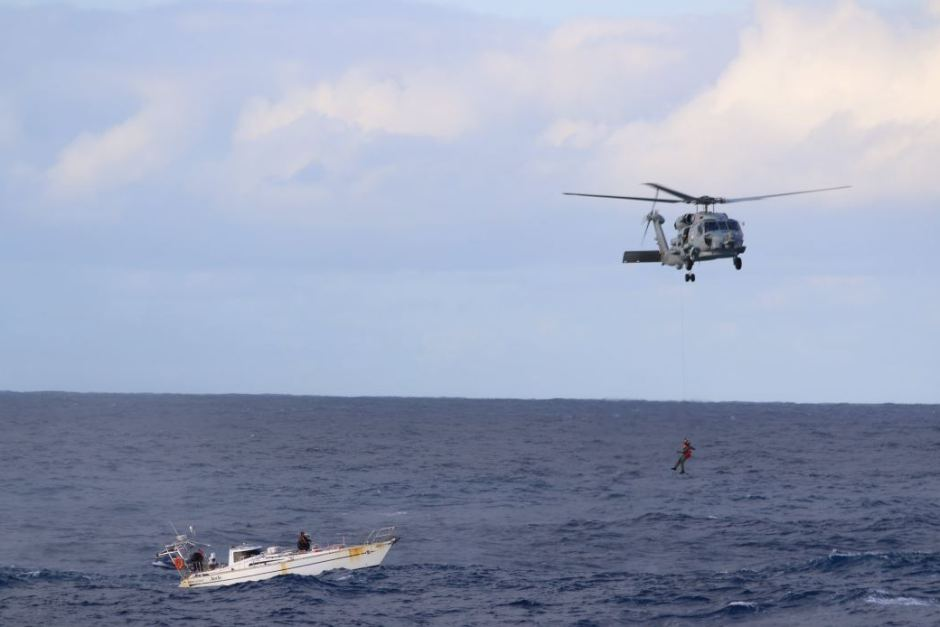 Based on the above information, answer the following questions.
View full solution → Based on the above information, answer the following questions.
- If the line joining the positions of the helicopter and boat is perpendicular to the plane in which boat moves, then equation of plane is:
- x - y + 3z = 2
- x + y + 3z = 2
- x - y + 3z = 3
- x + y + 3z = 3
- If the soldier decides to shoot the boat at given instant of time, where the distance measured in metres then what is the distance that bullet has to travel?
- $\sqrt{5}\text{m}$
- $\sqrt{8}\text{m}$
- $\sqrt{10}\text{m}$
- $\sqrt{11}\text{m}$
- If the speed of bullet is 30m/ sec, then how much time will the bullet take to hit the boat after the shot is fired?
- 30 seconds
- 1 second
- $\frac{1}{2}\text{second}$
- $\frac{\sqrt{11}}{30}\text{seconds}$
- At the given instant of time, the equation of line passing through the positions of helicopter and boat is:
- $\frac{\text{x}}{1}=\frac{\text{y}}{-1}=\frac{\text{z}}{3}$
- $\frac{\text{x}-1}{1}=\frac{\text{y}-4}{-1}=\frac{\text{z}-2}{3}$
- $\frac{\text{x}}{1}=\frac{\text{y}}{1}=\frac{\text{z}}{-3}$
- $\frac{\text{x}-1}{1}=\frac{\text{y}-4}{1}=\frac{\text{z}-2}{-3}$
- At a different instant of time, the boat moves to a different position along the planar surface. What should be the coordinates of the location of the boat for the bullet to hit the boat if soldier shoots the bullet along the line whose equation is $\frac{\text{x}-1}{1}=\frac{\text{y}-1}{-2}=\frac{\text{z}-2}{3}?$
- $\Big(\frac{1}{2},\frac{1}{2},\frac{1}{2}\Big)$
- $\Big(\frac{3}{4},\frac{3}{2},\frac{5}{4}\Big)$
- $\Big(\frac{1}{3},\frac{1}{4},\frac{1}{5}\Big)$
- None of these
The equation of motion of a rocket are: x = 2t, y = -4t, z = 41, where the time 't' is given in seconds, and the distance measured is in kilometres. 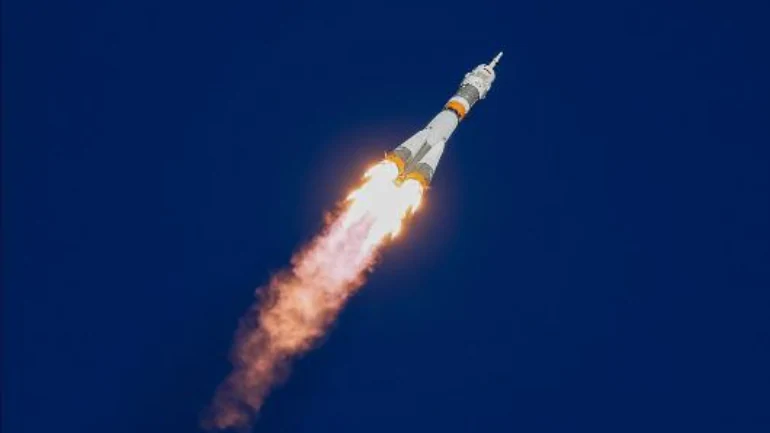 Based on the above information, answer the following questions.
View full solution → Based on the above information, answer the following questions.
- What is the path of the rocket?
- Straight line.
- Circle.
- Parabola.
- None of these.
- Which of the following points lie on the path of the rocket?
- (0, 1, 2)
- (1, -2, 2)
- (2, -2, 2)
- None of these
- At what distance will the rocket be from the starting point (0, 0, 0) in 10 seconds?
- 40km
- 60km
- 30km
- 80km
- If the position of rocket at certain instant of time is (3, -6, 6), then what will be the height of the rocket from the ground, which is along the xy-plane?
- 3km
- 2km
- 4km
- 6km
- At certain instant of time, if the rocket is above sea level, where equation of surface of sea is given by 3x - y + 4z = 2 and position of rocket at that instant of time is (1, -2, 2), then the image of position of rocket in the sea is:
- $\Big(\frac{20}{13},\frac{15}{13},\frac{18}{13}\Big)$
- $\Big(\frac{-20}{13},\frac{-15}{13},\frac{-18}{13}\Big)$
- $\Big(\frac{20}{13},\frac{-15}{13},\frac{18}{13}\Big)$
- None of these
Consider the following diagram, where the forces in the cable are given. 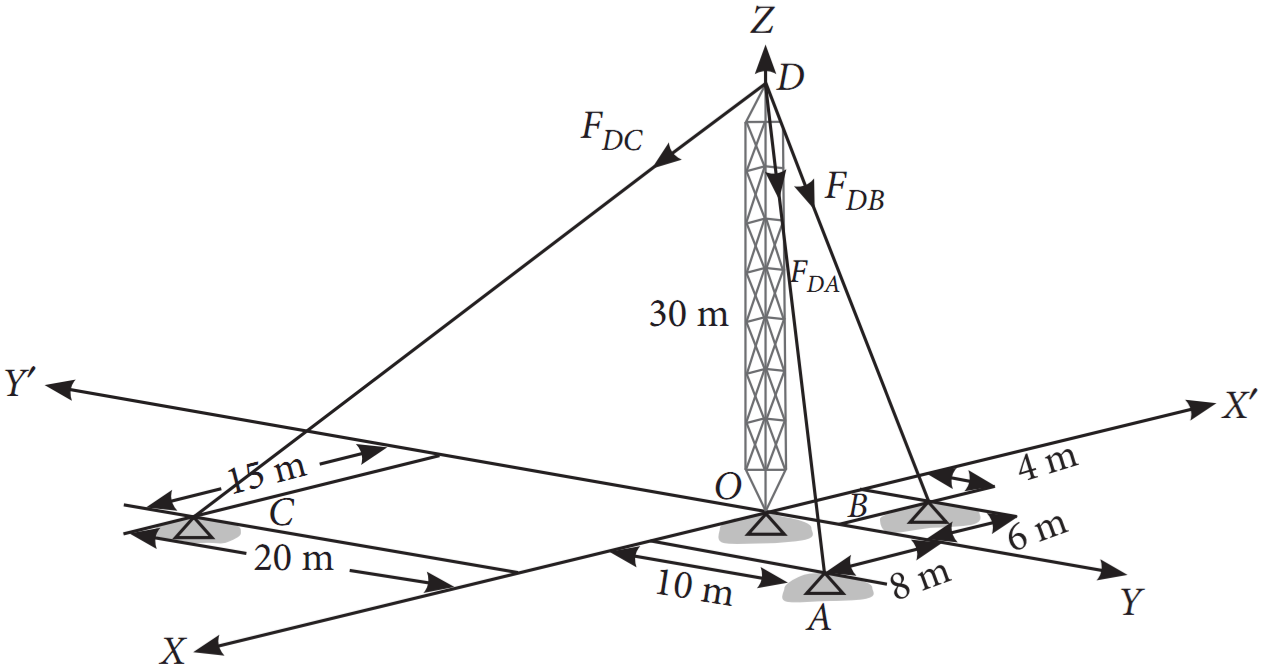 Based on the above information, answer the following questions.
View full solution → Based on the above information, answer the following questions.
- The equation of line along the cable AD is:
- $\frac{\text{x}}{5}=\frac{\text{y}}{4}=\frac{\text{z}-30}{15}$
- $\frac{\text{x}}{4}=\frac{\text{y}}{5}=\frac{\text{z}-30}{15}$
- $\frac{\text{x}}{5}=\frac{\text{y}}{4}=\frac{30-\text{z}}{15}$
- $\frac{\text{x}}{4}=\frac{\text{y}}{5}=\frac{30-\text{z}}{15}$
- The length of cable DC is:
- $4\sqrt{61}\text{m}$
- $5\sqrt{61}\text{m}$
- $6\sqrt{61}\text{m}$
- $7\sqrt{61}\text{m}$
- The vector DB is:
- $-6\hat{\text{i}}+4\hat{\text{j}}-30\hat{\text{k}}$
- $6\hat{\text{i}}-4\hat{\text{j}}+30\hat{\text{k}}$
- $6\hat{\text{i}}+4\hat{\text{j}}+30\hat{\text{k}}$
- None of these
- The sum of vectors along the cables is:
- $17\hat{\text{i}}+6\hat{\text{j}}+90\hat{\text{k}}$
- $17\hat{\text{i}}-6\hat{\text{j}}-90\hat{\text{k}}$
- $17\hat{\text{i}}+6\hat{\text{j}}-90\hat{\text{k}}$
- None of these
- The sum of distances of points A, B and C from the origin, i.e., OA + OB + OC is:
- $\sqrt{164}+\sqrt{52}+\sqrt{625}$
- $\sqrt{52}+\sqrt{625}+\sqrt{48}$
- $\sqrt{164}+\sqrt{625}+\sqrt{49}$
- None of these
Fill in the blanks.
A plane passes through the points (2, 0, 0) (0, 3, 0) and (0, 0, 4). The equation of plane is __________.
A plane passes through the points (2, 0, 0) (0, 3, 0) and (0, 0, 4). The equation of plane is __________.
The position vectors of two points A and B are $\overrightarrow{\text{OA}}=2\hat{\text{i}}-\hat{\text{j}}-\hat{\text{k}}$ and $\overrightarrow{\text{OB}}=2\hat{\text{i}}-\hat{\text{j}}-2\hat{\text{k}},$ respectively. The position vector of a point P which divides the line segment joining A and B in the ratio 2 : 1 is ___________.
View full solution →Fill in the blanks.
The vector equation of the line $\frac{\text{x}-5}{3}=\frac{\text{y}+4}{7}=\frac{\text{z}-6}{2}$ is _________.
View full solution →The vector equation of the line $\frac{\text{x}-5}{3}=\frac{\text{y}+4}{7}=\frac{\text{z}-6}{2}$ is _________.
Fill in the blanks.
The direction cosines of the vector $2\hat{\text{i}}+2\hat{\text{j}}-\hat{\text{k}}$ are ________.
View full solution →The direction cosines of the vector $2\hat{\text{i}}+2\hat{\text{j}}-\hat{\text{k}}$ are ________.
Fill in the blanks.
The cartesian equation of the plane $\vec{\text{r}}\cdot(\hat{\text{i}}+\hat{\text{j}}-\hat{\text{k}})=2$ is ________.
View full solution →The cartesian equation of the plane $\vec{\text{r}}\cdot(\hat{\text{i}}+\hat{\text{j}}-\hat{\text{k}})=2$ is ________.
State True or False for the following:
If the foot of perpendicular drawn from the origin to a plane is (5, -3, -2), then the equation of plane is $\vec{\text{r}}\cdot(5\hat{\text{i}}-3\hat{\text{j}}-2\hat{\text{k}})=38.$
View full solution →If the foot of perpendicular drawn from the origin to a plane is (5, -3, -2), then the equation of plane is $\vec{\text{r}}\cdot(5\hat{\text{i}}-3\hat{\text{j}}-2\hat{\text{k}})=38.$
State True or False for the following:
The angle between the planes $\vec{\text{r}}\cdot(2\hat{\text{i}}-3\hat{\text{j}}+\text{k})=1$ and $\vec{\text{r}}\cdot(\hat{\text{i}}-\hat{\text{j}})=4$ is $\cos^{-1}\Big(\frac{-5}{\sqrt{58}}\Big).$
View full solution →The angle between the planes $\vec{\text{r}}\cdot(2\hat{\text{i}}-3\hat{\text{j}}+\text{k})=1$ and $\vec{\text{r}}\cdot(\hat{\text{i}}-\hat{\text{j}})=4$ is $\cos^{-1}\Big(\frac{-5}{\sqrt{58}}\Big).$
State True or False for the following:
The unit vector normal to the plane x + 2y +3z – 6 = 0 is $\frac{1}{\sqrt{14}}\hat{\text{i}}+\frac{2}{\sqrt{14}}\hat{\text{j}}+\frac{3}{\sqrt{14}}\hat{\text{k}}.$
View full solution →The unit vector normal to the plane x + 2y +3z – 6 = 0 is $\frac{1}{\sqrt{14}}\hat{\text{i}}+\frac{2}{\sqrt{14}}\hat{\text{j}}+\frac{3}{\sqrt{14}}\hat{\text{k}}.$
State True or False for the following:
The line $\vec{\text{r}}=2\hat{\text{i}}-3\hat{\text{j}}-\hat{\text{k}}+\lambda({\text{i}}-{\text{j}}+2{\text{k}})$ lies in the plane $\vec{\text{r}}\cdot(3\hat{\text{i}}+{\text{j}}-{\text{k}})+2=0$
View full solution →The line $\vec{\text{r}}=2\hat{\text{i}}-3\hat{\text{j}}-\hat{\text{k}}+\lambda({\text{i}}-{\text{j}}+2{\text{k}})$ lies in the plane $\vec{\text{r}}\cdot(3\hat{\text{i}}+{\text{j}}-{\text{k}})+2=0$
State True or False for the following:
The angle between the line $\vec{\text{r}}=(5\hat{\text{i}}-\hat{\text{j}}-4\hat{\text{k}})+\lambda(2\hat{\text{i}}-\hat{\text{j}}-\hat{\text{k}})$ and the plane $\vec{\text{r}}(3\hat{\text{i}}-4\hat{\text{j}}-\hat{\text{k}})+5=0$ is $\sin^{-1}\Big(\frac{5}{2\sqrt{91}}\Big).$
View full solution →The angle between the line $\vec{\text{r}}=(5\hat{\text{i}}-\hat{\text{j}}-4\hat{\text{k}})+\lambda(2\hat{\text{i}}-\hat{\text{j}}-\hat{\text{k}})$ and the plane $\vec{\text{r}}(3\hat{\text{i}}-4\hat{\text{j}}-\hat{\text{k}})+5=0$ is $\sin^{-1}\Big(\frac{5}{2\sqrt{91}}\Big).$
Find the shortest distance between the lines whose vector equations are $ \vec r = \left( {1 - t} \right)\hat i + (t - 2)\hat j + (3 - 2t)\hat k$ and $\vec r = \left( {s + 1} \right)\hat i + (2s - 1)\hat j - (2s + 1)\hat k$
View full solution →Find the shortest distance between the lines $\frac{{x + 1}}{7} = \frac{{y + 1}}{{ - 6}} = \frac{{z + 1}}{1}$ and $\frac{{x - 3}}{1} = \frac{{y - 5}}{{ - 2}} = \frac{{z - 7}}{1}$
View full solution →Find the direction cosines of the sides of the triangle whose vertices are (3, 5, -4), (-1, 1, 2) and (-5, -5, -2).
Find the vector and Cartesian equations of the line through the point (5, 2, -4) and which is parallel to the vector $3\hat i + 2\hat j - 8\hat k$.
View full solution →Find the distance between the lines l1 and l2 given by
$\vec r = \hat i + 2\hat j - 4\hat k + \lambda (2\hat i + 3\hat j + 6\hat k)$
and $\vec r = 3\hat i + 3\hat j - 5\hat k + \mu (2\hat i + 3\hat j + 6\hat k)$
View full solution →$\vec r = \hat i + 2\hat j - 4\hat k + \lambda (2\hat i + 3\hat j + 6\hat k)$
and $\vec r = 3\hat i + 3\hat j - 5\hat k + \mu (2\hat i + 3\hat j + 6\hat k)$
Generate a Three Dimensional Geometry paper free
Pick question groups from the list above, set marks and difficulty, and export a branded PDF with step-by-step answer keys. First 3 chapters free — no signup.