Question
Find the time required for a 50Hz alternating current to change its value from zero to the rms value.
Answer

$\text{f}=50\text{Hz}$
$=\text{I}=\text{I}_0\sin\omega\text{t}$
Peak value $\text{I}=\frac{\text{I}_0}{\sqrt{2}}$
$\frac{\text{I}_0}{\sqrt{2}}=\text{I}_0\sin\omega\text{t}$
$\Rightarrow\ \frac{1}{\sqrt{2}}=\sin\omega\text{t}=\sin\frac{\pi}{4}$
$\Rightarrow\ \frac{\pi}{4}=\omega\text{t}$
Or $\text{t}=\frac{\pi}{400}$
$=\frac{\pi}{4\times2\pi\text{f}}=\frac{1}{8\text{f}}$
$=\frac{1}{8\times50}=0.0025\text{s}=2.5\text{ms}$

Need a full question paper?

Generate a complete, print-ready paper with questions like this in minutes — across 16+ boards, with answer keys.

Start Generating Free

Similar questions

Find the binding energy per nucleon of $\text{ }^{197}_{79}\text{Au}$ if its atomic mass is 196.96u.
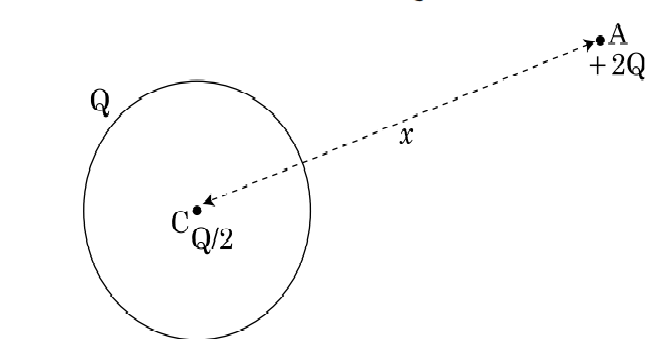
A thin metallic spherical shell of radius R carries a charge Q on its surface. A point charge Q/2 is placed at the centre C, and another charge + 2Q is placed outside the shell at A at a distance x from the centre as shown in the figure.
  1. Find the electric flux through the shell.
  2. State the law used.
  3. Find the force on the charges at the centre C of the shell and at the point A.

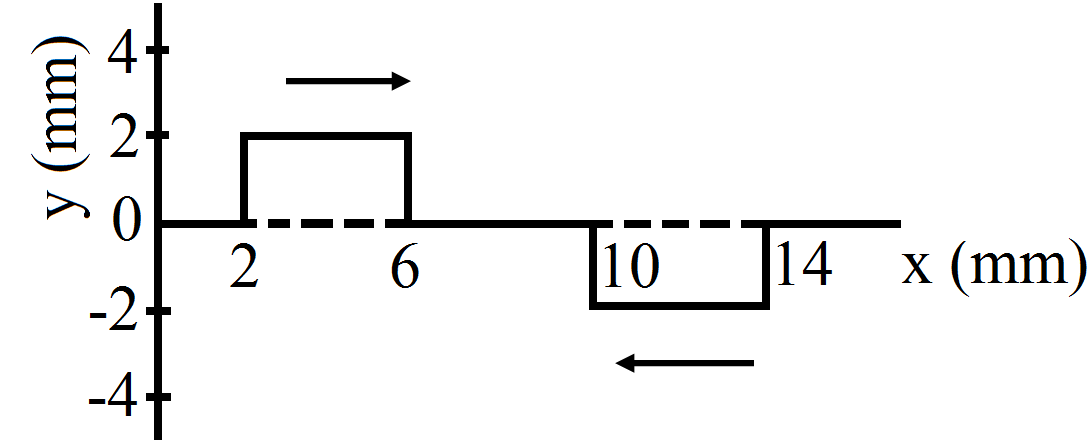
Figure shows two wave pulses at t = 0 travelling on a string in opposite directions with the same

wave speed 50cm/s. Sketch the shape of the string at t = 4ms, 6ms, 8ms, and 12ms.
Draw the circuit diagram showing how a p-n junction diode is
i. forward biased
ii. reverse biased
How is the width of depletion layer affected in the two cases?
  1.  

  1.  

What is the nature of electrostatic force between two point electric charges q1 and q2 if:
  1. q1 + q2 > 0?
  2. q1 + q2 < 0?
A nearsighted person cannot see beyond 25cm. Assuming that the separation of them glass from the eye is 1cm, find the power of lens needed to see distant objects.
Two identically charged particles are fastened to the two ends of a spring of spring constant 100Nm-1 and natural length 10cm. The system rests on a smooth horizontal table. If the charge on each particle is 2.0 × 10-8C, find the extension in the length of the spring. Assume that the extension is small as compared to the natural length. Justify this assumption after you solve the problem.
Accepting the relation $\frac{v_s}{v_p}=\frac{ N _s}{N_s}$ for ideal transformer, and using thé formula of power; derive
$\frac{I_p}{I_s}=\frac{v_s}{v_p}=\frac{N_s}{ N _p}$ and from that explain the types of the transformers.
In a photoelectric experiment, the collector plate is at 2.0V with respect to the emitter plate made of copper ($\phi$ - 4.5eV). The emitter is illuminated by a source of monochromatic light of wavelength 200 run. Find the minimum and maximum kinetic energy of the photoelectrons reaching the collector.