MCQ
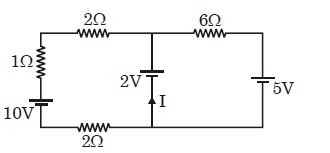
Find the value of $I$ ?................ $\mathrm{A}$
  • A
    $-1.4$
  • $-2.1$
  • C
    $2$
  • D
    $-4.2$

Answer

Correct option: B.
$-2.1$
b
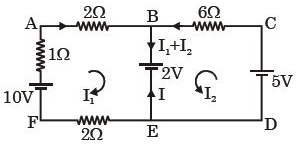
in loop $\mathrm{ABEFA}$

$I_{1}=\frac{8}{5} \,A=1.6 \,A$

in loop $\mathrm{BCDEB}$

$I_{1}=\frac{3}{6}=0.5 \mathrm{\,A}$

$\mathrm{I}=-\left(\mathrm{I}_{1}+\mathrm{I}_{2}\right)$

$\mathrm{I}=-2.1 \mathrm{\,A}$
Need a full question paper?

Generate a complete, print-ready paper with questions like this in minutes — across 16+ boards, with answer keys.
Start Generating Free

Similar questions

The radii of two planets are respectively ${R_1}$ and ${R_2}$ and their densities are respectively ${\rho _1}$ and ${\rho _2}$. The ratio of the accelerations due to gravity at their surfaces is
In a tonga, horse pulls a wagon. Which is the correct analysis of the situation?
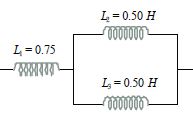
Three inductances are connected as shown below. Assuming no coupling, the resultant inductance will be.....$H$
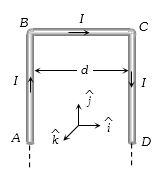
$AB$ and $CD$ are long straight conductor, distance $d$ apart, carrying a current $I$. The magnetic field at the midpoint of $BC$ is
A hollow pipe of length $0.8 \mathrm{~m}$ is closed at one end. At its open end a $0.5 \mathrm{~m}$ long uniform string is vibrating in its second harmonic and it resonates with the fundamental frequency of the pipe. If the tension in the wire is $50 \mathrm{~N}$ and the speed of sound is $320 \mathrm{~ms}^{-1}$, the mass of the string is
As shown in the figure $a$ body of mass $m$ moving vertically with speed $3\, m/s$ hits a smooth fixed inclined plane and rebounds with a velocity $v_f$ in the horizontal direction. If $\angle$ of inclined is $30^o$, the velocity $v_f$ will be
A liquid wets a solid completely. The meniscus of the liquid in a sufficiently long tube is
In an adiabatic process, the density of a diatomic gas becomes $32$ times its initial value. The final pressure of the gas is found to be $n$ times the initial pressure. The value of $n$ is
If at same temperature and pressure, the densities for two diatomic gases are respectively ${d_1}$ and ${d_2}$, then the ratio of velocities of sound in these gases will be
Two cars $A$ and $B$ are moving away from each other in opposite directions. Both the cars are moving with a speed of $20\, ms^{-1}$ with respect to the ground. If an observer in car $A$ detects a frequency $2000\, Hz$ of the sound coming from car $B$, what is the natural frequency of the sound source of car $B$ ....  $Hz$ ? (speed of sound in air $= 340\, ms^{-1}$)