Question
Find the volume, curved surface area and total surface area of the cylinders whose dimensions are:
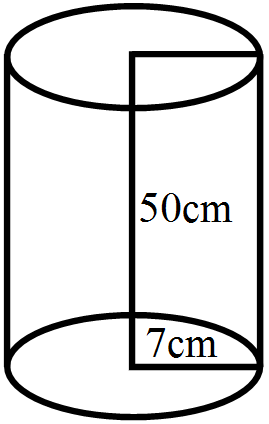
Radius of the base $= 7\ cm$ and height $= 50\ cm.$
Answer

Radius of the base of the cylinder $(r) = 7\ cm.$
Height $(h) = 50\ cm.$
$a. \therefore$ Volume $=\pi\text{r}^2\text{h}$

$=\frac{22}{7}\times(7)^2\times50\text{cm}^3$
$=\frac{22}{7}\times7\times7\times50\text{cm}^3$
$=7700\text{cm}^3$
$b.$ Lateral surface area $=2\pi\text{rh}$
$=2\times\frac{22}{7}\times7\times50$
$=2200\text{cm}^2$
$c.$ Total surface area $=2\pi\text{r}(\text{h}+\text{r})$
$=2\times\frac{22}{7}\times7(50+7)\text{cm}^2$
$=44\times57$
$=2508\text{cm}^2$

Need a full question paper?

Generate a complete, print-ready paper with questions like this in minutes — across 16+ boards, with answer keys.
Start Generating Free

Similar questions

A well with $14m$ diameter is dug $8m$ deep. The earth taken out of it has been evenly spread all around it to a width of $21m$ to form an embankment. Find the height of the embankment.
Find the product $ -3 y\left(x y+y^2\right) $ and find its value for $x = 4$ and $y = 5.$
Construct a quadrilateral $ABCD$ in which $AB = 7.7\ cm, BC = 6.8\ cm, CD = 5.1\ cm, AD = 3.6\ cm$ and $\angle\text{C}=120^\circ.$
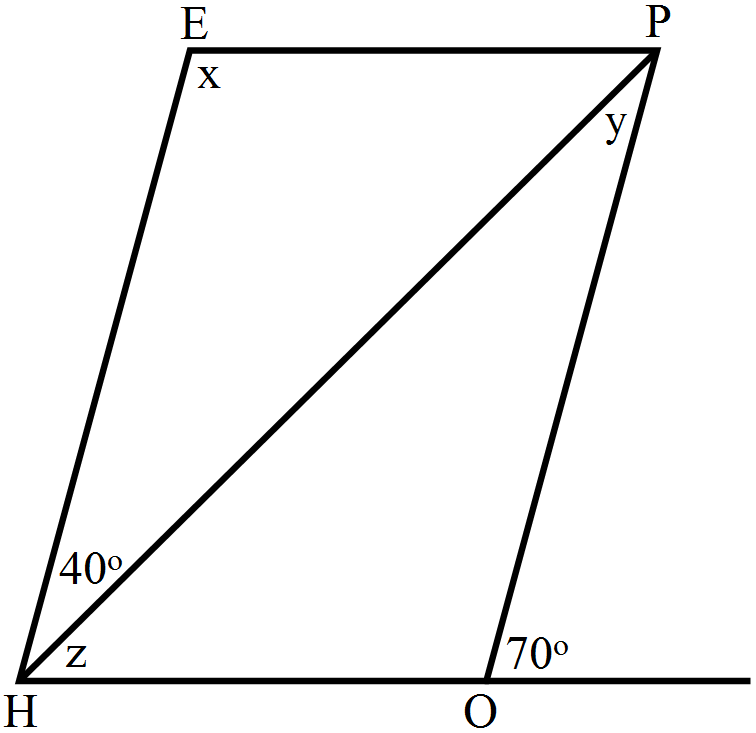
In the adjacent figure $HOPE$ is a parallelogram. Find the angle measures $x, y$ and $z$. State the geometrical truths you use to find them.
Construct a quadrilateral $ABCD$ given $AD = 3.5\ cm, BC = 2.5\ cm, CD = 4.1\ cm, AC = 7.3\ cm$ and $BD = 3.2\ cm$.
Construct a frequency table for the following weights $($in $gm)$ of $35$ mangoes using the equal class intervals, one of them is $40-50$ ($45$ not included):
$30, 40, 45, 32, 43, 50, 55, 62, 70, 70, 61, 62, 53, 52, 50, 42,$
$ 35, 37, 53, 55, 65, 70, 73, 74, 45, 46, 58, 59, 60, 62, 74, 34, 35, 70, 68$.
$i.$ What is the class mark of the class interval $40-45$?
$ii.$ What is the range of the above weights?
$iii.$ How many classes are there?
Consider the following input/ output table. Draw a line graph for it.
Input
$1$
$2$
$4$
$5$
$7$
Output
$2$
$5$
$11$
$14$
$20$
$V$ is the volume of the cuboid of dimensions $a, b, c$ and $S$ its the surface area then prove that: $\frac{1}{\text{V}}=\frac{2}{\text{S}}\Big(\frac{1}{\text{a}}+\frac{1}{\text{b}}+\frac{1}{\text{c}}\Big)$
The difference between the squares of two consecutive numbers is $31$. Find the numbers.
Construct a quadrilateral $ABCD$, in which $AB = BC = 3\ cm, AD = 5\ cm,$ $\angle\text{A}=90^\circ$ and $\angle\text{B}=105^\circ.$