Question
Find:
Which term in the $A.P. 84, 80, 76, ..... is 0?$

Answer

In the given problem, we are given an A.P. and the value of one of its term. We need to find which term it is (n).
So here we will find the value of n using the formula, $a_n = a + (n - 1)d.$
Given,
$A.P., 84, 80, 76, .....$
$a_n = 0$
Here,
First term = 84
Difference = (80 - 84) = -4
We have to find which term of A.P. is 0
We know, $n^{th}$ term of $A.P.$
$a_n = a + (n - 1)d$
$\Rightarrow 0 = 84 + (n - 1) - 4$
$\Rightarrow 0 = 84 + (-4n + 4)$
$\Rightarrow 0 = 84 - 4n + 4$
$\Rightarrow 4n = 88$
$\Rightarrow\ \text{n}=\frac{88}{4}$
$\Rightarrow n = 22$
Hence, $22^{th}$​​​​​​​ term of the given A.P. is 0.

Need a full question paper?

Generate a complete, print-ready paper with questions like this in minutes — across 16+ boards, with answer keys.
Start Generating Free

Similar questions

Find:$n^{th}$ term of the $A.P. 13, 8, 3, -2, ....$
Find the value of $p$ for which the points $(-5,1)$, $(1, p)$ and $( 4,-2 )$ are collinear.
An iron pillar consists of a cylindrical portion 2.8m high and 20cm in diameter and a cone 42cm high is surmounting it. Find the weight of the pillar, given that 1 cubic cm of iron weighs 7.5gm.
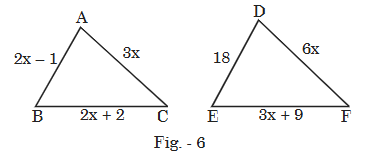
In figure, if $\triangle ABC \sim \triangle DEF$ and their sides of lengths $($in $\ cm )$ are marked along them, then find the lengths of sides of each triangle.
Image
A card is drawn from a well-shuffled pack of 52 cards. Find the probability of getting:
  1. A red face card.
  2. A black king.
Two poles of equal heights are standing opposite to each other on either side of the road which is 80m wide. From a point between them on the road the angles of elevation of the top of the poles are 60° and 30° respectively. Find the height of the poles and the distance of the point from the poles.
Evaluate the following:
$\sin 45^{\circ} \sin30^{\circ} +\cos 45^{\circ} \cos30^{\circ}$
All integers from $1$ to $500$ which are multiplies $2$ as well as of $5$.
Find the value of k for which the following equation have real root:
$x^2 - 4kx + k = 0$
A horse is tied to a peg at one corner of a square shaped grass field of side 15 m by means of a $5 \ m$ long rope. Find
  1. the area of that part of the field in which the horse can graze.
  2. the increase in the grazing area if the rope were $10 \ m$ long instead of 5 m (Use $\pi$ $= 3.14$)
    "https://pg-data.sgp1.digitaloceanspaces.com/chapter_wise/5245/image103.gif" style="height: 148px; width: 150px;" />