Question
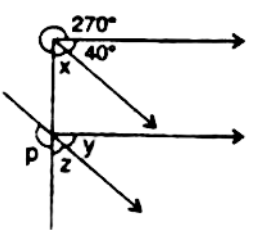
Find $x, y$ and $p$ is the given figure
Image

Answer

In the figure,
∵ Lines are parallel
∴ x = z .........(corresponding angles)
y = 40° ..........(corresponding angles)
But x + 40° + 270° = 360° .......(angles at a point)
⇒ x + 310° = 360°
⇒ x = 360°− 310° = 50°
∴ z = x = 50°
But p + z = 180° .......(linear pair)
⇒ p+ 50° = 180°
⇒ p = 180°− 50° = 130°
Hence x = 50°, y = 40°, z = 50° and p = 130°
Need a full question paper?

Generate a complete, print-ready paper with questions like this in minutes — across 16+ boards, with answer keys.

Start Generating Free

Similar questions

Evaluate: $\frac{-3}{8}+\frac{-5}{12}$
Find an angle which is one-fifth of its supplement.
Construct an isosceles Δ ABC such that:
Base AB = 6.2 cm and base angle = 45°. Measure the other two sides of the triangle.
Ranjan Singh makes statues of brass. Brass is an alloy of copper and zinc. Ranjan uses two varieties of brass for different kinds of statues. Variety 1 contains copper and zinc mixed in the ratio $7: 4$ and variety 2 contains these metals in the ratio $5: 3$. Ranjan makes an elephant statue from variety 1 and a horse statue from variety 2. The elephant statue weighs 176 g and it is known that the brass used in the horse statue contains 135 g zinc.
Q.1. Find the quantity of copper present in the brass used to make the elephant statue.
(a) 98 g $\quad$$\quad$(b) 112 g$\quad$$\quad$ (c) 121 g $\quad$$\quad$(d) 132 g
Q.2. How much copper is contained in the brass used to make the horse statue?
(a) 165 g $\quad$$\quad$(b) 175 g$\quad$$\quad$ (c) 205 g$\quad$$\quad$ (d) 225 g
Q.3. How much zinc is contained in the brass used to make the two statues?
(a) 169 g $\quad$$\quad$(b) 179 g$\quad$$\quad$ (c) 189 g$\quad$$\quad$ (d) 199 g
Q.4. The ratio of the quantities of copper and zinc used to make the two statues is:
(a) $113: 98$ $\quad$$\quad$(b) $337: 148$ $\quad$$\quad$(c) $221: 199$ $\quad$$\quad$(d) $337: 199$
Simplify : $\frac{7}{15}$ of $\left(\frac{2}{3}+\frac{7}{12}\right) \div\left(\frac{5}{6}-\frac{3}{5}\right)$
The numerator of a fraction is four less than its denominator. If 1 is added to both, is numerator and denominator, the fraction becomes $\frac{1}{2}$ Find the fraction.
Find whether the given division forms a terminating decimal or a non-terminating decimal:
23 ÷ 0.7
Construct an isosceles ∆ ABC such that:
BC = AB = 5.8 cm and ZB = 30°. Measure ∠A and ∠C.
A, B and C can do a piece of work in 12, 15 and 20 days respectively. How long will they take to do it working together?
The sides of a triangle are in the ratio 15 : 13 : 14 and its perimeter is 168 cm. Find the area of the triangle.