Question
Find $(x + y) ÷ (x − y)$, if $\text{x}=\frac{2}{3},\text{y}=\frac{3}{2}$

Answer

$\text{x}=\frac{2}{3},\text{y}=\frac{3}{2}$
$\therefore\text{x}+\text{y}=\frac{2}{3}+\frac{3}{2}$
$=\frac{4+9}{6}=\frac{13}{6}$ and $\text{x}-\text{y}=\frac{2}{3}-\frac{3}{2}$
$=\frac{4-9}{6}=\frac{-5}{6}$ Now $(\text{x}+\text{y})\div(\text{x}-\text{y})=\frac{13}{6}\div\frac{-5}{6}$
$=\frac{13}{6}\times\frac{6}{-5}$
$=\frac{13}{-5}=\frac{13\times(-1)}{-5(-1)}=\frac{-13}{5}$

Need a full question paper?

Generate a complete, print-ready paper with questions like this in minutes — across 16+ boards, with answer keys.

Start Generating Free

Similar questions

Sasha solves a linear equation. Her work is shown below
$\begin{aligned} 2 x-3 & =\frac{x}{2}-5 \\ 2(2 x-3) & =x-5 \ldots \ldots \text { Step } 1 \\ 4 x-6 & =x-5 \ldots \ldots \text { Step } 2 \\ 4 x-x & =6-5 \ldots \ldots \text { Step } 3 \\ 3 x & =1 \ldots \ldots \text { Step } 4 \\ x & =\frac{1}{3}\end{aligned}$
Is Sasha's solution correct? If not, in which step did Sasha make an error?
Verify the following: $-1+\Big(\frac{-2}{3}+\frac{-3}{4}\Big)=\Big(-1+\frac{-2}{3}\Big)+\frac{-3}{4}$
What could be the difficulties with using a number system that counts only in groups of a single particular size? How would you represent a number like 1345 in a system that counts only by 5s?
Living on your own, Sanjay is looking for one bedroom apartment on rent. At Neelgiri apartments, rent for the first two months is $20\%$ off. The one bedroom rate at Neelgiri is ₹ 6000 per month.
At Savana apartments the first month is $50\%$ off. The one bedroom rate at Savana apartments is ₹ $7000$ per month. Which apartment will be cheaper for the first two months and by how much?
The monthly income of family is $₹ 28800.$ The monthly expenditure of the family on various items is given below.
Beast animals
Other land animals
Birds
Water animals
Reptiles
$150$
$400$
$175$
$125$
$50$
Represent the above data by a pie chart.
$\frac{\text{x}}{2}+\frac{\text{x}}{3}+\frac{\text{x}}{4}=13$
A well with $14m$ diameter is dug $8m$ deep. The earth taken out of it has been evenly spread all around it to a width of $21m$ to form an embankment. Find the height of the embankment.
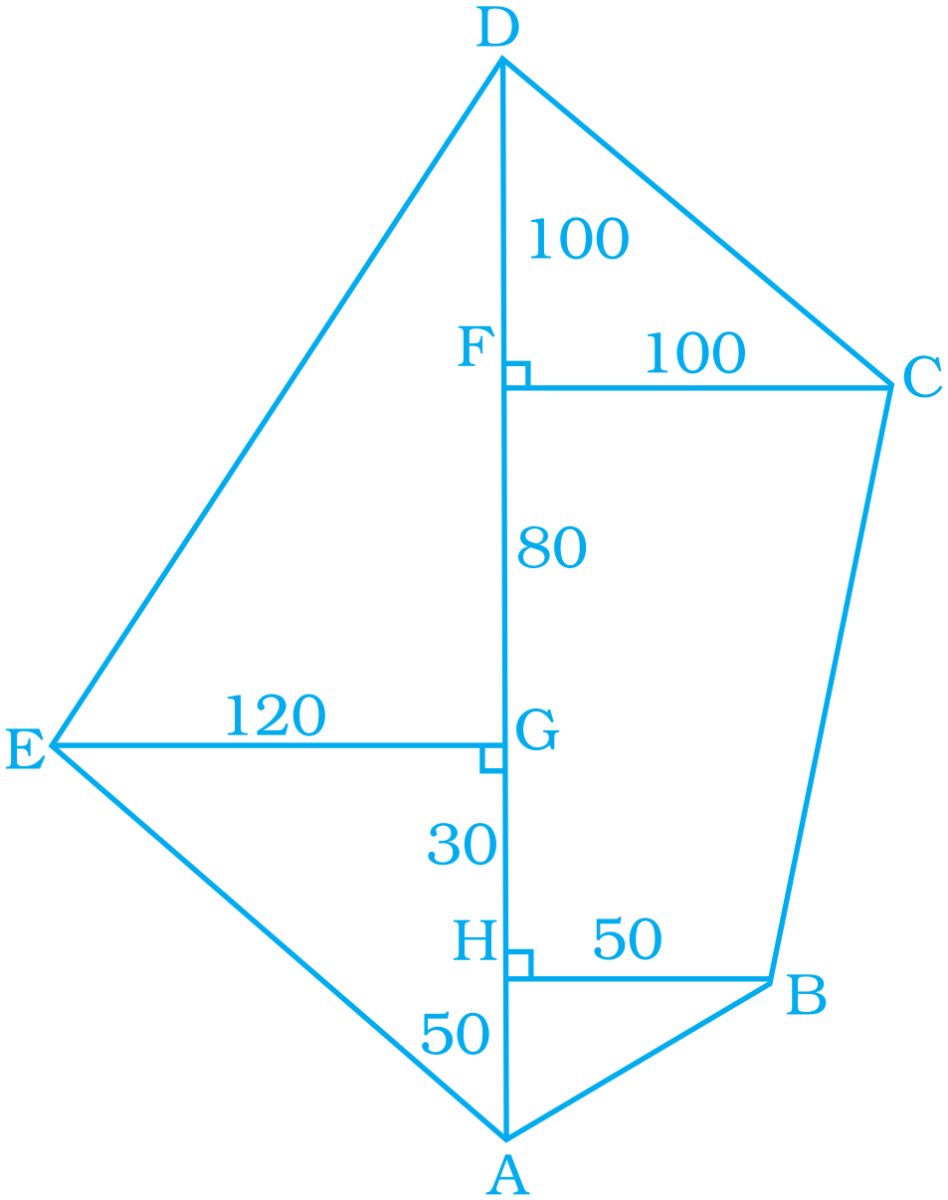
Find the area of the following fields. All dimensions are in metres.
By what numbers should the following be divided to get a perfect square in case? Also, find the number whose square is the new number. $3698$
Construct a rhombus $\text{CLUE}$ in which $\text{CL} = 7.5\ cm$ and $\text{LE} = 6\ cm$.