MCQ
Finely powered or colloidal catalyst particles having small surface area are rich in free valencies.State whether the statement is True or False
  • A
    The statement is True.
  • The statement is False.
  • C
    Neither.
  • D
    Finely powered or colloidal catalyst particles having large surface area are rich in free valencies.
Answer

Correct option: B.
The statement is False.
Finely powered or colloidal catalyst particles having small surface area cannot be rich in free valencies. When the catalyst is finely powdered the surface area of the particle is small but total surface area is very large.

Need a full question paper?

Generate a complete, print-ready paper with questions like this in minutes — across 16+ boards, with answer keys.

Start Generating Free

Similar questions

Which complex follow the Sidgwick $EAN$ rule (where atomic number of $M = 24$)
The half-life for radioactive decay of $C-14$ is $5730\,years.$ An archaeological artifact containing wood had only $80\%$ of the $C-14$ found in a living tree. The age of the sample is ....... $years$
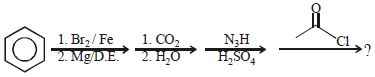
The final product of the given sequence is :
Given below are two statements:

Statement $(I)$ : The $\mathrm{NH}_2$ group in Aniline is ortho and para directing and a powerful activating group.

Statement $(II)$ : Aniline does not undergo FriedelCraft's reaction (alkylation and acylation).

In the light of the above statements, choose the most appropriate answer from the options given below :

A nitrate when mixed with common salt gives a white precipitate which is soluble in dilute $N{H_4}OH$. It is the nitrate of
Phenylmethanol can be prepared by reducing the benzaldehyde with
The ionizable valency of $Ni$ in $\mathrm{Ni}(\mathrm{CO})_4$​ is $.......$
In nucleic acids, the sequence is
White Phosphorus on reaction with concentrated $NaOH$ solution in an inert atmosphere of $\mathrm{CO}_{2}$ gives phosphine and compound $(\mathrm{X}) .(\mathrm{X})$ on acidification with $HCl$ gives compound $(Y)$. The basicity of compound $(Y)$ is
For reaction

$Cl_2(aq) + H_2S(aq) \to S(s) + 2H^+(aq) + 2Cl^-(aq)$ rate law is $r = K[Cl_2][H_2S]$
then which of these mechanism is/are consistent with this rate law

$(A)\, H_2S \rightleftharpoons  H^+ + HS^-$ (fast)

         $Cl_2 + HS^-\to 2Cl^-+ H^+ + S$ (slow)

$(B)\, Cl_2 + H_2S \to H^+ + Cl^-+ Cl^+ + HS^-$ (slow)

          $Cl^+ + HS^-\to H^+ + Cl^-+ S$ (fast)