MCQ
First ionization potential of $\ce{Mg}$ is less than that of :
- A$\ce{Li}$
- B$\ce{Na}$
- C$\ce{Ca}$
- ✓$\ce{Be}$
Generate a complete, print-ready paper with questions like this in minutes — across 16+ boards, with answer keys.
Assertion $A :$- Carbon forms two important oxides $- CO$ and $CO _2 . CO$ is neutral whereas $CO _2$ is acidic in nature.
Reason $R :$- $CO _2$ can combine with water in a limited way to form carbonic acid, while $CO$ is sparingly soluble in water.
In the light of the above statements, choose the most appropriate answer from the options given below :-
$(II)\,\,\,{{H}_{2}}C=CH-C{{H}_{2}}-\overset{+}{\mathop{C}}\,H-C{{H}_{3}}$
$(III)\,\,\,\begin{matrix}
\,\,\,\,\,C{{H}_{3}}\, \\
|\, \\
{{H}_{3}}C-C-\overset{+}{\mathop{C}}\,{{H}_{2}} \\
|\, \\
\,\,\,C{{H}_{3}} \\
\end{matrix}$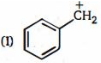
$(I)\, CO^{2-}_3$ $(II)\, XeF_4$ $(III)\, I^-_3$ $(IV)\, NCl_3$ $(V)$ $BeCl_2$
$(C= 3 \times 10^8 \,ms^{-1}$ and $N_A =6.02 \times mol^{-1}).$