MCQ
First law of thermodynamics:
  • A
    Explains temperature.
  • B
    Defines heat
  • C
    Expresses the maximum limit mechanical energy being converted into heat.
  • Expresses the equivalence of heat and mechanical energy.

Answer

Correct option: D.
Expresses the equivalence of heat and mechanical energy.
D

Need a full question paper?

Generate a complete, print-ready paper with questions like this in minutes — across 16+ boards, with answer keys.

Start Generating Free

Similar questions

The moment of inertia of a body about a given axis is $1.2 \;kg m^{2}$. Initially, the body is at rest. In order to produce a rotational kinetic energy of $1500\; joule$, an angular acceleration of $25 \;rad s^{-2}$ must be applied about that axis for a duration of
Three identical bodies of equal mass $M$ each are moving along a circle of radius $R$ under the action of their mutual gravitational attraction. The speed of each body is
One litre of Helium gas at a pressure $76\, cm$ of $Hg$ and temperature ${27}^\circ$ is heated till its pressure and volume are doubled. The final temperature attained by the gas is ..... $^oC$
If the law of gravitation, instead of being inversesquare law, becomes an inversecube law.
$Assertion :$ Speed of wave $=\frac{wavelength}{time period}$
$Reason :$ Wavelength is the distance between two nearest particles in phase.
Snow is more heat insulating than ice, because
Two trains each of length $100 \,m$ moving parallel towards each other at speed $72 \,km / h$ and $36 \,km / h$ respectively. In how much time will they cross each other is ..........
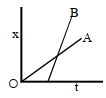
The position-time graphs for two students $A$ and $B$ returning from the school to their homes are shown in figure

$(A)$ $A$ lives closer to the school

$(B)$ $B$ lives closer to the school

$(C)$ $A$ takes lesser time to reach home

$(D)$ $A$ travels faster than $B$

$(E)$ $B$ travels faster than $A$

Choose the correct answer from the options given below :
A bullet of mass $25\,g$ moving with a velocity of $200\,m/s$ is stopped within $5\,cm$ of the target. The average resistance offered by the target is ............... $\mathrm{kN}$
The velocity of sound is $v_s$ in air. If the density of air is increased to $4$ times, then the new velocity of sound will be