MCQ
Fischer Tropsch process is used for the manufacture of
  • Synthetic petrol
  • B
    Thermosetting plastics
  • C
    Ethanol
  • D
    Benzene

Answer

Correct option: A.
Synthetic petrol
a
The Fisher-Tropscgh process is used in the manufacturing of Syntheticpetrol. The Fischer-Tropsch process is a collection of chemical reactions that converts a mixture of carbon monoxide and hydrogen into liquid hydrocarbons.... In the usual implementation, carbon monoxide and hydrogen, the feedstocks for $FT$, are produced from coal, natural gas, or biomass in a process known as gasification.

Need a full question paper?

Generate a complete, print-ready paper with questions like this in minutes — across 16+ boards, with answer keys.

Start Generating Free

Similar questions

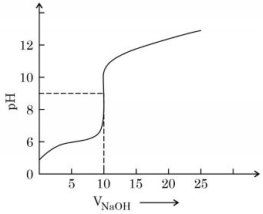
The titration curve of weak acid vs. strong base with phenolphthalein as indictor) is shown below. The $K _{\text {phenolphthalein }}=4 \times 10^{-10}$. Given: $\log 2=0.3$

The number of following statements which is/are correct about phenolphthalein is $.....$.

$A$. It can be used as an indicator for the titration of weak acid with weak base.

$B$. It begins to change colour at $pH =8.4$

$C$. It is a weak organic base

$D$. It is colourless in acidic medium
Find out the major product for the above reaction.
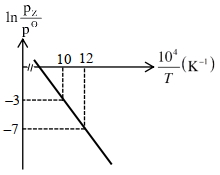
For the reaction $X ( s ) \rightleftharpoons Y ( s )+ Z ( g )$, the plot of $\ln \frac{ p _z}{ p ^\theta}$ versus $\frac{10^4}{T}$ is given below (in solid line), where $p_z$ is the pressure (in bar) of the gas $Z$ at temperature $T$ and $P ^{\ominus}=1$ bar.

(Given, $\frac{ d (\ln K )}{ d \left(\frac{1}{T}\right)}=-\frac{\Delta H^{\ominus}}{ R }$, where the equilibrium constant, $K =\frac{ p _{ z }}{ p ^{\ominus}}$ and the gas constant, $R =8.314$ $\left.J K ^{-1} mol ^{-1}\right)$

($1$) The value of standard enthalpy, $\Delta H ^{\ominus}$ (in $kJ mol ^{-1}$ ) for the reaction is. . . . . . .

($2$) The value of $\Delta S^{\ominus}$ (in $J K ^{-1} mol ^{-1}$ ) for the given reaction, at $1000 K$ is. . . . . . 

Give the answer or quetin ($1$) and ($2$)
You are given $500\, mL$ of $2\,N\, HCl$ and $500\, mL$ of $5\,N\, HCl$. What will be the maximum volume of $3\, M\, HCl$ that you can make from these two sotutions ? .............. $\mathrm{mL}$
In the given reaction $\begin{array}{*{20}{c}}
  {{C_6}{H_5} - C - C{H_3}} \\ 
  {||} \\ 
  O 
\end{array}$ $\xrightarrow{{N{H_2}OH/{H^ \oplus }}}X\xrightarrow{{Na/{C_2}{H_5}OH}}Y$. $Y$will be
Meso-tartaric acid is optically inactive due to the presence of
The correct statements from the following are :
(A) The decreasing order of atomic radii of group 13 elements is Tl > In > Ga > Al> B.
(B) Down the group 13 electronegativity decreases from top to bottom.
(C) Al dissolves in dil. HCl and liberate H, but conc. HNO, renders Al passive by forming a protective oxide layer on the surface.
(D) All elements of group 13 exhibits highly stable +1 oxidation state.
(E) Hybridisation of Al in $\left[ Al \left( H _2 O \right)_6\right]^{3+}$ ion is $sp ^3 d^2$.
Choose the correct answer from the options given below :
Which of the following set of quantum number is not possible

         $n$                $l$             $m_1$                $m_2$    

If a compound $Ab$ dissociates to the extent of $75 \,\%$ in an aqueous solution, the molality of the solution which shows a $2.5\, K$ rise in the boiling point of the solution is ......  molal.

(Rounded-off to the nearest integer) $\left[ K _{ b }=0.52 \,K \,kg\, mol ^{-1}\right]$

Which of the following is correct