Five similar condenser plates, each of area $A$, are placed at equal distance apart and are connected to a source of $e.m.f.$ $V$ as shown in the following diagram. The charge on the plates $1$ and $4$ will be:-
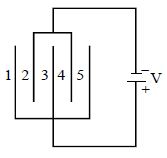
Medium

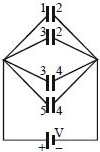

Download our appand get started for free
Experience the future of education. Simply download our apps or reach out to us for more information. Let's shape the future of learning together!No signup needed.*
Similar Questions
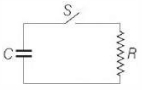
- 1The capacitor of capacitance $C$ in the circuit shown is fully charged initially resistance is $R$. After the switch $S$ is closed, the time taken to reduce the stored energy in the capacitor to half its initial value isView Solution
- 2In a uniform electric field, the potential is $10$ $V $ at the origin of coordinates, and $8$ $V$ at each of the points $(1, 0, 0), (0, 1, 0) $ and $(0, 0, 1)$. The potential at the point $(1, 1, 1)$ will be....$V$View Solution
- 3A $4\ \mu F$ capacitor, a resistance of $2.5 \,MW$$\Omega$ is in series with $12\, V$ battery. Find the time after which the potential difference across the capacitor is $3$ times the potential difference across the resistor.......$s$ [Given $ln(2)= 0.693$]View Solution
- 4How will the voltage $(V)$ between the two plates of a parallel plate capacitor depend on the distance $(d)$ between the plates, if the charge on the capacitor remains the same?View Solution
- 5View SolutionSome charge is being given to a conductor. Then its potential is
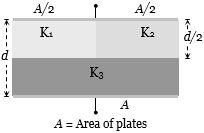
- 6A parallel plate capacitor of area $A$, plate separation $d$ and capacitance $C$ is filled with three different dielectric materials having dielectric constants ${k_1},{k_2}$ and ${k_3}$ as shown. If a single dielectric material is to be used to have the same capacitance $C$ in this capacitor, then its dielectric constant $k$ is given byView Solution
- 7The electric potential at a point on the axis of an electric dipole depends on the distance $r$ of the point from the dipole asView Solution
- 8A parallel plate capacitor is connected to a battery. The plates are pulled apart with a uniform speed. If $x$ is the separation between the plates, the time rate of change of electrostatic energy of capacitor is proportional toView Solution
- 9View SolutionIf a charge is shifted from a low potential region to high potential region, the electric potential energy
- 10A disk of radius $R$ with uniform positive charge density $\sigma$ is placed on the $x y$ plane with its center at the origin. The Coulomb potential along the $z$-axis isView Solution
$V(z)=\frac{\sigma}{2 \epsilon_0}\left(\sqrt{R^2+z^2}-z\right)$
A particle of positive charge $q$ is placed initially at rest at a point on the $z$ axis with $z=z_0$ and $z_0>0$. In addition to the Coulomb force, the particle experiences a vertical force $\vec{F}=-c \hat{k}$ with $c>0$. Let $\beta=\frac{2 c \epsilon_0}{q \sigma}$. Which of the following statement($s$) is(are) correct?
$(A)$ For $\beta=\frac{1}{4}$ and $z_0=\frac{25}{7} R$, the particle reaches the origin.
$(B)$ For $\beta=\frac{1}{4}$ and $z_0=\frac{3}{7} R$, the particle reaches the origin.
$(C)$ For $\beta=\frac{1}{4}$ and $z_0=\frac{R}{\sqrt{3}}$, the particle returns back to $z=z_0$.
$(D)$ For $\beta>1$ and $z_0>0$, the particle always reaches the origin.