If a charge is shifted from a low potential region to high potential region, the electric potential energy
Easy
Download our app for free and get started
$\Delta U = q\Delta V$ Sign of $\Delta U$ depends on sign of $q$.

Download our appand get started for free
Experience the future of education. Simply download our apps or reach out to us for more information. Let's shape the future of learning together!No signup needed.*
Similar Questions
- 1View SolutionWhen a negative charge is taken at a height from earth's surface, then its potential energy
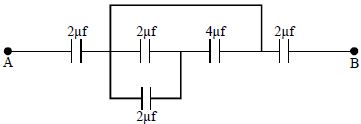
- 2Find the equivalent capacitance between $A$ and $B$.......$\mu f$View Solution
- 3The radius of a metallic sphere if its capacitance is $1/9\,F$, isView Solution
- 4A uniformly charged solid sphere of radius $R$ has potential $V_0$ (measured with respect to $\infty$) on its surface. For this sphere the equipotential surfaces with potentials $\frac{{3{V_0}}}{2},\;\frac{{5{V_0}}}{4},\;\frac{{3{V_0}}}{4}$ and $\frac{{{V_0}}}{4}$ have rasius $R_1,R_2,R_3$ and $R_4$ respectively. ThenView Solution
- 5A parallel plate capacitor having capacitance $12\, pF$ is charged by a battery to a potential difference of $10\, V$ between its plates. The charging battery is now disconnected and a porcelain slab of dielectric constant $6.5$ is slipped between the plates. The work done by the capacitor on the slab is.......$pJ$View Solution
- 6View SolutionThe energy stored in the condenser is
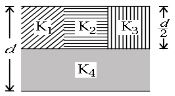
- 7A parallel-plate capacitor of area $A,$ plate separation $d$ and capacitance $C$ is filled with four dielectric materials having dielectric constants $K_1,K_2,K_3$ and $K_4$ as shown in the figure. If a single dielectric material is to be used to have the same capacitance $C$ in this capacitor, then its dielectric constant $K$ is given byView Solution
- 8A parallel plate capacitor has a plate separation of $0.01\, mm$ and use a dielectric (whose dielectric strength is $19\, KV/mm$) as an insulator. The maximum potential difference that can be applied to the terminals of the capacitor is......$V$View Solution
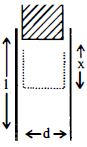
- 9A parallel plate capacitor is made of two plates of length $l$, width $w$ and separated by distance $d$. A dielectric slab ( dielectric constant $K$) that fits exactly between the plates is held near the edge of the plates. It is pulled into the capacitor by a force $F = -\frac{{\partial U}}{{\partial x}}$ where $U$ is the energy of the capacitor when dielectric is inside the capacitor up to distance $x$ (See figure). If the charge on the capacitor is $Q$ then the force on the dielectric when it is near the edge isView Solution
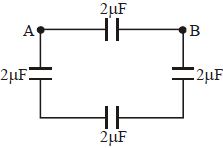
- 10The equivalent capacitance between the points $A$ and $B$ in the given diagram isView Solution