Question
Flux passing through an equipotential surface is always:

Answer

(a)perpendicular to the page.

Need a full question paper?

Generate a complete, print-ready paper with questions like this in minutes — across 16+ boards, with answer keys.
Start Generating Free

Similar questions

An electron in the n = 1 orbit of hydrogen atom is bound by 13.6 eV. If a hydrogen atom is in the n = 3 state, how much energy is required to ionize it(a) 13.6 eV(b) 4.53 eV(c) 3.4 eV (d) 1.51 eV
       
In Young's double$-$slit experiment, the intensity of light at a point on the screen where the path difference is $\lambda$ is $k ( \lambda$ being the wavelength of light used$)$. The intensity at a point where the path difference is $\frac{\lambda}{4},$ will be
 A rod of length l rotates with a small but uniform angular velocity $\omega$ about its perpendicular bisector. A uniform magnetic field B exists parallel to the axis of rotation. The potential difference between the centre of the rod and an end is:
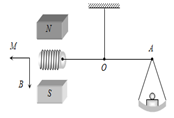
A small coil $C$ with $N = 200$ turns is mounted on one end of a balance beam and introduced between the poles of an electromagnet as shown in figure. The cross sectional area of coil is $A= 1.0 \ cm^2,$ length of arm $OA$ of the balance beam is $l = 30 \ cm$. When there is no current in the coil the balance is in equilibrium. On passing a current $I = 22\ mA$ through the coil the equilibrium is restored by putting the additional counter weight of mass $\triangle m = 60\ mg$ on the balance pan. Find the magnetic induction at the spot where coil is located.
______ of a two particle system depends only on the separation between the two particles. The most appropriate choice for the blank space in the above sentence is:
  1. Kinetic energy.
  2. Total mechanical energy.
  3. Potential energy.
  4. Total energy.
In an elastic collision:
  1. The kinetic energy remains constant.
  2. The linear momentum remains constant.
  3. The final kinetic energy is equal to the initial kinetic energy.
  4. The final linear momentum is equal to the initial linear momentum.
Hydrogen bomb is based on:
The difference between the mass of a nucleus and the total mass of the constituents is its.
Two charged spheres separated at a distance $d$ exert a force $F$ on each other. If they are immersed in a liquid of dielectric constant $2 ,$ then what is the force $($if all conditions are same$)$
Which of the following about potential at a point due to a given point charge is true?
The potential at a point P due to a given point charge.