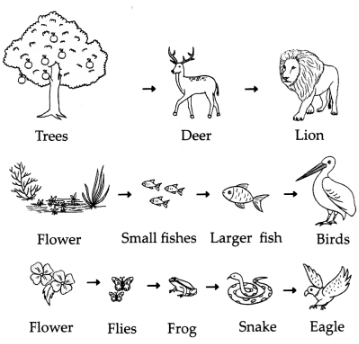
According to the mode of nutrition the organisms are classified into producers, consumers, saprotrophs (saprophytes) and decomposers. Primary consumers are directly dependent on autotrophs (producers), e.g.: Grasshopper, squirrel, elephant) Secondary consumers use herbivores as their food, e.g.: Frog, owl, fox, etc. Apex or top consumers use herbivores and carnivores as their food. No animals feed on top consumers, e.g.: Tiger, lion, etc. Omnivores feed on herbivores and carnivores, e.g.: Humans, bear, etc. A continuous interaction between producers, consumers and decomposers in a definite sequence is called as food chain.
Food chain, in ecology is the sequence of transfers of matter and energy in the form of food from organism to organism. Food chains intertwine locally into a food web because most organisms consume more than one type of animal or plant. Plants, which convert solar energy to food by photosynthesis, are the primary food source. In a predator chain, a plant-eating animal is eaten by a flesh-eating animal. In a parasite chain, a smaller organism consumes part of a larger host and may itself be parasitized by even smaller organisms. In a saprophytic chain, microorganisms live on dead organic matter.