MCQ
For a ball falling in a liquid with constant velocity, ratio of resistance force due to the liquid to that due to gravity is:
  • $1$
  • B
    $\frac29\frac{\text{a}^2\rho\text{g}}{\eta^2}$
  • C
    $\frac29\frac{\text{a}^2(\rho-\sigma)\text{g}}{\eta}$
  • D
    None of these.

Answer

Correct option: A.
$1$
When a body while falling in a viscous liquid moves with a constant velocity $($i.e., attains terminal velocity$),$ the resultant force on the body is zero.
So the viscous force acting upwards is equal to the gravity pull acting downwards.

Need a full question paper?

Generate a complete, print-ready paper with questions like this in minutes — across 16+ boards, with answer keys.

Start Generating Free

Similar questions

A horizontal disc of moment of inertia $4.25 \,kg - m ^2$ with respect to its axis of symmetry is spinning counter clockwise at 15 rps about its axis, as viewed from above. A second disc of moment of inertia $1.80 \,kg - m ^2$ with respect to its axis of symmetry is spinning clockwise at $25 \,rps$ as viewed from above about the same axis and is dropped on top of the first disc. The two discs stick together and rotate as one about their axis of symmetry. The new angular velocity of the system as viewed from above is close to
One mole of an ideal monoatomic gas is compressed isothermally in a rigid vessel to double its pressure at room temperature, $27\,^oC$.The work done on the gas will be
Consider the following two statements
$1.$ Linear momentum of a system of particles is zero
$2.$ Kinetic energy of a system of particles is zeroThen
Three waves of equal frequency having amplitudes $10\mu m,$ $4\mu m,$ $7\mu m$ arrive at a given point with successive phase difference of $\frac{\pi }{2},$ the amplitude of the resulting wave in $\mu m$ is given by
The numbers $2.745$ and $2.735$ on rounding off to $3$ significant figures will give:
What is the ratio of specific heats for a monatomic gas?
If $| A + B |=| A |+| B |$ the angle between $\overrightarrow A $and $\overrightarrow B $ is ....... $^o$
A particle is projected at $60^o $ to the horizontal with a kinetic energy $K$. The kinetic energy at the highest point is
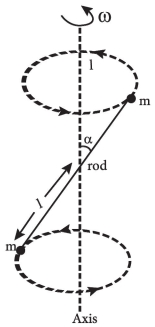
A massless rod $S$ having length $2I$ has equal point masses attached to its two ends as shown in figure. The rod is rotating about an axis passing through its centre and making angle $\alpha$ with the axis. The magnitude of change of momentum of rod i.e. $\left|\frac{ dL }{ dt }\right|$ equals
The unit vector parallel to the resultant of the vectors $\vec A = 4\hat i + 3\hat j + 6\hat k$ and $\vec B = - \hat i + 3\hat j - 8\hat k$ is