For a black body at temperature $727^{\circ} C$, its radiating power is $60\; watt$ and temperature of surrounding is $227^{\circ} C$. If temperature of black body is changed to $1227^{\circ} C$ then its radiating power will be ..... $watt$
AIPMT 2002, Medium


Download our appand get started for free
Experience the future of education. Simply download our apps or reach out to us for more information. Let's shape the future of learning together!No signup needed.*
Similar Questions
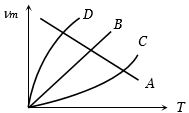
- 1Which of the following is the $\nu_m = T$ graph for a perfectly black body ($\nu_m$ =maximum frequency of radiation)View Solution
- 2View SolutionWhen fluids are heated from the bottom, convection currents are produced because
- 3A tungsten body of diameter $2.3\, cm$ is at $2000\,^oC$. It radiates $30\%$ of the energy radiated by a black body of same radius and temperature. Find radius of black body which will radiate energy at same rate at the same temperature......... $cm$View Solution
- 4At $127^o C$ radiates energy is $2.7 \times 10^{-3} J/s$. At ....... $K$ temperature radiated energy is $4.32 \times 10^6 J/s$View Solution
- 5View SolutionThe Wien’s displacement law express relation between
- 6Instantaneous temperature difference between cooling body and the surroundings obeying Newton's law of cooling is $\theta$. Which of the following represents the variation of $\ln \theta$ with time $t ?$View Solution
- 7A body cools from $60^{\circ} C$ to $40^{\circ} C$ in $6$ minutes. If, temperature of surroundings is $10^{\circ} C$. Then, after the next 6 minutes, its temperature will be $.........{ }^{\circ} C$.View Solution
- 8View SolutionAn ideal black body at room temperature is thrown into a furnace. It is observed that
- 9Two identical objects $A$ and $B$ are at temperatures $T_A$ and $T_B$ respectively. Both objects are placed in a room with perfectly absorbing walls maintained at temperatures T $({T_A} > T > {T_B}).$ The objects A and B attain temperature $T $ eventually which one of the following is correct statementView Solution
- 10View SolutionA hot and a cold body are kept in vacuum separated from each other. Which of the following cause decrease in temperature of the hot body