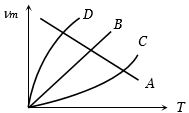
Which of the following is the $\nu_m = T$ graph for a perfectly black body ($\nu_m$ =maximum frequency of radiation)
Easy
Download our app for free and get started
(b) Wein's law ${\lambda _m} \propto \frac{1}{T}$ or ${\nu _m} \propto T$
$v_m$ increases with temperature. So the graph will be straight line.
$v_m$ increases with temperature. So the graph will be straight line.

Download our appand get started for free
Experience the future of education. Simply download our apps or reach out to us for more information. Let's shape the future of learning together!No signup needed.*
Similar Questions
- 1Two identical plates of different metals are joined to form a single plate whose thickness is double the thickness of each plate. If the coefficients of conductivity of each plate are $2$ and $3$ respectively, then the conductivity of composite plate will beView Solution
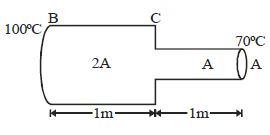
- 2A metal rod of length $2\, m$ has cross-sectional areas $2A$ and $A$ as shown in the following figure. The two ends are maintained at temperatures $100\,^oC$ and $70\,^oC$. The temperature of middle point $C$ is ........ $^oC$View Solution
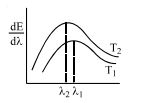
- 3The spectral emissive power $E_\lambda $ for a body at temperature $T_1$ is plotted against the wavelength and area under the curve is found to be $A$. At a different temperature $T_2$ the area is found to be $9A$. Then $\lambda _1/\lambda _2 =$View Solution
- 4View SolutionAs compared to the person with white skin, the person with black skin will experience
- 5View SolutionWhen fluids are heated from the bottom, convection currents are produced because
- 6A cane is taken out from a refrigerator at $0°C$ . The atmospheric temperature is $25°C$ . If $t_1$ is the time taken to heat from $0°C$ to $5°C$ and $t_2$ is the time taken from $10°C$ to $15°C$, thenView Solution
- 7The ratio of thermal conductivity of two rods of different material is $5 : 4$ . The two rods of same area of cross-section and same thermal resistance will have the lengths in the ratioView Solution
- 8If between wavelength $\lambda $and $\lambda + d\lambda $, ${e_\lambda }$and ${a_\lambda }$ be the emissive and absorptive powers of a body and ${E_\lambda }$ be the emissive power of a perfectly black body, then according to Kirchoff's law, which is trueView Solution
- 9Two thermometers $A$ and $B$ are exposed in sun light. The valve of $A$ is painted black, But that of $B$ is not painted. The correct statement regarding this case isView Solution
- 10A cylinder of radius $R$ is surrounded by a cylindrical shell of inner radius $R$ and outer radius $2R$. The thermal conductivity of the material of the inner cylinder is $K_1$ and that of the outer cylinder is $K_2$. Assuming no loss of heat, the effective thermal conductivity of the system for heat flowing along the length of the cylinder isView Solution