MCQ
For a body executing $S.H.M. :$

$(a)$ Potential energy is always equal to its $K.E.$

$(b)$ Average potential and kinetic energy over any given time interval are always equal.

$(c)$ Sum of the kinetic and potential energy at any point of time is constant.

$(d)$ Average $K.E.$ in one time period is equal to average potential energy in one time period.

Choose the most appropriate option from the options given below:

  • $(c)$ and $(d)$
  • B
    only $(c)$
  • C
    $(b)$ and $(c)$
  • D
    only $(b)$

Answer

Correct option: A.
$(c)$ and $(d)$
a
In $S.H.M.$ total mechanical energy remains constant and also $<{K} . {E} .>=<{P} . {E}>=\frac{1}{4} {KA}^{2}$

(for $1$ time period)

Need a full question paper?

Generate a complete, print-ready paper with questions like this in minutes — across 16+ boards, with answer keys.

Start Generating Free

Similar questions

A particle of mass $2\, kg$ is moving such that at time $t$, its position, in meter, is given by $\overrightarrow r \left( t \right) = 5\hat i - 2{t^2}\hat j$ . The angular momentum of the particle at $t\, = 2\, s$ about the origin in $kg\, m^{-2}\, s^{-1}$ is
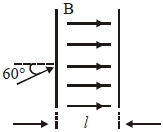
The figure shows a region of length $'l'$ with a uniform magnetic field of $0.3\, T$ in it and a proton entering the region with velocity $4 \times 10^{5}\, ms ^{-1}$ making an angle $60^{\circ}$ with the field. If the proton completes $10$ revolution by the time it cross the region shown, $l$ is close to....... $m$

(mass of proton $=1.67 \times 10^{-27} \,kg ,$ charge of the proton $\left.=1.6 \times 10^{-19}\, C \right)$

A particle moving with a uniform acceleration travels $24 \,m$ and $64\, m$ in the first two consecutive intervals of $4 \,sec$ each. Its initial velocity is............$m/sec$
A proton and an electron have the same de Broglie wavelength. If $K_p$ and $K_e$ be the kinetic energies of proton and electron respectively. Then choose the correct relation :
Which among the following is true
Sunlight of intensity $1.3 kW m ^{-2}$ is incident normally on a thin convex lens of focal length $20 cm$. Ignore the energy loss of light due to the lens and assume that the lens aperture size is much smaller than its focal length. The average intensity of light, in $kW m ^{-2}$, at a distance $22 cm$ from the lens on the other side is. . . . .
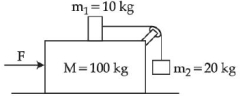
Three masses $M =100\,kg , m _{1}=10\,kg$ and $m_{2}=20\,kg$ are arranged in a system as shown in figure. All the surfaces are frictionless and strings are inextensible and weightless. The pulleys are also weightless and frictionless. $A$ force $F$ is applied on the system so that the mass $m_{2}$ moves upward with an acceleration of $2\,ms ^{-2}$. The value of $F$ is $......N$

$\left(\right.$ Take $\left.g =10\,ms ^{-2}\right)$

A body, whose momentum is constant, must have constant
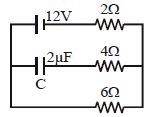
Charge on the capacitor in the given circuit in steady state condition is :- ............... $\mu C$
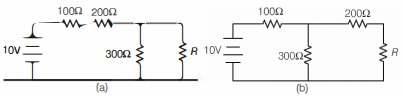
A student was trying to construct the circuit shown in the figure below marked $(a)$, but ended up constructing the circuit marked $(b)$. Realising her mistake, she corrected the circuit, but to her surprise, the output voltage (across $R$ ) did not change. The value of resistance $R$ is ............ $\Omega$