Which among the following is true
Medium


Download our appand get started for free
Experience the future of education. Simply download our apps or reach out to us for more information. Let's shape the future of learning together!No signup needed.*
Similar Questions
- 1View SolutionA constant voltage is applied between the two ends of a uniform metallic wire. Some heat is developed in it. The heat developed is double if
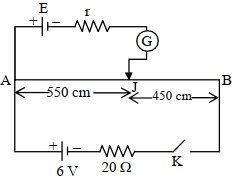
- 2In the given figure, there is a circuit of potentiometer of length $A B=10 \,{m}$. The resistance per unit length is $0.1 \,\Omega$ per ${cm}$. Across ${AB}$, a battery of emf ${E}$ and internal resistance ' ${r}^{\prime}$ is connected. The maximum value of emf measured by this potentiometer is : (In $V$)View Solution
- 3It takes $12$ minutes to boil $1$ litre of water in an electric kettle. Due to some defect it becomes necessary to remove $20 \%$ turns of heating coil of the kettle. After repair, how much time will it take to boil $1$ litre of water.View Solution
- 4$n$ identical cells are joined in series with two cells $A$ and $B$ with reversed polarities. $emf$ of each cell is $E$ and internal resistance is $r$. Potential difference across cell $A$ and $B$ is : $(n > 4)$View Solution
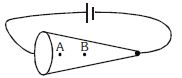
- 5View SolutionSuppose a current carrying wire has a cross-sectional area that, gradually become smaller along the wire, has the shape of a very long cone as shown in figure. Choose the correct statement
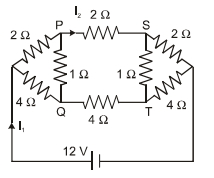
- 6For the resistance network shown in the figure, choose the correct option$(s)$. $Image$View Solution
$(A)$ The current through $P Q$ is zero.
$(B)$ $I_1=3 A$.
$(C)$ The potential at $S$ is less than that at $Q$.
$(D)$ $I _2=2 A$.
- 7A potentiometer wire of length $L$ and a resistance $r$ are connected in series with a battery of e.m.f. $E_0$ and a resistance $r_1$. An unknown e.m.f. $E$ is balanced at a length $l$ of the potentiometer wire. The e.m.f. $E$ will be given byView Solution
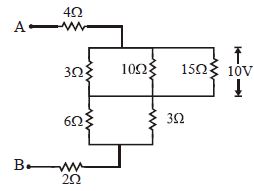
- 8Calculate the potential difference between, points $A$ and $B$ and current flowing in $10\,\Omega $ resistor in the part of network belowView Solution
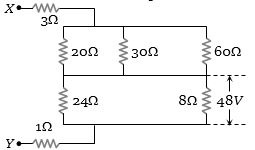
- 9The potential difference across $8\, ohm$ resistance is $48\, volt$ as shown in the figure. The value of potential difference across $X$ and $Y$ points will be ............. $volt$View Solution
- 10View SolutionIf a high power heater is connected to electric mains, then the bulbs in the house become dim, because there is a