Question
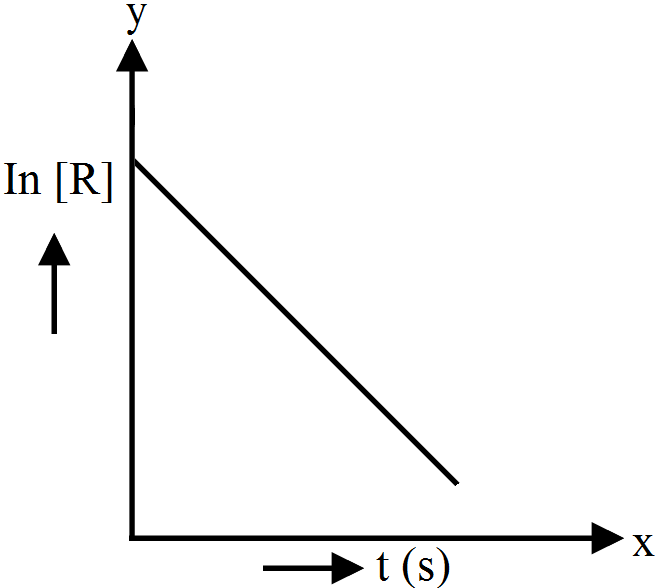
For a certain chemical reaction variation in the concentration ln [R] vs. time plot is given alongside.

For this reaction:

  1. What is the order of the reaction?
  2. What are the units of rate constant k?
  3. Give the relationship between k and t1/2 (half-life period).
  4. What is the slope of the curve?
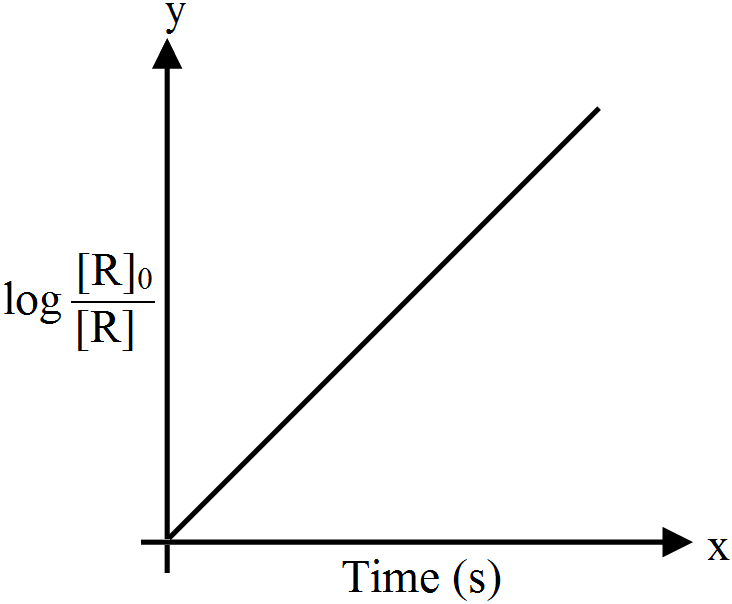
  5. Draw the plot log [R]0 /[R] vs time t(s).
Answer

  1. First order.
  2. Time-1 (s-1)
  3. $\text{k}=\frac{0.693}{\text{t}_{1/2}}$
  4. Slope = - k (rate constant).
  5.  

Need a full question paper?

Generate a complete, print-ready paper with questions like this in minutes — across 16+ boards, with answer keys.

Start Generating Free

Similar questions

Expian the basic properties of amines.
Mention the type of compounds formed when small atoms like H, C and N get trapped inside the crystal lattice of transition metals. Also give physical and chemical characteristics of these compounds.
Describe the reactions of -COOH group present in carboxylic acids.
Match the property given in Column I with the element given in Column II.
 
Column I (Property)
 
Column II (Element)
(i)
Lanthanoid which shows +4 oxidation state
(a)
Pm
(ii)
Lanthanoid which can show +2 oxidation state
(b)
Ce
(iii)
Radioactive lanthanoid
(c)
Lu
(iv)
Lanthanoid which has 4felectronic configuration in +3 oxidation state
(d)
Eu
(v)
 Lanthanoid which has 4f14 electronic configuration in +3 oxidation state
(e)
Gd
 
 
(f)
Dy
What are the similarities between lanthanoids and actinoids?
  1. What are essential and non-essential amino acids? Give two examples of each.
  2. What are the two types of photosynthesis in green plants? Give the basic equations of photosynthesis.
  3. Mention the two products of glycolysis.
At 291K, the molar conductivities at infinite dilution of NH4Cl, NaOH and NaCl are 129.8, 217.4 and 108.9S cm2 mol-1 respectively. If the molar conductivity of a centinormal solution of NH4OH is 9.33S cm2 mol-1, what is the percentage dissociation of NH4OH at this dilution? Also calculate the dissociation constant of NH4OH.
Why is it not possible to obtain pure ethanol by fractional distillation? What general name is given to binary mixtures which show deviation from Raoult’s law and whose components cannot be separated by fractional distillation. How many types of such mixtures are there?
Concentration terms such as mass percentage, ppm, mole fraction and molality are independent of temperature, however molarity is a function of temperature. Explain.
After watching a programme on TV about the presence of carcinogens (cancer causing agents) Potassium bromate and Potassium iodate in bread and other bakery products, Veena, a class XII student, decided to make others aware about the adverse effects of these carcinogens in foods. She consulted the school principal and requested him to instruct the canteen contractor to stop selling sandwiches, pizzas, burgers and other bakery products to the students. The principal took an immediate action and instructed the canteen contractor to replace the bakery products with some proteins and vitamins-rich food like fruits, salads, sprouts, etc. The decision was welcomed by the parents and students.
After reading the above passage, answer the following questions:
  1. What are the values (at least two) displayed by Veena?
  2. Which polysaccharide component of carbohydrates is commonly present in bread?
  3. Write the two types of secondary structures of proteins.
  4. Give two examples of water soluble vitamins.