A certain reaction is 50% complete in 20 minutes at 300 K and the same reaction is again 50% complete in 5 minutes at 350 K. Calculate the activation energy if it is a first order reaction. [R = 8.314$$ JK-1mol-1, log 4 = 0.602].
View full solution →Question types
Chemical Kinetics question types
203 questions across 6 question groups — pick any mix to generate a Chemistry paper with step-by-step answer keys.
203
Questions
6
Question groups
5
Question types
01
2 Marks Questions
63 Q→023 Marks Question
66 Q→031 Marks Question
6 Q→04Case study (4 Marks)
11 Q→05M.C.Q (1 Marks)
35 Q→065 Marks Questions
22 Q→Sample Questions
Chemical Kinetics questions
One sample from each question group in this chapter. Select any group above to see the full set with answer keys.
How is the concept of coupling reactions useful in explaining the occurrence of non spontaneous thermochemical reactions? Explain giving an example.
For the first order thermal decomposition reaction, the following data were obtained:
$\text{C}_{2}\text{H}_{5}\text{Cl}\text{(g)}\rightarrow \text{C}_{2}\text{H}_{4}\text{(g)} + \text{HCl}\text{(g)} $
Calculate the rate constant
(Given: log 2 = 0.301, log 3=0.4771, log 4 =0.6021)
View full solution →$\text{C}_{2}\text{H}_{5}\text{Cl}\text{(g)}\rightarrow \text{C}_{2}\text{H}_{4}\text{(g)} + \text{HCl}\text{(g)} $
| Time/sec | Total pressure/atm |
| 0 | 0.30 |
| 300 | 0.50 |
(Given: log 2 = 0.301, log 3=0.4771, log 4 =0.6021)
A first order reaction takes 20 minutes for 25% decomposition. Calculate the time when 75% of the reaction will be completed. (Given : log 2 = 0·3010, log 3 = 0·4771, log 4 = 0·6021)
The following data were obtained during the first order thermal decomposition of SO2Cl2 at a constant volume:
SO2Cl2(g) $\rightarrow$SO2(g) + Cl2(g)
Calculate the rate constant.
(Given: log4 = 0.6021, log2 = 0.3010).
View full solution →SO2Cl2(g) $\rightarrow$SO2(g) + Cl2(g)
| Experiment | Time/s–1 | Total pressure/atm |
| 1 | 0 | 0.4 |
| 2 | 100 | 0.7 |
(Given: log4 = 0.6021, log2 = 0.3010).
How is the concept of coupling reactions useful in explaining the occurrence of non spontaneous thermochemical reactions? Explain giving an example.
A certain reaction is 50% complete in 20 minutes at 300 K and the same reaction is again 50% complete in 5 minutes at 350 K. Calculate the activation energy if it is a first order reaction. [R = 8.314$$ JK-1mol-1, log 4 = 0.602].
View full solution →For the first order thermal decomposition reaction, the following data were obtained:
$\text{C}_{2}\text{H}_{5}\text{Cl}\text{(g)}\rightarrow \text{C}_{2}\text{H}_{4}\text{(g)} + \text{HCl}\text{(g)} $
Calculate the rate constant
(Given: log 2 = 0.301, log 3=0.4771, log 4 =0.6021)
View full solution →$\text{C}_{2}\text{H}_{5}\text{Cl}\text{(g)}\rightarrow \text{C}_{2}\text{H}_{4}\text{(g)} + \text{HCl}\text{(g)} $
| Time/sec | Total pressure/atm |
| 0 | 0.30 |
| 300 | 0.50 |
(Given: log 2 = 0.301, log 3=0.4771, log 4 =0.6021)
A first order reaction takes 20 minutes for 25% decomposition. Calculate the time when 75% of the reaction will be completed. (Given : log 2 = 0·3010, log 3 = 0·4771, log 4 = 0·6021)
The following data were obtained during the first order thermal decomposition of SO2Cl2 at a constant volume:
SO2Cl2(g) $\rightarrow$SO2(g) + Cl2(g)
Calculate the rate constant.
(Given: log4 = 0.6021, log2 = 0.3010).
View full solution →SO2Cl2(g) $\rightarrow$SO2(g) + Cl2(g)
| Experiment | Time/s–1 | Total pressure/atm |
| 1 | 0 | 0.4 |
| 2 | 100 | 0.7 |
(Given: log4 = 0.6021, log2 = 0.3010).
For the reaction R → P, the concentration of a reactant changes from 0.03M to 0.02M in 25 minutes. Calculate the average rate of reaction using units of time both in minutes and seconds.
In a reaction, 2A → Products, the concentration of A decreases from 0.5 mol L–1 to 0.4 mol L–1 in 10 minutes. Calculate the rate during this interval?
For a reaction, A + B → Product; the rate law is given by, r = k [ A]1/2 [B]2. What is the order of the reaction?
Define 'order of a reaction'.
Write the rate equation for the reaction $2\text{A + B}\xrightarrow{\ \ \ \ \ \ }\text{C}$ if the order of the reaction is zero.
View full solution →Decrease in concentration of reactant or increase in concentration of product per unit time is called rate of reaction. lt is of two types:
View full solution →- Instantaneous rate of reaction: Rate of change of concentration of reactant or product at a particular time is called instantaneous rate of reaction.
$\text{r}_\text{inst.}=\frac{\text{dC}}{\text{dt}}$
where, dC = infinitely small change in concentration
dt = infinitely small change in time.
- Average rate of reaction: Ratio of change in concentration and time required for the change is average rate of reaction.
$\text{r}_\text{av}=\frac{\triangle\text{x}}{\triangle\text{t}}=\frac{\text{Change in concentration}}{\text{Time required for the change}}$
For a reaction of the type, m1A + m2B → n1C + n2D
Rate of reaction is given as
$\frac{1}{\text{m}_1}\frac{\text{d[A]}}{\text{dt}}=-\frac{1}{\text{m}_2}\frac{\text{d[B]}}{\text{dt}}=+\frac{1}{\text{n}_1}\frac{\text{d[C]}}{\text{dt}}=+\frac{1}{\text{n}_2}\frac{\text{d[D]}}{\text{dt}}$
In these questions (Q. No. i-iv), a statement of assertion followed by a statement ofreason is given. Choose the correct answer out of the following choices.
- Assertion and reason both are correct statements and reason is correct explanation for assertion.
- Assertion and reason both are correct statements but reason is not correct explanation for assertion.
- Assertion is correct statement but reason is wrong statement.
- Assertion is wrong statement but reason is correct statement.
- Assertion: The kinetics of the reaction, $\text{mA}+\text{nB}+\text{pC}\rightarrow\text{m}'\text{ X}+\text{n}'\text{ Y}+\text{p}'\text{ Z}$ obey the rate expression as $\frac{\text{dx}}{\text{dt}}=\text{k}[\text{A}]^\text{m}[\text{B}]^\text{n}.$
Reason: The rate of the reaction does not depend upon the concentration of C.
- Assertion: Instantaneous rate of reaction is equal to $\frac{\text{dx}}{\text{dt}}.$
Reason: lt is the rate of reaction at any particular instant of time.
- Assertion: For the reaction, $\text{RCl}+\text{NaOH}\rightarrow\text{ROH}+\text{NaCl},$ the rate of reaction is reduced to half on reducing the concentration of RCl to half.
Reason: The rate of reaction is represented by k[RCl].
- Assertion: ln rate law, unlike in the expression for equilibrium constants, the exponents for concentrations do not necessarily match the stoichiometric coefficients.
Reason: It is the mechanism and not the balanced chemical equation for the overall change that governs the reaction rate.
- Assertion: ln a reaction, 2A + B → A2B, the reactant B will disappear at twice the rate as A will decrease.
Reason: The rate of disappearance of reactant will be $-\frac{1}{2}\frac{\text{d[A]}}{\text{dt}}=-\frac{\text{d[B]}}{\text{dt}}$
The following reaction, $\text{A}_{(\text{g})}\xrightarrow{\ \ \triangle\ \ \ }\text{P}_{(\text{g})}+\text{Q}_{(\text{g})}+\text{R}_{(\text{g})},$ follows first order kinetics. The half-life period of this reaction is 69.3s at 500ºC. The gas A is enclosed in a container at 500ºC and at a pressure of 0.4 atm.
The following questions are multiple choice questions. Choose the most appropriate answer:
View full solution →The following questions are multiple choice questions. Choose the most appropriate answer:
- The rate constant for the reaction is:
- 0.4s-1
- 0.02s-1
- 0.01s-1
- 0.3s-1
- The pressure of the gas A after 230 s will be:
- 0.04 atm
- 0.36 atm
- 0.4 atm
- 0.036 atm
- The total pressure of the system after 230 swill be:
- 2.15 atm
- 1.12 atm
- 0.4 atm
- 3.08 atm
- The plot ofln[A] vs twill be:
- Linear with slope = k
- Linear with intercept = In[A]0
- Linear with slope = In[A]0
- Linear with intercept = [A]0
- Which of the following is not an example of first order reaction?
- $\text{C}_2\text{H}_{4(\text{g})}+\text{H}_{2(\text{g})}\rightarrow\text{C}_2\text{H}_{6(\text{g})}$
- $2\text{N}_2\text{O}_{5(\text{g})}\rightarrow4\text{NO}_{2(\text{g})}+\text{O}_{2(\text{g})}$
- $2\text{N}\text{H}_{3(\text{g})}\xrightarrow[\triangle]{\text{pt}}\text{N}_{2(\text{g})}+3\text{H}_{2(\text{g})}$
- $2\text{N}_2\text{O}_{(\text{g})}\xrightarrow{\ \ \triangle\ \ }2\text{N}_{2(\text{g})}+\text{O}_{2(\text{g})}$
Number of molecules which must collide simultaneously to give product is called molecularity. It is equal to sum of coefficients of reactants present in stoichiometric chemical equation. For reaction, m1A + m2B → Product Molecularity = [m1 + m2] ln complex reaction each step has its own molecularity which is equal to the sum of coefficients of reactants present in a particular step. Molecularity is a theoretical property. Its value is any whole number. Number of concentration terms on which rate of reaction depends is called order of reaction or sum of powers of concentration terms present in the rate equation is called order of reaction. If rate equation ofreaction is: Rate $=\text{k}\cdot\text{C}^{\text{m}_1}_\text{A}\cdot\text{C}^{\text{m}_2}_\text{B}$ Then order of reaction = m1 + m2. ln simple reaction, order and molecularity are same. ln complex reaction, order of slowest step is the order ofover all reaction. This step is known as rate determining step. Order is an experimental property. Its value may be zero, fractional or negative. The following questions are multiple choice questions. Choose the most appropriate answer:
View full solution →- Higher order(> 3) reactions are rare due to:
- Shifting of equilibrium towards reactants due to elastic collisions.
- Loss of active species on collision.
- Low probability of simultaneous collision of all the reacting species.
- Increase in entropy and activation energy as more molecules are involved.
- The molecularity of the reaction:
$6\text{FeSO}_4+3\text{H}_2\text{SO}_4+\text{KClO}_3\rightarrow\text{KCl}+3\text{Fe}_2(\text{SO}_4)_3+3\text{H}_2\text{O}$ is:
- 6
- 10
- 3
- 7
- Which of the following statements is false in the following?
- Order of a reaction may be even zero.
- Molecularity of a reaction is always a whole number.
- Molecularity and order always have same values for a reaction.
- Order of a reaction depends upon the mechanism of the reaction.
- The rate of reaction, A + 2B → products, is given by the following equation:
$-\frac{\text{d}[\text{A}]}{\text{dt}}=\text{k}[\text{A}][\text{B}]^2$
If B is present in large excess, the order of the reaction is:
- Zero
- First
- Second
- Third
- The rate of the reaction, A + B + C → products, is given by $\text{r}=\frac{\text{d}[\text{A}]}{\text{dt}}=\text{k}[\text{A}]^\frac{1}{2}[\text{B}]^\frac{1}{3}[\text{C}]^\frac{1}{4}.$ The order of the reaction is:
- $\frac{1}{3}$
- $\frac{1}{4}$
- $\frac{1}{2}$
- $\frac{13}{12}$
A reaction is said to be of the first order if the rate of the reaction depends upon one concentration term only. For a first order reaction of the type A → Products, the rate of the reaction is given as: rate = k[A]. The differential rate law is given as: $\frac{\text{dA}}{\text{dt}}=-\text{k}[\text{A}].$ The integrated rate law is: In $\frac{[\text{A}]}{[\text{A}]_0}=-\text{kt},$ [A] is the concentration of reactant left at time t and [A]0 is the initial concentration of the reactant, k is the rate constant.
The following questions are multiple choice questions. Choose the most appropriate answer:
View full solution →The following questions are multiple choice questions. Choose the most appropriate answer:
- The unit of rate constant for a first order reaction is:
- S-1
- mol L-1 s-1
- L mol-1 s-1
- L2 mol-2 s-1
- Half-life period of a first order reaction is 10min. Starting with initial concentration 12M, the rate after 20min is:
- 0.693 × 3M min-1
- 0.0693 × 4M min-1
- 0.0693 × M min-1
- 0.0693 × 3M min-1
- 50% of a first order reaction is complete in 23 minutes. Calculate the ti me required to complete 90% of the reaction.
- 70.4 minutes.
- 76.4 minutes.
- 38.7 minutes.
- 35.2 minutes.
- For a first order reaction, (A) → products, the concentration of A changes from 0.1M to 0.025M in 40 minutes. The rate of reaction when the concentration of A is 0.01M, is:
- 3.47 × 10⁻⁴ M/ min
- 3.47 × 10⁻⁵ M/ min
- 1.73 × 10⁻⁴ M/ min
- 1.73 × 10⁻⁵ M/ min
- The half-life period ofa 1st order reaction is 60 minutes. What percentage will be left over after 240 minutes?
- 6.25%
- 4.25%
- 5%
- 6%
The progress of the reaction, $\text{A}\rightleftharpoons\text{nB}$ with time is represented in the following figure:
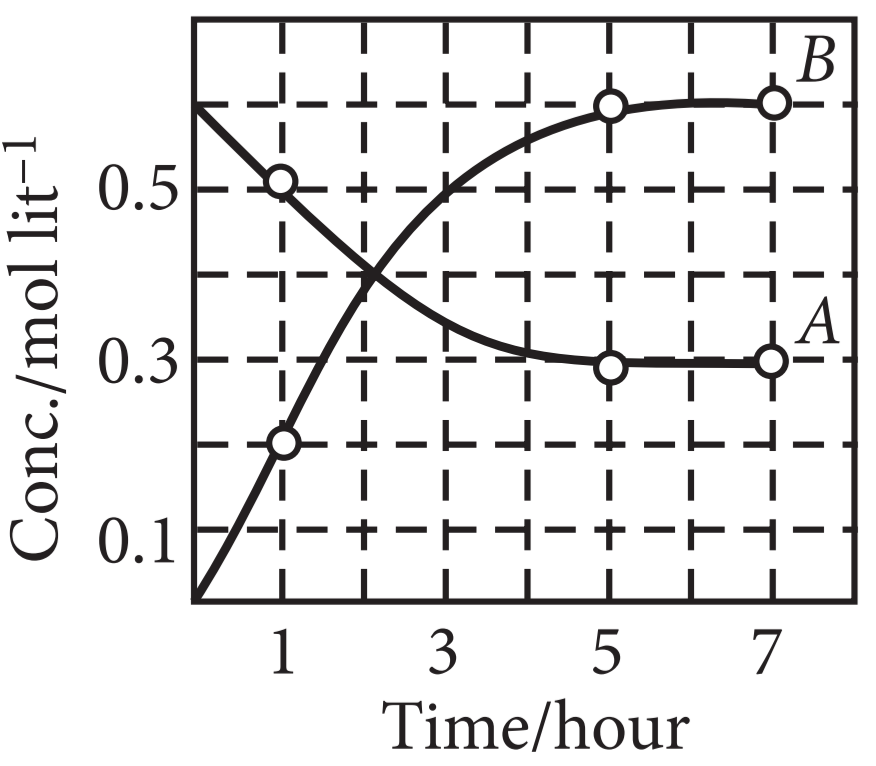
The following questions are multiple choice questions. Choose the most appropriate answer:
View full solution →The following questions are multiple choice questions. Choose the most appropriate answer:
- What is the value of n?
- 1
- 2
- 3
- 4
- Find the value of the equilibrium constant.
- 0.6M
- 1.2M
- 0.3M
- 2.4M
- The initial rate of conversion of A will be:
- 0.1 mol L-1hr-1
- 0.2 mol L-1hr-1
- 0.4 mol L-1hr-1
- 0.8 mol L-1hr-1
- For the reaction, if $\frac{\text{d}[\text{B}]}{\text{dt}}=2\times10^{-4},$ value of $-\frac{\text{d}[\text{A}]}{\text{dt}}$ will be:
- 2 × 10⁻⁴
- 10-4
- 4 × 10⁻⁴
- 0.5 × 10⁻⁴
- Which factor has no effect on rate of reaction?
- Temperature.
- Nature of reactant.
- Concentration of reactant.
- Molecularity.
The reactions having very high values of energy of activation are generally________.
- AVery slow
- BVery fast
- CSpontaneous
- DMedium fast.
Which of the following is not correct reason for the substantially lower rate of reaction than the collision frequency?
- AAll the collisions do not attain threshold energy level.
- BThe activated complex formed is short lived.
- CAll the collisions do not have proper orientation.
- DEffective collision are lesser in number than all collisions.
In general, the rate of a reaction can be increased by all the factors except:
- AIncreasing the temperature.
- BIncreasing the concentration of reactants.
- CIncreasing the activation energy.
- DUsing a catalyst.
If hydrogen and oxygen are mixed and kept in the same vessel at room temperature, the reaction does not take place to form water because:
- AActivation energy for the reaction is very high at room temperature.
- BMolecules have no proper orientation to react to form water.
- CThe frequency of collisions is not high enough for the reaction to take place.
- DNo catalyst is present in the reaction mixture.
For a hypothetical reaction: A + B → Products, the rate law is r = k[A][B]0. The order of reaction is:
- A0
- B1
- C2
- D3
The experimental data for decomposition of N2O5
[2N2O5 → 4NO2 + O2]
in gas phase at 318K are given below:
[2N2O5 → 4NO2 + O2]
in gas phase at 318K are given below:
| t/s | 0 | 400 | 800 | 1200 | 1600 | 2000 | 2400 | 2800 | 3200 |
| 102 × [N2O5]/mol L-1 | 1.63 | 1.36 | 1.14 | 0.93 | 0.78 | 0.64 | 0.53 | 0.43 | 0.35 |
- Plot [N2O5] against t.
- Find the half-life period for the reaction.
- Draw a graph between log[N2O5] and t.
- What is the rate law?
- Calculate the rate constant.
- Calculate the half-life period from k and compare it with (ii).
The rate constant for the decomposition of N2O5 at various temperatures is given below:
Draw a graph between ln k and 1/T and calculate the values of A and Ea. Predict the rate constant at 30° and 50°C.
| T/°C | 0 | 20 | 40 | 60 | 80 |
| 105 × k/s-1 | 0.0787 | 1.70 | 25.7 | 178 | 2140 |
The rate constant for the first order decomposition of H2O2 is given by the following equation:
log k = 14.34 – 1.25 × 10⁴K/T
Calculate Ea for this reaction and at what temperature will its half-period be 256 minutes?
log k = 14.34 – 1.25 × 10⁴K/T
Calculate Ea for this reaction and at what temperature will its half-period be 256 minutes?
The time required for 10% completion of a first order reaction at 298K is equal to that required for its 25% completion at 308K. If the value of A is 4 × 10¹⁰s–1. Calculate k at 318K and Ea.
The experimental data for decomposition of N2O5
[2N2O5 → 4NO2 + O2]
in gas phase at 318K are given below:
[2N2O5 → 4NO2 + O2]
in gas phase at 318K are given below:
| t/s | 0 | 400 | 800 | 1200 | 1600 | 2000 | 2400 | 2800 | 3200 |
| 102 × [N2O5]/mol L-1 | 1.63 | 1.36 | 1.14 | 0.93 | 0.78 | 0.64 | 0.53 | 0.43 | 0.35 |
- Plot [N2O5] against t.
- Find the half-life period for the reaction.
- Draw a graph between log[N2O5] and t.
- What is the rate law?
- Calculate the rate constant.
- Calculate the half-life period from k and compare it with (ii).
Generate a Chemical Kinetics paper free
Pick question groups from the list above, set marks and difficulty, and export a branded PDF with step-by-step answer keys. First 3 chapters free — no signup.