Question
For a certain chemical reaction variation in the concentration ln $[R]$ vs. time plot is given alongside.For this reaction:
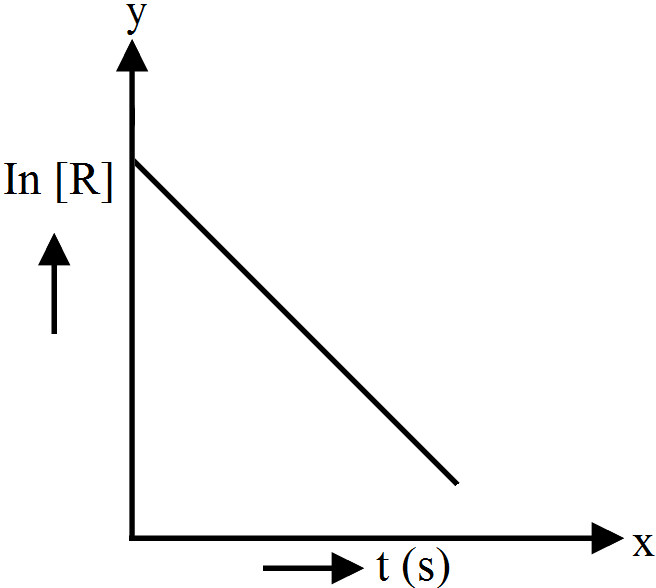
  1. What is the order of the reaction?
  2. What are the units of rate constant $k$?
  3. Give the relationship between $k$ and $t1/2$ (half-life period).
  4. What is the slope of the curve?
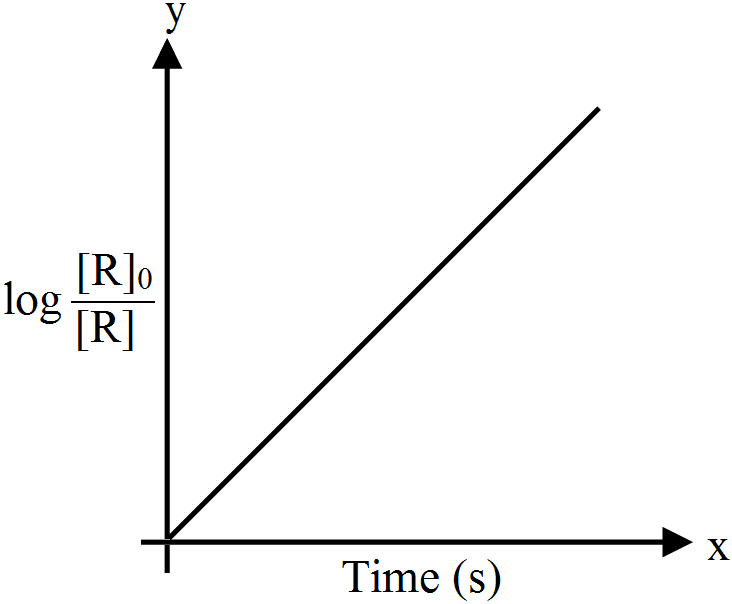
  5. Draw the plot log $[R]0 /[R]$ vs time $t(s)$.
Answer

  1. First order.
  2. $Time^{-1} (s^{-1})$
  3. $\text{k}=\frac{0.693}{\text{t}_{1/2}}$
  4. Slope = - k (rate constant).
  5.  

Need a full question paper?

Generate a complete, print-ready paper with questions like this in minutes — across 16+ boards, with answer keys.

Start Generating Free

Similar questions

$(a).$ Out of formic acid and acetic acid, which one will give the $HVZ$ reaction? Give a suitable reason in support of your answer and write the chemical reaction involved.
$(b).$ Alcohols are acidic but they are weaker acids than water. Arrange various isomers of butanol in the increasing order of their acidic nature. Give a reason for the same.
$(c).$ An organic compound $A$ which is a Grignard reagent is used to obtain $2-$methylbutan$-2-ol$ on reaction with a carbonyl compound $'B \ '.$ Identify $'A \ '$ and $'B \ '.$ Write the equation for the reaction between $A$ and $B.$
Answer the following question:
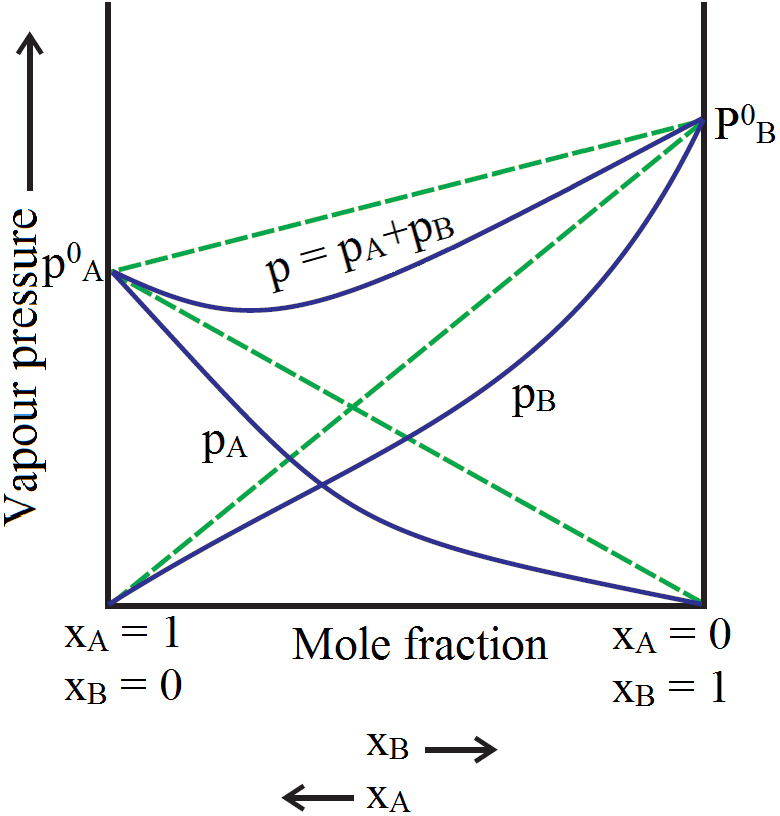
The graphical representation of vapour pressures of two component system as a function of composition is given alongside. By graphic inspection, answer the following questions:
  1. Are the A-B interactions weaker, stronger or of the same magnitude as A-A and B-B?
  2. Name the type of deviation shown by this system from Raoult’s law.
  3. Predict the sign of $\Delta_\text{mix}\text{H}$ for this system.
  4. Predict the sign of $\Delta_\text{mix}\text{H}$ for this system.
  5. Give an example of such a system.
  6. What type of azeotrope will this system form, if possible?
Explain the open chain structure of glucose.
$(a).$ Give reasons for the following:
$(i)$ The reaction of ethanol with acetyl chloride is carried out in the presence of pyridine.
$(ii)$ Cresols are less acidic than phenol.
$(b).$ Williamson's process is used for the preparation of ethers from alkyl halide. Identify the alkyl bromide and sodium alkoxide used for the preparation of $2-$ Ethoxy$-3-$methylpentane
$(c).$ Convert:
$(i) $ Toluene to $3-$nitrobenzoic acid.
$(ii)$ Benzene to $m-$nitroacetophenone.
Match the statements given in Column I with the oxidation states given in Column II.
 
Column I
 
Column II
$(i)$
Oxidation state of $Mn$ in $MnO2$ is
$(a)$
$+2$
$(ii)$
Most stable oxidation state of $Mn$ is
$(b)$
$+3$
$(iii)$
Most stable oxidation state of $Mn$ in oxides is
$(c)$
$+4$
$(iv)$ Characteristic oxidation state of lanthanoids is
$(d)$
$+5$
    $(e)$ $+7$
Assign reasons for the following:
  1. Sulphur vapour is paramagnetic.
  2. Ammonia $(NH_3)$ has greater affinity for protons than phosphine $(PH_3)$.
  3. The negative value of electron gain enthalpy of fluorine is less than that of chlorine.
  4. $SF_6$​​​​​​​ is much less reactive than $SF_4$​​​​​​​.
  5. Of the noble gases only xenon is known to form well-established chemical compounds.
Answer the following question:
Calculate the molality of a sulphuric acid solution in which the mole fraction of water is 0.85.
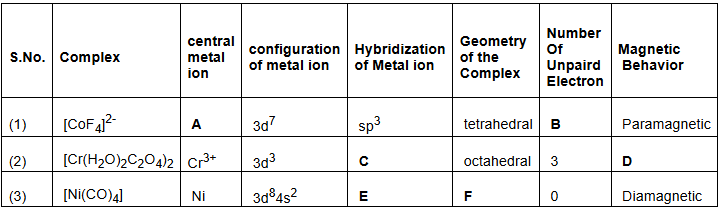
$(a).$ Using, Valence Bond Theory identify $A, B, C, D, E$ and $F$ in the following table:
Image
$(b).$ Write the ionic equations for the reaction of acidified $K_2Cr_2O_7$ with
$(i) \ H_2S$ and $(ii) \ FeSO_4$
Discuss the different chemical properties of amines.
Discus in detail the following $C - H$ bond cleavage reactions of ether :
(i) Peroxide formation
(ii) Halogenation