For a certain organ pipe three successive resonance frequencies are observed at $425 \,\,Hz$, $595\,\, Hz$ and $765\,\, Hz$ respectively. If the speed of sound in air is $340 \,\,m/s$, then the length of the pipe is .... $m$
Diffcult
Download our app for free and get started
since frequencies are in odd number ratio, the pipe has to be a closed pipe.
Ratio of $3$ frequencies $=425: 595: 765$
$=5: 7: 9$
So fundamental frequency $=f=\frac{425}{5}=85 H z$
For fundamental frequency
$l=\frac{v}{4 f}=\frac{340}{4 \times 85}=1 m$

Download our appand get started for free
Experience the future of education. Simply download our apps or reach out to us for more information. Let's shape the future of learning together!No signup needed.*
Similar Questions
- 1In order to double the frequency of the fundamental note emitted by a stretched string, the length is reduced to $\frac{3}{4}$$^{th}$ of the original length and the tension is changed. The factor by which the tension is to be changed, isView Solution
- 2A train moves towards a stationary observer with speed $34 m/s$. The train sounds a whistle and its frequency registered by the observer is ${f_1}$. If the train’s speed is reduced to $17\, m/s$, the frequency registered is ${f_2}$. If the speed of sound is 340 m/s then the ratio ${f_1}/{f_2}$ isView Solution
- 3View SolutionSound waves travel fastest in
- 4A closed organ pipe of length $L$ and an open organ pipe contain gases of densities $\rho_{1}$ and $\rho_{2}$ respectively. The compressibility of gases are equal in both the pipes. Both the pipes are vibrating in their first overtone with same frequency. The length of the open pipe is $\frac{ x }{3} L \sqrt{\frac{\rho_{1}}{\rho_{2}}}$ where $x$ is ......... . (Round off to the Nearest Integer)View Solution
- 5The equation of the propagating wave is $y = 25\sin (20t + 5x),$ where $y$ is displacement. Which of the following statement is not trueView Solution
- 6The equation of a progressive wave is $y = 8\sin \left[ {\pi \left( {\frac{t}{{10}} - \frac{x}{4}} \right) + \frac{\pi }{3}} \right]$. The wavelength of the wave is .... $m$View Solution
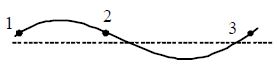
- 7The diagram below shows as instantaneous position of a string as a transverse progressive wave travels along it from left to right Which one of the following correctly shows the direction of the velocity of the points $1,2$ and $3$ on the stringView Solution
- 8View SolutionWhen a wave travelling in medium is reflected from the boundary of a denser medium, which of the following will not change?
- 9View SolutionIn stationary waves, antinodes are the points where there is
- 10A source and a detector move away from each other in absence of wind with a speed of $20\, {m} / {s}$ with respect to the ground. If the detector detects a frequency of $1800\, {Hz}$ of the sound coming from the source, then the original frequency of source considering speed of sound in air $340\, {m} / {s}$ will be ${Hz}$View Solution