The equation of the propagating wave is $y = 25\sin (20t + 5x),$ where $y$ is displacement. Which of the following statement is not true
Easy
Download our app for free and get started
(b) Positive sign in the argument of $sin$ indicating that wave is travelling in negative $x-$ direction.

Download our appand get started for free
Experience the future of education. Simply download our apps or reach out to us for more information. Let's shape the future of learning together!No signup needed.*
Similar Questions
- 1Two waves are approaching each other with a velocity of $20 m/s$ and frequency $n$. The distance between two consecutive nodes isView Solution
- 2An earthquake generates both transverse $(S)$ and longitudinal $(P)$ sound waves in the earth. The speed of $S$ waves is about $4.5 \,km/s$ and that of $P$ waves is about $8.0 \,km/s.$ A seismograph records $P$ and $S$ waves from an earthquake. The first $P$ wave arrives $4.0\, min$ before the first $S$ wave. The epicenter of the earthquake is located at a distance about .... $km$View Solution
- 3A bus is moving with a velocity of $5 m/s$ towards a huge wall. the driver sounds a horn of frequency $165 Hz.$ If the speed of sound in air is $355 m/s,$ the number of beats heard per second by a passenger on the bus will beView Solution
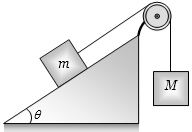
- 4A wire of $9.8 \times {10^{ - 3}}kg{m^{ - 1}}$ passes over a frictionless light pulley fixed on the top of a frictionless inclined plane which makes an angle of $30°$ with the horizontal. Masses $m$ and $M$ are tied at the two ends of wire such that $m$ rests on the plane and $M$ hangs freely vertically downwards. The entire system is in equilibrium and a transverse wave propagates along the wire with a velocity of $100 ms^{-1}$. Chose the correct option $m =$ ..... $kg$View Solution
- 5There is a destructive interference between the two waves of wavelength $\lambda$ coming from two different paths at a point. To get maximum sound or constructive interference at that point, the path of one wave is to be increased byView Solution
- 6The frequency of a tuning fork is $256\, Hz$. The velocity of sound in air is $344\, ms^{-1}$. The distance travelled (in $meters$) by the sound during the time in which the tunning fork complete $32$ vibrations isView Solution
- 7View SolutionIf you set up the seventh harmonic on a string fixed at both ends, how many nodes and antinodes are set up in it
- 8An organ pipe of length $L$ open at both ends is found to vibrate in its first harmonic when sounded with a tuning fork of $480\, Hz$. What should be the length of a pipe closed at one end, so that it also vibrates in its first harmonic with the same tuning fork ?View Solution
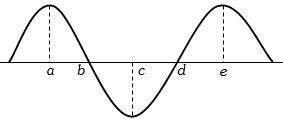
- 9The rope shown at an instant is carrying a wave travelling towards right, created by a source vibrating at a frequency $n$. Consider the following statementsView Solution
$I.$ The speed of the wave is $4n \times ab$
$II.$ The medium at $a$ will be in the same phase as $d$ after $\frac{4}{{3n}}s$
$III.$ The phase difference between $b$ and $e$ is $\frac{{3\pi }}{2}$
Which of these statements are correct
- 10View SolutionIf the initial tension on a stretched string is doubled, then the ratio of the initial and final speeds of a transverse wave along the string is :