MCQ
For a certain organ pipe three successive resonance frequencies are observed at $425 \,\,Hz$, $595\,\, Hz$ and $765\,\, Hz$ respectively. If the speed of sound in air is $340 \,\,m/s$, then the length of the pipe is .... $m$
  • A
    $2$
  • B
    $0.4$
  • $1$
  • D
    $0.2$

Answer

Correct option: C.
$1$
c
since frequencies are in odd number ratio, the pipe has to be a closed pipe.

Ratio of $3$ frequencies $=425: 595: 765$

$=5: 7: 9$

So fundamental frequency $=f=\frac{425}{5}=85 H z$

For fundamental frequency

$l=\frac{v}{4 f}=\frac{340}{4 \times 85}=1 m$

Need a full question paper?

Generate a complete, print-ready paper with questions like this in minutes — across 16+ boards, with answer keys.

Start Generating Free

Similar questions

A constant current of 2.8A exists in a resistor. The rms current is:
An object with uniform density $\rho$ is attached to a spring that is known to stretch linearly with applied force as shown below.When the spring object system is immersed in a liquid of density $\rho_1$ as shown in the above figure, the spring stretches by an amount $x_1\left(\rho > \rho_1\right)$. When the experiment is repeated in a liquid of density $\left(\rho_2 < \rho_1\right)$, the spring stretches by an amount $x_2$. Neglecting any buoyant force on the spring, the density of the object is
The two nearest harmonics of a tube closed at one end and open at other end are $220\,\, Hz$ and $260\,\, Hz.$ What is the fundamental frequency of the system .... $Hz$ ?
An object of mass $m$ is sliding down a hill of arbitrary shape and after traveling a certain horizontal path stops because of friction. The friction coefficient is different for different segments of the entire path but it is independent of the velocity and direction of motion. The work done that a force must perform to return the object  its initial position along the same path would be :-
The dimensional formula for latent heat is:
Young's modulus of rubber is ${10^4}\,N/{m^2}$ and area of cross-section is $2\,c{m^2}$. If force of $2 \times {10^5}$ dynes is applied along its length, then its initial length $l$ becomes
In the previous question, the smallest kinetic energy at the bottom of the incline will be achieved by:
A load of mass $M\,kg$ is suspended from a steel wire of length $2\,m$ and radius $1.0\,mm$ in Searle’s apparatus experiment. The increase in length produced in the wire is $4.0\,mm.$ Now the load is fully immersed in a liquid of relative density $2$. The relative density of the material of load is $8$. The new value of increase in length of the steel wire is ........ $mm$
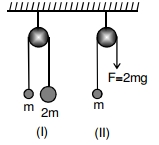
The pulley arrangements shown in figure are identical the mass of the rope being negligible. In case $I$, the mass $m$ is lifted by attaching a mass $2 m$ to the other end of the rope. In case II, the mass $m$ is lifted by pulling the other end of the rope with cosntant downward force $F=2 mg$, where $g$ is acceleration due to gravity. The acceleration of mass in case $I$ is
A glass of ice$-$cold water left on a table on a hot summer day eventually warms up whereas a cup of hot tea on the same table cools down because: